Difficulty distribution
How the classified questions are distributed by difficulty.
Your cart is empty.
Practice Electrical Machines - Electrical Engineering previous year questions organised from real papers, with year-wise coverage and clear topic navigation.
Every graph below is calculated only from this selection.
Year-wise coverage for Electrical Machines. Each bar uses a separate theme-derived color.
How the classified questions are distributed by difficulty.
MCQ, numerical, multiple-select and other formats found in these papers.
Top subjects by unique question coverage.
Top topics across the included previous year papers.
Top subtopics inside this exact selection.
Question coverage for the most populated papers. Every active PYP paper remains listed below.
Open a focused page built from the same verified paper data.
Explore previous-paper coverage, trends and focused practice for Induction Machines.
Explore previous-paper coverage, trends and focused practice for Transformers.
Explore previous-paper coverage, trends and focused practice for Synchronous Machines.
Explore previous-paper coverage, trends and focused practice for DC Machines.
Newest papers appear first. Sort by year, question coverage or name.
| Paper | Year / session | Questions in this view | Open |
|---|---|---|---|
| Electrical Engineering (EE) 2025 | 2025 | 3 | View paper |
| Electrical Engineering (EE) 2024 | 2024 | 5 | View paper |
| Electrical Engineering (EE) 2023 | 2023 | 7 | View paper |
| Electrical Engineering (EE) 2022 | 2022 | 6 | View paper |
| Electrical Engineering (EE) 2021 | 2021 | 5 | View paper |
| Electrical Engineering (EE) 2020 | 2020 | 8 | View paper |
| Electrical Engineering (EE) 2019 | 2019 | 7 | View paper |
| Electrical Engineering (EE) 2018 | 2018 | 7 | View paper |
| Electrical Engineering (EE) 2017 [Session 1] | 2017 | 7 | View paper |
| Electrical Engineering (EE) 2017 [Session 2] | 2017 | 7 | View paper |
| Electrical Engineering (EE) 2016 [Session 1] | 2016 | 9 | View paper |
| Electrical Engineering (EE) 2016 [Session 2] | 2016 | 7 | View paper |
| Electrical Engineering (EE) 2014 [Session 1] | 2014 | 7 | View paper |
| Electrical Engineering (EE) 2014 [Session 2] | 2014 | 8 | View paper |
| Electrical Engineering (EE) 2014 [Session 3] | 2014 | 5 | View paper |
| Electrical Engineering (EE) 2013 [Session 1] | 2013 | 3 | View paper |
| Electrical Engineering (EE) 2013 [Session 2] | 2013 | 3 | View paper |
| Electrical Engineering (EE) 2013 [Session 3] | 2013 | 4 | View paper |
| Electrical Engineering (EE) 2013 [Session 4] | 2013 | 3 | View paper |
| Electrical Engineering (EE) 2012 | 2012 | 4 | View paper |
| Electrical Engineering (EE) 2011 | 2011 | 6 | View paper |
| Electrical Engineering (EE) 2010 | 2010 | 9 | View paper |
| Electrical Engineering (EE) 2009 | 2009 | 9 | View paper |
| Electrical Engineering (EE) 2008 | 2008 | 12 | View paper |
| Electrical Engineering (EE) 2007 | 2007 | 13 | View paper |
A varied preview from the papers represented in this selection, with every available option.
A field excitation of 20 A in a certain alternator results in an armature current of 400 A in short circuit and a terminal voltage of 2000 V on open circuit. The magnitude of the internal voltage drop within the machine at a load current of 200 A is
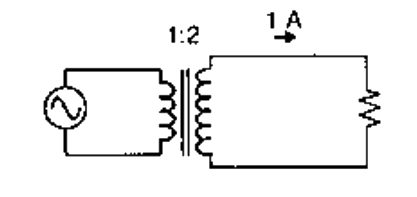
A single-phase transformer has a turns ratio of 1:2, and is connected to a purely resistive load as shown in the figure. The magnetizing current drawn is 1 A, and the secondary current is 1 A. If core losses and leakage reactances are neglected, the primary current is