- Total number of questions: 65
- 30 questions carry one mark each
- 35 questions carry two marks each
- Negative marking: 1/3 of the marks allotted to the question
- Use of calculator is allowed
- This is a proctored examination
- All other browser applications will be automatically closed
- After three warnings, the examination window will close automatically
Exam Details
Electrical Engineering (EE) 2017 [Session 2]
Review the key details, then start the test when you are ready. You can also open the full package to see related papers.
Questions
65
Duration
180 mins
Package
Electrical Engineering (EE) - Previous Year Papers
Paper pattern & analysis
Filter this paper by subject, topic or subtopic. Every graph updates from the selected questions.
Topic distribution
Subtopic distribution
Difficulty distribution
65questions
Easy
41
63.1%
Hard
24
36.9%
Question type distribution
65questions
Multiple Choices
41
63.1%
Fill in the blanks
24
36.9%
Instructions
Electrical Engineering (EE) 2017 [Session 2] – Instructions
Syllabus
Full Syllabus
Sample questions from this paper
Questions are selected across the paper subjects wherever the paper contains that variety.
2017 · Unclassified
Electrical Engineering (EE) 2017 [Session 2]
Q.1 – Q.5 carry one mark each.
An urn contains 5 red balls and 5 black balls. In the first draw, one ball is picked at random and discarded without noticing its colour. The probability to get a red ball in the second draw is
2017 · Unclassified
Electrical Engineering (EE) 2017 [Session 2]
Correct : 1 Wrong : -0.33
Consider a solid sphere of radius 5 cm made of a perfect electric conductor. If one million electrons are added to this sphere, these electrons will be distributed
2017 · Unclassified
Electrical Engineering (EE) 2017 [Session 2]
Correct : 1 Wrong : -0.33
The figures show diagramatic representations of vector fields

2017 · Unclassified
Electrical Engineering (EE) 2017 [Session 2]
Correct: 1 Wrong: -0.33
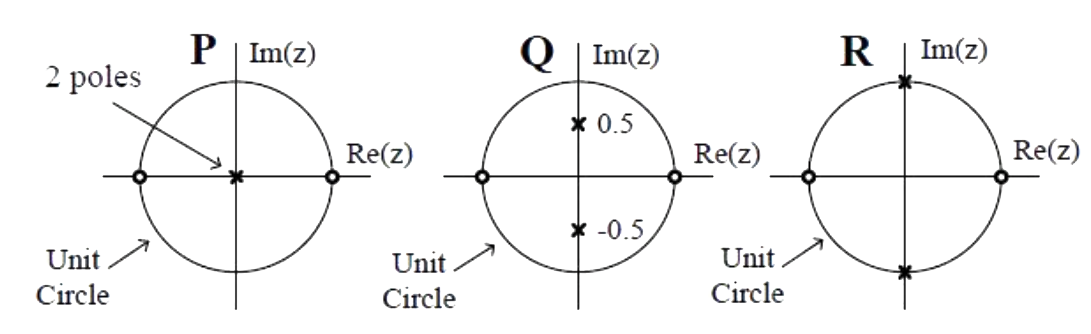
The pole-zero plots of three discrete-time systems P, Q and R on the z-plane are shown below.
2017 · Unclassified
Electrical Engineering (EE) 2017 [Session 2]
Correct: 1 Wrong: -0.33
If a synchronous motor is running at a leading power factor, its excitation induced voltage (E0) is
2017 · Unclassified
Electrical Engineering (EE) 2017 [Session 2]
Q.6 – Q.10 carry two marks each.
When a unit ramp input is applied to the unity feedback system having closed loop transfer function C(s)/R(s) = (Ks + b)/(s2 + as + b), (a > 0, b > 0, K > 0), the steady state error will be