- Total number of questions: 65
- 30 questions carry one mark each
- 35 questions carry two marks each
- Negative marking: 1/3 of the marks allotted to the question
- Use of calculator is allowed
- This is a proctored examination
- All other browser applications will be automatically closed
- After three warnings, the examination window will close automatically
Exam Details
Electrical Engineering (EE) 2013 [Session 2]
Review the key details, then start the test when you are ready. You can also open the full package to see related papers.
Questions
65
Duration
180 mins
Package
Electrical Engineering (EE) - Previous Year Papers
Paper pattern & analysis
Filter this paper by subject, topic or subtopic. Every graph updates from the selected questions.
Topic distribution
Subtopic distribution
Difficulty distribution
65questions
Easy
65
100%
Question type distribution
65questions
Multiple Choices
65
100%
Instructions
Electrical Engineering (EE) 2013 [Session 2] – Instructions
Syllabus
Full Syllabus
Sample questions from this paper
Questions are selected across the paper subjects wherever the paper contains that variety.
2013 · Unclassified
Electrical Engineering (EE) 2013 [Session 2]
Q.1 – Q.25 carry one mark each.
The input impedance of the permanent magnet moving coil (PMMC) voltmeter is infinite. Assuming that the diode shown in the figure below is ideal, the reading of the voltmeter in Volts is

2013 · Unclassified
Electrical Engineering (EE) 2013 [Session 2]
In the feedback network shown below, if the feedback factor k is increased, then the

2013 · Unclassified
Electrical Engineering (EE) 2013 [Session 2]
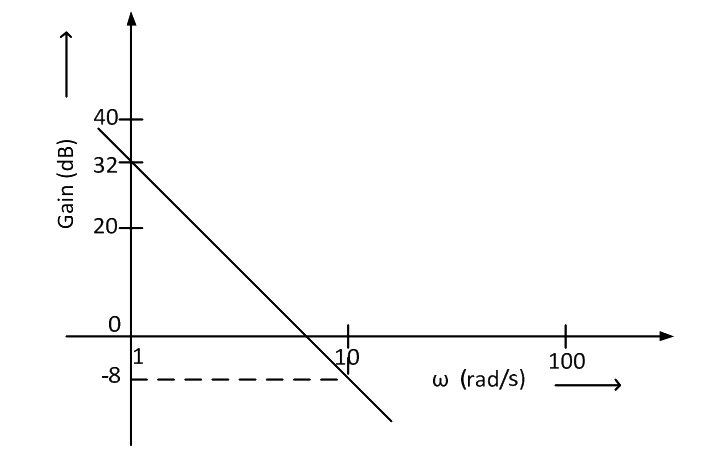
The Bode plot of a transfer function G(s) is shown in the figure below.
2013 · Unclassified
Electrical Engineering (EE) 2013 [Session 2]
A bulb in a staircase has two switches, one switch being at the ground floor and the other one at the first floor. The bulb can be turned ON and also can be turned OFF by any one of the switches irrespective of the state of the other switch. The logic of switching of the bulb resembles
2013 · Unclassified
Electrical Engineering (EE) 2013 [Session 2]
For a periodic signal v(t) = 30 sin 100t + 10 cos 300t + 6 sin (500t + π/4), the fundamental frequency in rad/s is
2013 · Unclassified
Electrical Engineering (EE) 2013 [Session 2]
A band-limited signal with a maximum frequency of 5 kHz is to be sampled. According to the sampling theorem, the sampling frequency in kHz which is not valid is