Difficulty distribution
How the classified questions are distributed by difficulty.
Your cart is empty.
Practice Induction Machines - Electrical Machines - Electrical Engineering previous year questions organised from real papers, with year-wise coverage and clear topic navigation.
Every graph below is calculated only from this selection.
Year-wise coverage for Induction Machines. Each bar uses a separate theme-derived color.
How the classified questions are distributed by difficulty.
MCQ, numerical, multiple-select and other formats found in these papers.
Top subjects by unique question coverage.
Top topics across the included previous year papers.
Top subtopics inside this exact selection.
Question coverage for the most populated papers. Every active PYP paper remains listed below.
Newest papers appear first. Sort by year, question coverage or name.
| Paper | Year / session | Questions in this view | Open |
|---|---|---|---|
| Electrical Engineering (EE) 2025 | 2025 | 1 | View paper |
| Electrical Engineering (EE) 2024 | 2024 | 2 | View paper |
| Electrical Engineering (EE) 2023 | 2023 | 3 | View paper |
| Electrical Engineering (EE) 2022 | 2022 | 4 | View paper |
| Electrical Engineering (EE) 2021 | 2021 | 2 | View paper |
| Electrical Engineering (EE) 2020 | 2020 | 1 | View paper |
| Electrical Engineering (EE) 2019 | 2019 | 2 | View paper |
| Electrical Engineering (EE) 2018 | 2018 | 1 | View paper |
| Electrical Engineering (EE) 2017 [Session 1] | 2017 | 2 | View paper |
| Electrical Engineering (EE) 2017 [Session 2] | 2017 | 2 | View paper |
| Electrical Engineering (EE) 2016 [Session 1] | 2016 | 1 | View paper |
| Electrical Engineering (EE) 2016 [Session 2] | 2016 | 2 | View paper |
| Electrical Engineering (EE) 2014 [Session 1] | 2014 | 2 | View paper |
| Electrical Engineering (EE) 2014 [Session 2] | 2014 | 3 | View paper |
| Electrical Engineering (EE) 2014 [Session 3] | 2014 | 1 | View paper |
| Electrical Engineering (EE) 2013 [Session 1] | 2013 | 2 | View paper |
| Electrical Engineering (EE) 2013 [Session 2] | 2013 | 2 | View paper |
| Electrical Engineering (EE) 2013 [Session 3] | 2013 | 2 | View paper |
| Electrical Engineering (EE) 2013 [Session 4] | 2013 | 2 | View paper |
| Electrical Engineering (EE) 2012 | 2012 | 2 | View paper |
| Electrical Engineering (EE) 2011 | 2011 | 1 | View paper |
| Electrical Engineering (EE) 2010 | 2010 | 1 | View paper |
| Electrical Engineering (EE) 2009 | 2009 | 2 | View paper |
| Electrical Engineering (EE) 2008 | 2008 | 3 | View paper |
| Electrical Engineering (EE) 2007 | 2007 | 4 | View paper |
Practice every matching question in batches of 20, with every available option.
A voltage source inverter is used to control the speed of a three-phase, 50 Hz, squirrel cage induction motor. Its slip for rated torque is 4%. The flux is maintained at rated value. If the stator resistance and rotational losses are neglected, then the frequency of the impressed voltage to obtain twice the rated torque at starting should be
A three-phase squirrel cage induction motor has a starting torque of 150% and a maximum torque of 300% with respect to rated torque at rated voltage and rated frequency. Neglect the stator resistance and rotational losses. The value of slip for maximum torque is
If a star-delta starter is used to start this induction motor, the per unit starting torque will be
If a starting torque of 0.5 per unit is required then the per unit starting current should be
A 230V, 50 Hz, 4-pole, single-phase induction motor is rotating in the clockwise (forward) direction at a speed of 1425 rpm. If the rotor resistance at standstill is 7.8 Ω, then the effective rotor resistance in the backward branch of the equivalent circuit will be

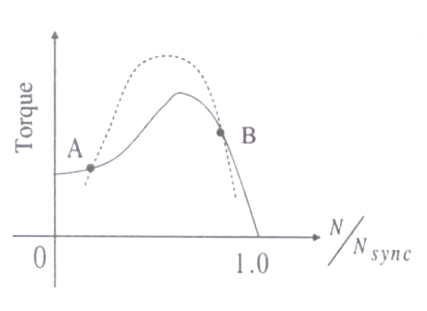
A 3-phase squirrel cage induction motor supplied from a balanced 3-phase source drives a mechanical load. The torque-speed characteristics of the motor (solid curve) and of the load (dotted curve) are shown. Of the two equilibrium points A and B, which of the following options correctly describes the stability of A and B?


A three-phase 440V, 6 pole, 50Hz, squirrel cage induction motor is running at a slip of 5%. The speed of stator magnetic field with respect to rotor magnetic field and speed of rotor with respect to stator magnetic field are

The locked rotor current in a 3-phase, star connected 15 kW, 4-pole, 230 V, 50 Hz induction motor at rated conditions is 50 A. Neglecting losses and magnetizing current, the approximate locked rotor line current drawn when the motor is connected to a 236 V, 57 Hz supply is
A 4-pole induction motor, supplied by a slightly unbalanced three-phase 50 Hz source, is rotating at 1440 rpm. The electrical frequency in Hz of the induced negative sequence current in the rotor is
Showing 20 of 44 questions