The class size of the class interval 60 – 68 is 8.
Show solutionHide solution
Solution:-
True.
The difference between the upper and lower limit of a class interval is called the
Size of the class interval. i.e. 68 – 60 = 8
Your cart is empty.
Practice each question, then open the answer or worked solution.
The class size of the class interval 60 – 68 is 8.
Solution:-
True.
The difference between the upper and lower limit of a class interval is called the
Size of the class interval. i.e. 68 – 60 = 8
If a pair of coins is tossed, then the number of outcomes are 2.
Solution:-
False.
If a pair of coins is tossed, then the number of outcomes are 4, i.e. HH, TT, TH and HT.
On throwing a dice once, the probability of occurrence of an even number is ½.
Solution:-
True.
The even numbers in a dice are 2, 4 and 6.
Probability = total number of even numbers/ Total numbers
= 3/6 … [divide numerator and denominator by 3]
= ½
On throwing a dice once, the probability of occurrence of a composite number is ½.
Solution:-
False.
The composite numbers in a dice are 4 and 6.
Probability = total number of composite numbers/ Total numbers
= 2/6 … [divide numerator and denominator by 2]
= 1/3
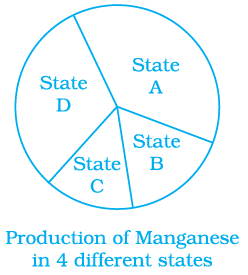
From the given pie chart, we can infer that production of Manganese is least in state B.

Solution:-
False.
It is not possible to declare, from the given pie chart that the production of Manganese is least in state B. Because, we do not know the central angle of the sectors.
One or more outcomes of an experiment make an event.
Solution:-
True.
Each outcome or a collection of outcomes in an experiment makes an Event.
The probability of getting the number 6 in a throw of a dice is 1/6. Similarly, the probability of getting the number 5 is 1/5.
Solution:-
False.
The probability of getting the number 5 is 1/6.
The probability of getting a prime number is the same as that of a composite number in a throw of a dice.
Solution:-
False.
The composite numbers in a dice are 4 and 6.
Probability = total number of composite numbers/ Total numbers
= 2/6 … [divide numerator and denominator by 2]
= 1/3
The prime numbers in a dice are 2, 3 and 5.
Probability = total number of prime numbers/ Total numbers
= 3/6 … [divide numerator and denominator by 3]
= ½
In a throw of a dice, the probability of getting an even number is the same as that of getting an odd number.
Solution:-
True.
The even numbers in a dice are 2, 4 and 6.
Probability = total number of even numbers/ Total numbers
= 3/6 … [divide numerator and denominator by 3]
= ½
The odd numbers in a dice are 1, 3 and 5.
Probability = total number of odd numbers/ Total numbers
= 3/6 … [divide numerator and denominator by 3]
= ½
To verify Pythagoras theorem is a random experiment.
Solution:-
False.
We know the result i.e. only one result, before going to verify the Pythagoras theorem. So, it is not a random experiment.