My Cart
Your Cart 0

    Your cart is empty.

  • Total (Amount) ₹0.00
NCERT Exemplar · Class 9 · Maths

Chapter 9: Areas of Parallelograms and Triangles

Practice each question, then open the answer or worked solution.

Exercise 9.4

Textbook page 94 · 5 questions
Q1Written answer

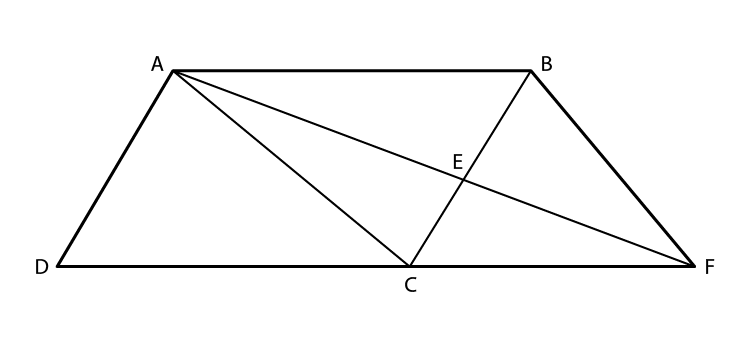
A point, E, is taken on the side BC of a parallelogram ABCD. AE and DC are produced to meet at F. Prove that ar (ADF) = ar (ABFC)

Show solutionHide solution
Worked solution

According to the question,

ABCD is a parallelogram.

E is a point on BC.

AE and DC are produced to meet at F.
NCERT Exemplar Solutions Class 9 Maths Chapter 9 Ex 9.4-1

To prove: area (ΔADF) = area (ABFC).

Proof:

We know that,

Triangles on the same base and between the same parallels are equal in area.

Here,

We have,

ΔABC and ΔABF are on the same base AB and between the same parallels, AB || CF.

Area (ΔABC) = area (ΔABF) … (1)

We also know that,

The diagonal of a Parallelogram divides it into two triangles of equal area

So,

Area (ΔABC) = area (ΔACD) … (2)

Now,

Area (ΔADF) = area (ΔACD) + area (ΔACF)

∴ Area (ΔADF) = area (ΔABC) + area (ΔACF) … (From equation (2))

⇒ Area (ΔADF) = area (ΔABF) + area (ΔACF) … (From equation (1))

⇒ Area (ΔADF) = area (ABFC)
Q2Written answer

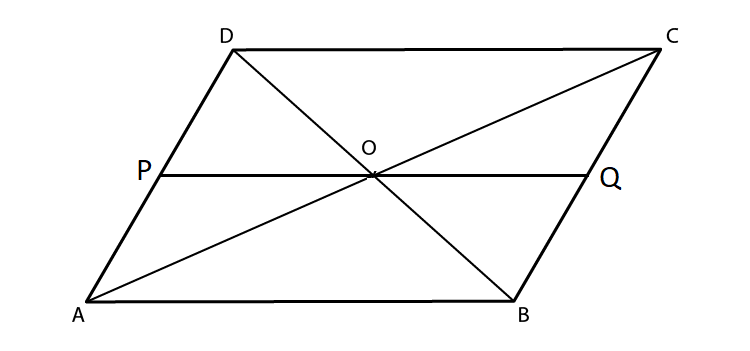
The diagonals of a parallelogram ABCD intersect at a point O. Through O, a line is drawn to intersect AD at P and BC at Q. Show that PQ divides the parallelogram into two parts of equal area.

Show solutionHide solution
Worked solution

NCERT Exemplar Solutions Class 9 Maths Chapter 9 Ex 9.4-2

According to the question,

The diagonals of a parallelogram ABCD intersect at point O.

Through O, a line is drawn to intersect AD at P and BC at Q.

To Prove:

Ar (parallelogram PDCQ) = ar (parallelogram PQBA).

Proof:

AC is a diagonal of || gm ABCD

∴ ar(ΔABC) = ar(ΔACD)

= ½ ar (||gm ABCD) …(1)

In ΔAOP and ΔCOQ,

AO = CO

Since, diagonals of a parallelogram bisect each other,

We get,

∠AOP = ∠COQ

∠OAP = ∠OCQ (Vertically opposite angles)

∴ ΔAOP = ΔCOQ (Alternate interior angles)

∴ ar(ΔAOP) = ar(ΔCOQ) (By ASA Congruence Rule)

We know that,

Congruent figures have equal areas

So,

ar(ΔAOP) + ar(parallelogram OPDC) = ar(ΔCOQ) + ar(parallelogram OPDC)

⇒ ar(ΔACD) = ar(parallelogram PDCQ)

⇒ ½ ar(|| gm ABCD) = ar(parallelogram PDCQ)

From equation (1),

We get,

ar(parallelogram PQBA) = ar(parallelogram PDCQ)

⇒ ar(parallelogram PDCQ) = ar(parallelogram PQBA).

Hence Proved.

Q3Written answer

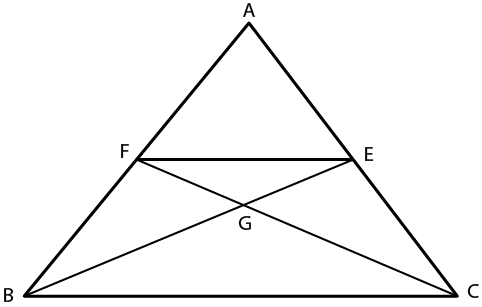
The medians BE and CF of a triangle ABC intersect at G. Prove that the area of △ GBC = area of the quadrilateral AFGE.

Show solutionHide solution
Worked solution

According to the question,

We have,

BE &  CF are medians

E is the midpoint of AC

F is the midpoint of AB

∴ ΔBCE = ΔBEA … ( i )

ΔBCF = ΔCAF

Construct:

Join EF,

By the midpoint theorem,

We get FE || BC

NCERT Exemplar Solutions Class 9 Maths Chapter 9 Ex 9.4-3

We know that,

Δ on the same base and between the same parallels are equal in area

∴ ΔFBC = ΔBCE

ΔFBC – ΔGBC = ΔBCE – ΔGBC

⇒ ΔFBG = ΔCGE (ΔGBC is common)

⇒ ΔCGE = ΔFBG …( ii )

Subtracting equation (ii) from (i)

We get,

ΔBCE – ΔCGE = ΔBEA – ΔFBG

∴ ΔBGC =quadrilateral AFGE.

Q4Written answer

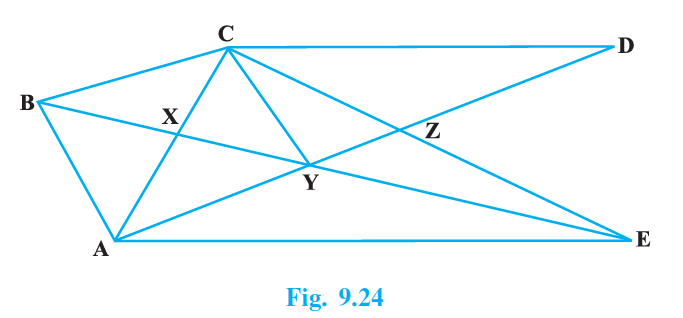
In Fig. 9.24, CD || AE and CY || BA. Prove that ar (CBX) = ar (AXY).

NCERT Exemplar Solutions Class 9 Maths Chapter 9 Ex 9.4-4

Show solutionHide solution
Worked solution

According to the question,

From figure,

We get,

CD||AE

and CY || BA

To prove:

ar (ΔCBX) = ar (ΔAXY) .

Proof:

We know that,

Triangles on the same base and between the same parallels are equal in area.

Here,

ΔABY and ΔABC both lie on the same base AB and between the same parallels CY and BA.

ar (ΔABY) = ar (ΔABC)

⇒ ar (ABX) + ar (AXY) = ar (ABX) + ar (CBX)

Solving and cancelling ar (ABX),

We get,

⇒ ar (AXY) = ar (CBX)

Q5Written answer

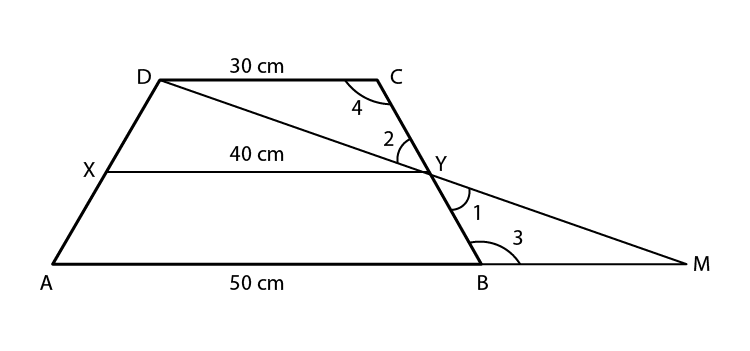
ABCD is a trapezium in which AB || DC, DC = 30 cm and AB = 50 cm. If X and Y are, respectively, the mid-points of AD and BC, prove that ar (DCYX) = 7/9 ar (XYBA)

Show solutionHide solution
Worked solution

NCERT Exemplar Solutions Class 9 Maths Chapter 9 Ex 9.4-5

According to the question,

We have,

ABCD is a trapezium with AB || DC

Construction:  Join DY and produce it to meet AB produced at P.

In ∆BYP and ∆CYD

∠BYP = ∠CYD    (vertically opposite angles)

Since alternate opposite angles of DC || AP and BC are the transversal

∠DCY = ∠PBY

Since Y is the midpoint of BC,

BY = CY

Thus ∆BYP ≅ ∆CYD (by ASA cogence criterion)

So, DY = YP and DC = BP

⇒ Y is the midpoint of AD

∴ XY || AP and XY = ½ AP (by midpoint theorem)

⇒ XY = ½ AP

= ½ (AB + BP)

= ½ (AB + DC)

= ½ (50 + 30)

= ½ × 80 cm

= 40 cm

Since X is the midpoint of AD

And Y is the midpoint of BC

Hence, trapezium DCYX and ABYX are of the same height, h, cm

Now

NCERT Exemplar Solutions Class 9 Maths Chapter 9 Ex 9.4-6

⇒ 9 ar(DCXY) = 7 ar(XYBA)

⇒ ar(DCXY) = 7/9 ar(XYBA)

Hence Proved.