My Cart
Your Cart 0

    Your cart is empty.

  • Total (Amount) ₹0.00
NCERT Exemplar · Class 9 · Maths

Chapter 9: Areas of Parallelograms and Triangles

Practice each question, then open the answer or worked solution.

Exercise 9.2

Textbook page 88 · 2 questions
Q1Written answer

ABCD is a parallelogram and X is the mid-point of AB. If ar (AXCD) = 24 cm2, then ar (ABC) = 24 cm2.

Show solutionHide solution
Worked solution

False

Explanation:
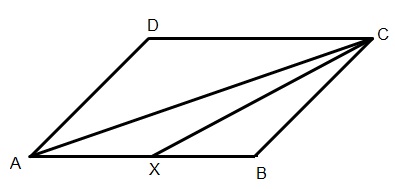
NCERT Exemplar Solutions Class 9 Maths Chapter 9 Ex 9.2-1

In ΔABC, X is the midpoint of AB

Considering the given question,

Hence ar(ΔAXC) = ar(ΔBXC) = ½ ar(ΔABC)

Therefore,

ar(ΔAXC) = ar(ΔBXC) = 12 cm2

Area of ||gm ABCD = 2 x ar(ΔABC)

= 2 x 24 = 48 cm2

But, according to the question,

area of ||gm ABCD = ar(AXCD) + ar(ΔBXC)

= 24 + 12 = 36 cm2

Hence, we find a contradiction here.

So, If ar (AXCD) = 24 cm2, then ar (ABC) ≠ 24 cm2
Q2Written answer

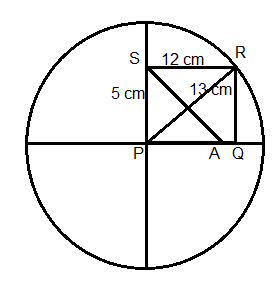
PQRS is a rectangle inscribed in a quadrant of a circle of radius 13 cm. A is any point on PQ. If PS = 5 cm, then ar (PAS) = 30 cm2.

Show solutionHide solution
Worked solution

True. Since A is any point on PQ, then ar (PAS) ≠ 30 cm2

But, the statement can be true if PA is equal to PS.

Justification:

According to the question,

PQRS is a rectangle inscribed in a quadrant of a circle of radius 13 cm.

NCERT Exemplar Solutions Class 9 Maths Chapter 9 Ex 9.2-2

Given,

A is any point on PQ

PA<PQ

ar (△PQR) = ½ ×PQ×QR

= ½ ×12×5

= 30cm2

PS=5 cm

Suppose PA<PQ,

ar(△PAS) < ar(△PQR)

ar(△PAS) < 30 cm2

Suppose PA=PQ,

ar (△PAS) = ½ ×PQ×PS

= ½ ×12×5

= 30cm2