My Cart
Your Cart 0

    Your cart is empty.

  • Total (Amount) ₹0.00
NCERT Exemplar · Class 9 · Maths

Chapter 9: Areas of Parallelograms and Triangles

Practice each question, then open the answer or worked solution.

Exercise 9.1

Textbook page 85 · 5 questions
Q1Written answer

The median of a triangle divides it into two

(A) triangles of equal area

(B) congruent triangles

(C) right triangles

(D) isosceles triangles

Show solutionHide solution
Worked solution

(A) triangles of equal area

Explanation:

The median of a triangle divides it into triangles of equal area.

Hence, option (A) is the correct answer.
Q2Written answer

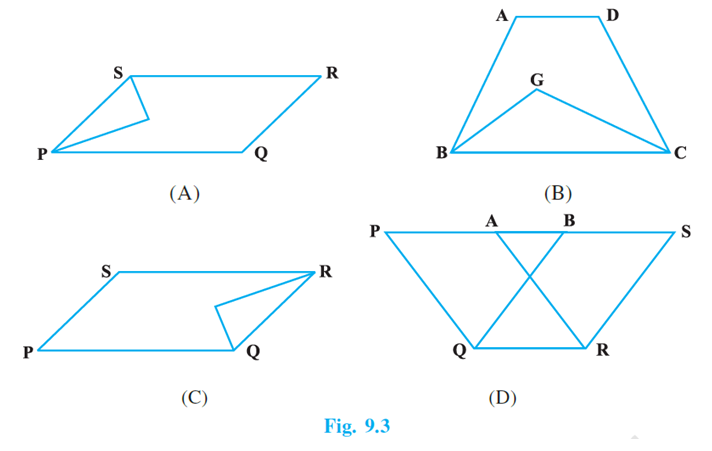
In which of the following figures (Fig. 9.3) do you find two polygons on the same base and between the same parallels?

NCERT Exemplar Solutions Class 9 Maths Chapter 9 Ex 9.1-1

Show solutionHide solution
Worked solution

(D)

Explanation:

In figure (D), the parallelograms, PQRA and BQRS, are on the same base QR and between the same parallels QR and PS.

Hence, option (D) is the correct answer.

Q3Written answer

The figure obtained by joining the mid-points of the adjacent sides of a rectangle of sides 8 cm and 6 cm is :

(A) a rectangle of area 24 cm2

(B) a square of area 25 cm2

(C) a trapezium of area 24 cm2

(D) a rhombus of area 24 cm2

Show solutionHide solution
Worked solution

(D) a rhombus of area 24 cm2

Explanation:

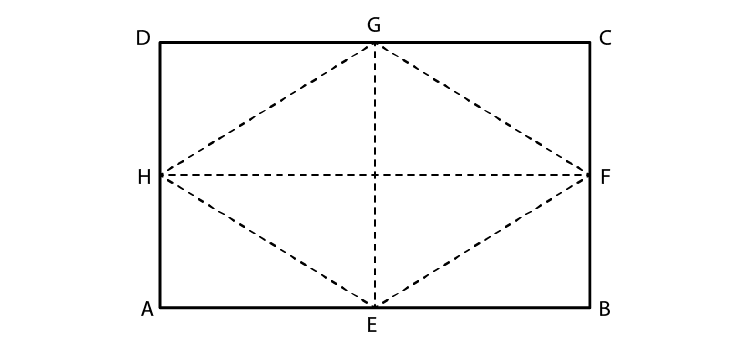
NCERT Exemplar Solutions Class 9 Maths Chapter 9 Ex 9.1-2

According to the question,

Let ABCD be the rectangle.

E is the mid-point of the side AB

F is the mid-point of the side BC

G is the mid-point of the side CD

H is the mid-point of the side DA

The figure obtained by joining the midpoints E, F, G and H is a rhombus.

The sides of the rectangle are given,

We know that,

Side of the rectangle AB = diagonal of the rhombus FH = 8cm

Similarly,

Side of the rectangle AD = diagonal of the rhombus EG = 6cm

Then,

Area of the rhombus = ½ × EG × FH

= ½ × 6 × 8

= 24 cm2

Hence, option (D) is the correct answer.

Q4Written answer

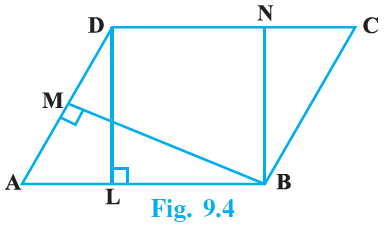
In Fig. 9.4, the area of parallelogram

ABCD is:

(A) AB × BM

(B) BC × BN

(C) DC × DL

(D) AD × DL

NCERT Exemplar Solutions Class 9 Maths Chapter 9 Ex 9.1-3

Show solutionHide solution
Worked solution

(C) DC × DL

Explanation:

Area of parallelogram = Base × Corresponding altitude

= AB × DL … (eq 1)

Since opposite sides of a parallelogram are equal,

We get,

AB = DC

Substituting this in eq(1), we get,

Area of parallelogram = AB × DL

= DC × DL

Hence, option (C) is the correct answer.

Q5Written answer

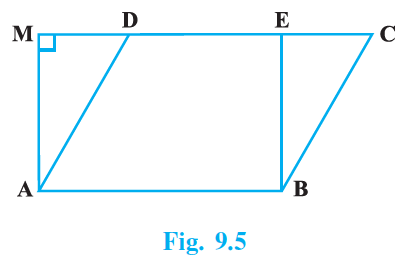
In Fig. 9.5, if parallelogram ABCD and rectangle ABEF are of equal area, then :

(A) Perimeter of ABCD = Perimeter of ABEM

(B) Perimeter of ABCD < Perimeter of ABEM

(C) Perimeter of ABCD > Perimeter of ABEM

(D) Perimeter of ABCD = ½ (Perimeter of ABEM)

NCERT Exemplar Solutions Class 9 Maths Chapter 9 Ex 9.1-4

Show solutionHide solution
Worked solution

(C) Perimeter of ABCD > Perimeter of ABEM

Explanation:

In rectangle ABEM,

AB = EM …(eq.1) [sides of rectangle]

In parallelogram ABCD,

CD = AB …(eq.2)

Adding equations (1) and (2),

We get

AB + CD = EM + AB …(i)

We know that,

The perpendicular distance between two parallel sides of a parallelogram is always less than the length of the other parallel sides.

BE < BC and AM < AD

On adding both above inequalities, we get

SE + AM <BC + AD or BC + AD> BE + AM

On adding AB + CD on both sides, we get

AB + CD + BC + AD> AB + CD + BE + AM

⇒ AB+BC + CD + AD> AB+BE + EM+ AM    [∴ CD = AB = EM]

Hence,

We get,

The perimeter of parallelogram ABCD > perimeter of rectangle ABEM

Hence, option (C) is the correct answer.