My Cart
Your Cart 0

    Your cart is empty.

  • Total (Amount) ₹0.00
NCERT Exemplar · Class 9 · Maths

Chapter 9: Areas of Parallelograms and Triangles

Practice each question, then open the answer or worked solution.

Exercise 9.3

Textbook page 89 · 4 questions
Q1Written answer

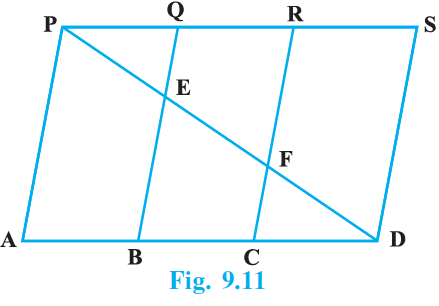
In Fig.9.11, PSDA is a parallelogram. Points Q and R are taken on PS such that PQ = QR = RS and PA || QB || RC. Prove that ar (PQE) = ar (CFD).
NCERT Exemplar Solutions Class 9 Maths Chapter 9 Ex 9.3-1

Show solutionHide solution
Worked solution

According to the question,

PA║QB║RC║SD & PQ=QR=RS

According to the Equal intercept theorem,

We know that if three or more parallel lines make equal intercepts on traversal, then they make equal intercepts on any other form of traversal.

Hence, we get,

PE=EF=FD& AB=BC=CD

From ΔPQE & ΔDCF,

We get,

∠PEQ=∠DFC

PE=DF

∠QPE=∠CDF

So,

ΔPQE ≅ ΔDCF

Since Congruent figures have equal areas,

We get,

ar ΔPQE= ar ΔDCF

Hence proved.
Q2Written answer

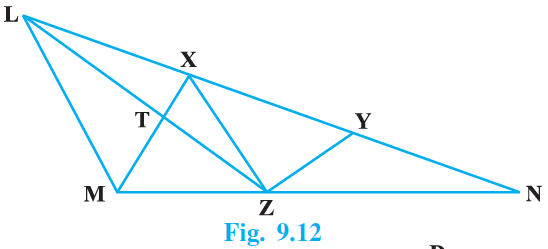
X and Y are points on the side LN of the triangle LMN such that LX = XY = YN. Through X, a line is drawn parallel to LM to meet MN at Z (See Fig. 9.12). Prove that

ar (LZY) = ar (MZYX)

NCERT Exemplar Solutions Class 9 Maths Chapter 9 Ex 9.3-2

Show solutionHide solution
Worked solution

According to the question,

LX=XY=YN

XZ II LM

We have,

ar(LZX)+(XZY)=ar(LZY)               — (1)

ar(MXZ)+ar(XZY)=ar(MZYX)        — (2)

Both triangles LZX and MXZ are on the same base XZ and between the same parallels LM and XZ

ar(LZX)=ar(MXZ)

Adding equations (1) and (2),

We get,

ar(LZY)=ar(MZYX)

Hence proved

Q3Written answer

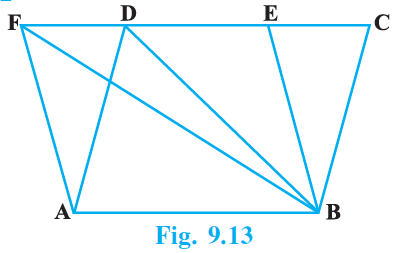
The area of the parallelogram ABCD is 90 cm2 (see Fig.9.13). Find

(i) ar (ABEF)

(ii) ar (ABD)

(iii) ar (BEF)

NCERT Exemplar Solutions Class 9 Maths Chapter 9 Ex 9.3-3

Show solutionHide solution
Worked solution

According to the question,

Area of parallelogram, ABCD = 90 cm2

(i)

We know that,

Parallelograms on the same base and between the same parallel are equal in area.

Here,

The parallelograms ABCD and ABEF are on the same base AB and between the same parallels AB and CF.

Therefore, ar (ABEF) = ar (ABCD) = 90 cm2

(ii)

We know that,

If a triangle and a parallelogram are on the same base and between the same parallels, then the area of the triangle is equal to half of the area of the parallelogram.

Here,

ΔABD and parallelogram ABCD are on the same base AB and between the same parallels AB and CD.

Therefore, ar (ΔABD) = ½ ar (ABCD)

= ½ x 90 = 45 cm2

(iii)

We know that,

If a triangle and a parallelogram are on the same base and between the same parallels, then the area of a triangle is equal to half of the area of the parallelogram.

Here,

ΔBEF and parallelogram ABEF are on the same base EF and between the same parallels AB and EF.

Therefore, ar (ΔBEF) = ½ ar (ABEF)

= ½ x 90 = 45 cm2

Q4Written answer

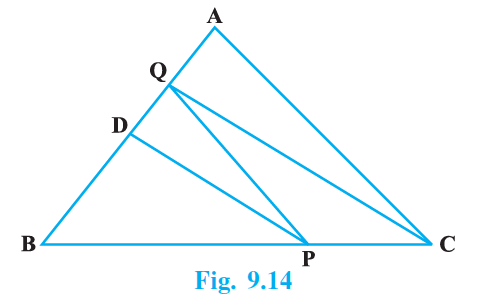
In △ ABC, D is the mid-point of AB, and P is any point on BC. If CQ || PD meets AB in Q (Fig. 9.14), then prove that ar (BPQ) = ½ ar (ABC).

NCERT Exemplar Solutions Class 9 Maths Chapter 9 Ex 9.3-4

Show solutionHide solution
Worked solution

According to the question,

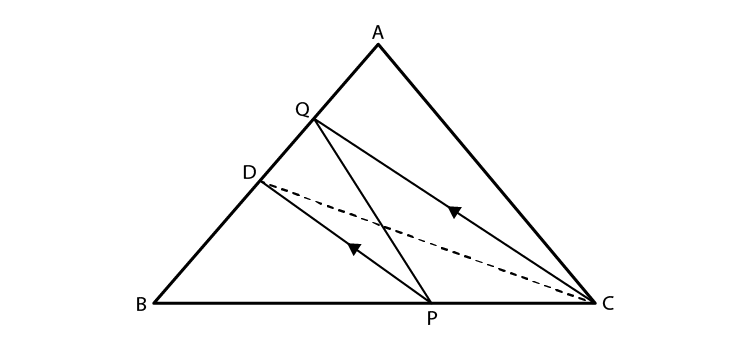
We have the figure,

NCERT Exemplar Solutions Class 9 Maths Chapter 9 Ex 9.3-5

In △ ABC,

D is the mid-point of AB

P is any point on BC.

If CQ || PD meets AB at Q

To prove: ar (BPQ) = ½ ar (ABC)

Construction: Join DC

Proof:- Since D is the mid-point of AB. so, in △ ABC, CD is the median.

ar(△ BCD) = ½ ar (△ ABC) ….. (1)

We know that,

△ PDQ and △ PDC are on the same base PD and between the same parallel lines PD QC.

Therefore, ar(△ PDQ) = ar(△ PDC) ……………. (2)

From (1) and (2)

ar(△ BCD) = ½ ar(△ ABC)

ar(△ BCD = ar(△ BPD) + ar(△ PDC)

= ½ ar(△ ABC)

Area of △ PDC = PDQ

So,

ar(△ BPQ) = ar(△ BPD) + ar(△ PDQ)

= ½ ar(△ ABC)

Therefore, ar(△BPQ) = ½ ar(△ ABC)

Hence Proved