My Cart
Your Cart 0

    Your cart is empty.

  • Total (Amount) ₹0.00
NCERT Exemplar · Class 9 · Maths

Chapter 8: Quadrilaterals

Practice each question, then open the answer or worked solution.

Exercise 8.1

Textbook page 73 · 7 questions
Q1Written answer

Three angles of a quadrilateral are 75º, 90º and 75º. The fourth angle is

(A) 90º

(B) 95º

(C) 105º

(D) 120º

Show solutionHide solution
Worked solution

(D) 120º

Explanation:

According to the question,

Three angles of quadrilateral are 75°, 90° and 75°

Consider the fourth angle to be x.

We know that,

Sum of all angles of a quadrilateral = 360°

⇒ 75° + 90° + 75° + x = 360°

⇒ 240° + x = 360°

⇒ x = 360° – 240°

⇒ x = 120°

Hence, the fourth angle is 120°.

Therefore, option (D) is the correct answer.
Q2Written answer

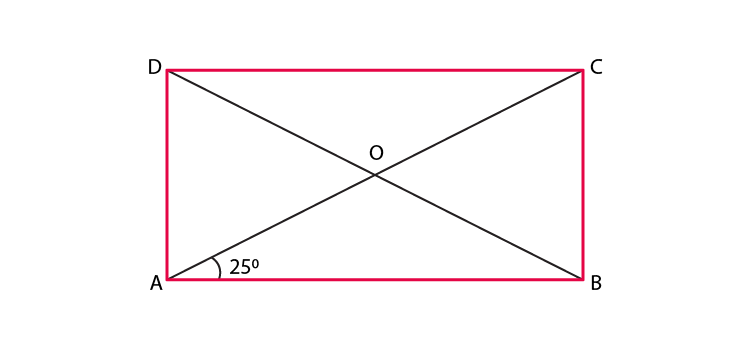
A diagonal of a rectangle is inclined to one side of the rectangle at 25º. The acute angle between the diagonals is

(A) 55º

(B) 50º

(C) 40º

(D) 25º

Show solutionHide solution
Worked solution

(B) 50º

Explanation:

According to the question,

A diagonal of a rectangle is inclined to one side of the rectangle at 25º

i.e., Angle between a side of rectangle and its diagonal = 25°

Consider the acute angle between diagonals to be = x

NCERT Exemplar Solutions Class 9 Maths Chapter 8 Exercise 8.1-1

We know that diagonals of a rectangle are equal in length i.e.,

AC = BD

Dividing RHS and LHS by 2,

⇒ ½ AC = ½ BD

Since, O is mid-point of AC and BD

⇒ OD = OC

Since, angles opposite to equal sides are equal

⇒ ∠y = 25°

We also know that,

Exterior angle is equal to the sum of two opposite interior angles.

So, ∠BOC = ∠ODC + ∠OCD

⇒ ∠x = ∠y + 25°

⇒ ∠x = 25° + 25°

⇒ ∠x = 50°

Hence, the acute angle between diagonals is 50°.

Therefore, option (B) is the correct answer.

Q3Written answer

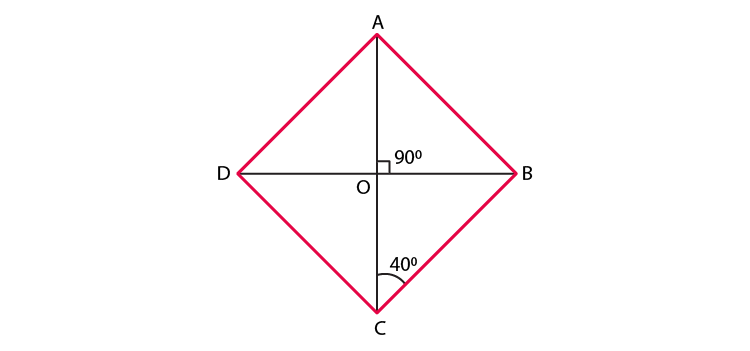
ABCD is a rhombus such that ∠ACB = 40º. Then ∠ADB is

(A) 40º

(B) 45º

(C) 50º

(D) 60º

Show solutionHide solution
Worked solution

(C) 50º

Explanation:

According to the question,

ABCD is a rhombus

∠ACB = 40°

NCERT Exemplar Solutions Class 9 Maths Chapter 8 Exercise 8.1-2

∵ ∠ACB = 40°

⇒ ∠OCB = 40°

∵ AD ∥ BC

⇒ ∠DAC = ∠BCA = 40° [Alternate interior angles]

⇒ ∠DAO = 40°

Since, diagonals of a rhombus are perpendicular to each other

We have,

∠AOD = 90°

We know that,

Sum of all angles of a triangle = 180°

⇒ ∠AOD + ∠ADO + ∠DAO = 180°

⇒ 90° + ∠ADO + 40° = 180°

⇒ 130° + ∠ADO = 180°

⇒ ∠ADO = 180° – 130°

⇒ ∠ADO = 50°

⇒ ∠ADB = 50°

Hence, ∠ADB = 50°

Therefore, option (C) is the correct answer.

Q4Written answer

The quadrilateral formed by joining the mid-points of the sides of a quadrilateral

PQRS, taken in order, is a rectangle, if

(A) PQRS is a rectangle

(B) PQRS is a parallelogram

(C) diagonals of PQRS are perpendicular

(D) diagonals of PQRS are equal.

Show solutionHide solution
Worked solution

(C) diagonals of PQRS are perpendicular

Explanation:

Let the rectangle be ABCD,

We know that,

Diagonals of rectangle are equal

∴ AC = BD

⇒ PQ = QR

∴ PQRS is a rhombus

Diagonals of a rhombus are perpendicular.

Hence, diagonals of PQRS are perpendicular

Therefore, option (C) is the correct answer.

Q5Written answer

The quadrilateral formed by joining the mid-points of the sides of a quadrilateral

PQRS, taken in order, is a rhombus, if

(A) PQRS is a rhombus

(B) PQRS is a parallelogram

(C) diagonals of PQRS are perpendicular

(D) diagonals of PQRS are equal.

Show solutionHide solution
Worked solution

(D) diagonals of PQRS are equal.

Explanation:

Since, ABCD is a rhombus

We have,

AB = BC = CD = DA

Now,

Since, D and C are midpoints of PQ and PS

By midpoint theorem,

We have,

DC = ½ QS

Also,

Since, B and C are midpoints of SR and PS

By midpoint theorem

We have,

BC = ½ PR

Now, again, ABCD is a rhombus

∴ BC = CD

⇒ ½ QS = ½ PR

⇒ QS = PR

Hence, diagonals of PQRS are equal

Therefore, option (D) is the correct answer.
Q6Written answer

If angles A, B, C and D of the quadrilateral ABCD, taken in order, are in the ratio

3:7:6:4, then ABCD is a

(A) rhombus

(B) parallelogram

(C) trapezium

(D) kite

Show solutionHide solution
Worked solution

(C) trapezium

Explanation:

As angles A, B, C and D of the quadrilateral ABCD, taken in order, are in the ratio 3: 7: 6: 4,

We have the angles A, B, C and D = 3x, 7x, 6x and 4x.

Now, sum of the angle of a quadrilateral = 360o.

3x + 7x + 6x + 4x = 360o

⇒20x = 360o

⇒ x = 360 ÷ 20 =18o

So, the angles A, B, C and D of quadrilateral ABCD are,

∠A = 3×18o = 54o,

∠B = 7×18o = 126o

∠C = 6×18o = 108o

∠D = 4×18o = 72o

AD and BC are two lines cut by a transversal CD

Now, sum of angles ∠C and ∠D on the same side of transversal,

∠C +∠D =108o + 72o =180

Hence, AD|| BC

So, ABCD is a quadrilateral in which one pair of opposite sides are parallel.

Hence, ABCD is a trapezium.

Therefore, option (C) is the correct answer.

Q7Written answer

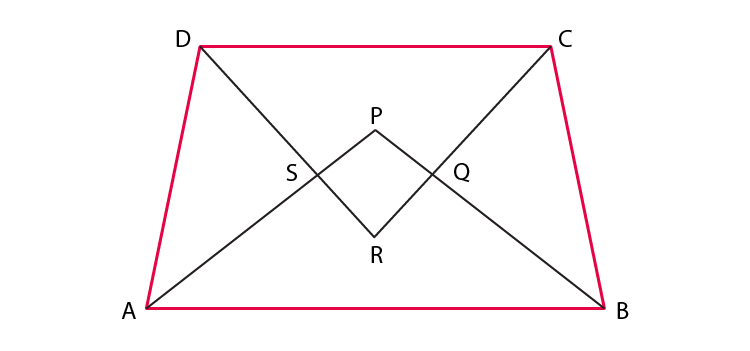
If bisectors of ∠A and ∠B of a quadrilateral ABCD intersect each other at P, of ∠B and ∠C at Q, of ∠C and ∠D at R and of ∠D and ∠A at S, then PQRS is a

(A) rectangle

(B) rhombus

(C) parallelogram

(D) quadrilateral whose opposite angles are supplementary

Show solutionHide solution
Worked solution

(D) quadrilateral whose opposite angles are supplementary

Explanation:

NCERT Exemplar Solutions Class 9 Maths Chapter 8 Exercise 8.1-3

We know that,

Sum of all angles of a quadrilateral = 360°

⇒ ∠A + ∠B + ∠C + ∠D = 360°

Dividing LHS and RHS by 2,

⇒ ½ (∠A + ∠B + ∠C + ∠D) = ½ × 360° = 180°

Since, AP, PB, RC and RD are bisectors of ∠A, ∠B, ∠C and ∠D

⇒ ∠PAB + ∠ABP + ∠RCD + ∠RDC = 180° … (1)

We also know that,

Sum of all angles of a triangle = 180°

∠PAB + ∠APB + ∠ABP = 180°

⇒ ∠PAB + ∠ABP = 180° – ∠APB …(2)

Similarly,

∴ ∠RDC + ∠RCD + ∠CRD = 180°

⇒ ∠RDC + ∠RCD = 180° – ∠CRD …(3)

Substituting the value of equations (2) and (3) in equation (1),

180° – ∠APB + 180° – ∠CRD = 180°

⇒ 360° – ∠APB – ∠CRD = 180°

⇒ ∠APB + ∠CRD = 360° – 180°

⇒ ∠APB + ∠CRD = 180° …(4)

Now,

∠SPQ = ∠APB [vertically opposite angles]

∠SRQ = ∠DRC [vertically opposite angles]

Substituting in equation (4),

⇒ ∠SPQ + ∠SRQ = 180°

Hence, PQRS is a quadrilateral whose opposite angles are supplementary.

Therefore, option (D) is the correct answer.