Q1Written answer
A square is inscribed in an isosceles right triangle so that the square and the triangle have one angle in common. Show that the vertex of the square opposite the vertex of the common angle bisects the hypotenuse.
Show solutionHide solution
Worked solution
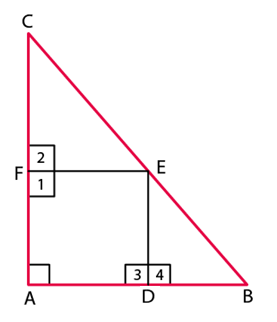
According to the question,
ΔABC with ∠A = 90o and
Since, ABC is an isosceles triangle,
We get,
AB = AC …(i)
Let ADEF be the square inscribed in the isosceles triangle ABC.
Then, we have,
AD = AF = EF = AD …(ii)
Subtracting equation (ii) from (i),
AB – AD = AC – AF
BD = CF
Now,
Considering ΔCFE and ΔEDB,
BD = CF
DE = EF
∠CFE = ∠EDB = 90o (Since, they are the side of a square)
ΔCEF ~ ΔBED (By SAS criteria)
Hence, CE = BE
Therefore, vertex E of the square bisect the hypotenuse BC.