My Cart
Your Cart 0

    Your cart is empty.

  • Total (Amount) ₹0.00
NCERT Exemplar · Class 11 · Physics

Chapter 15: Waves

Practice each question, then open the answer or worked solution.

Questions

36 questions
Q15.31Written answer

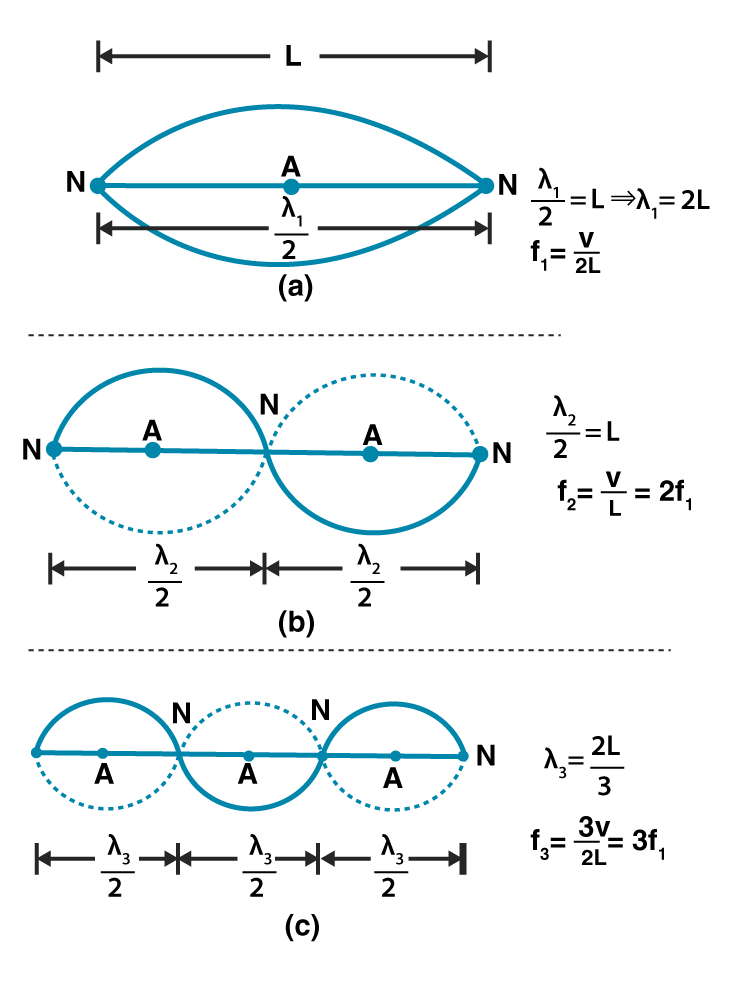
Show that when a string fixed at its two ends vibrates in 1 loop, 2 loops, 3 loops, and 4 loops, the frequencies are in the ratio 1:2:3:4.

Show solutionHide solution
Worked solution

When n = 1, f1 = v/2L, which is known as the fundamental frequency.

When n = 2, f2 = 2(v/2L), which is known as the first overtone.

When n = 3, f3 = 3(v/2L), which is known as the second overtone.

When n = 4, f4 = 4(v/2L), which is known as the third overtone.

In all cases, the tone is equal to the fundamental frequency.
Exemplar Solutions Physics Class 11 Chapter 15 - 9

Long Answers
Q15.32Written answer

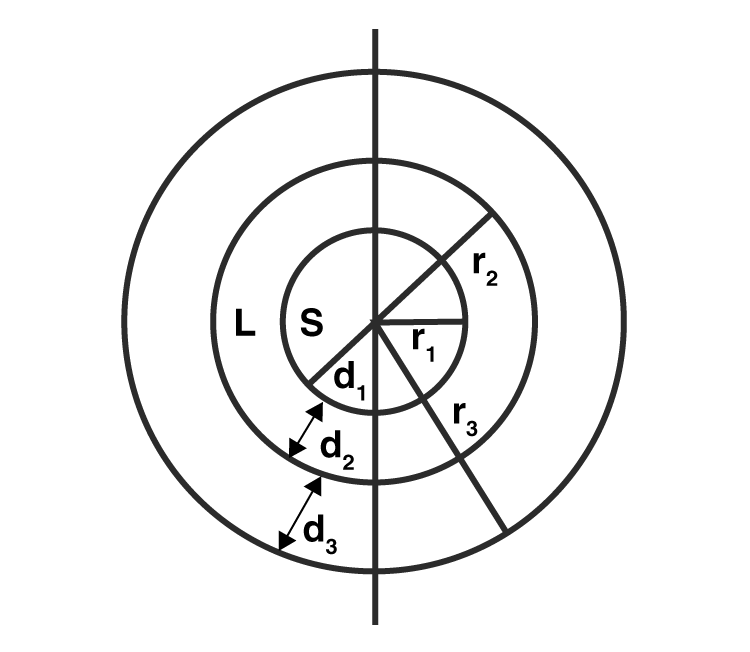
The earth has a radius of 6400 km. The inner core of the 1000 km radius is solid. Outside it, there is a region from 1000 km to a radius of 3500 km which is in a molten state. Then again, from 3500 km to 6400 km, the earth is solid. Only longitudinal (P) waves can travel inside a liquid. Assume that the P wave has a speed of 8 km/s in solid parts and of 5 km/s in liquid parts of the earth. An earthquake occurs at someplace close to the surface of the earth. Calculate the time after which it will be recorded in a seismometer at a diametrically opposite point on the earth if the wave travels along diameter.

Show solutionHide solution
Worked solution

Exemplar Solutions Physics Class 11 Chapter 15 - 10

Given,

r1 = 1000 km

r2 = 3500 km

r3 = 6400 km

d1 = 1000 km

d2 = 3500 – 1000 = 2500 km

d3 = 6400 – 3500 = 2900 km

The solid distance is given as:

2(d1 + d3) = 2(1000 + 2900)

Time taken by the wave during the production of an earthquake is

(3900)(2)/8 sec

Liquid distance = 2d2 = (2)(2500)

Time taken by the seismic wave in the liquid part is

(2)(2500)/5

Therefore, total time taken = time taken by the wave during the production of an earthquake + time taken by the seismic wave in the liquid part

= 32 minutes 55 seconds

Q15.33Written answer

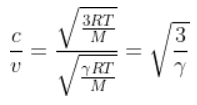
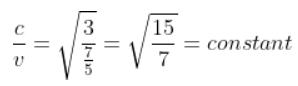
If c is r.m.s speed of molecules in a gas and v is the speed of sound waves in the gas, show that c/v is constant and independent of temperature for all diatomic gases.

Show solutionHide solution
Worked solution

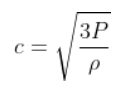
We know the following is the equation for molecules:

Exemplar Solutions Class 11 Physics Chapter 15 Img.10

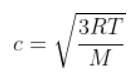
Exemplar Solutions Class 11 Physics Chapter 15 Img.11

p/ρ = PT/M

Where, M is the molar mass of the gas

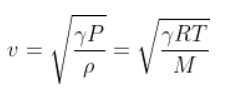
Exemplar Solutions Class 11 Physics Chapter 15 Img.12

c/v is given as:

Exemplar Solutions Class 11 Physics Chapter 15 Img.13

Therefore,

Exemplar Solutions Class 11 Physics Chapter 15 Img.14

Q15.34Written answer

Given below are some functions of x and t to represent the displacement of an elastic wave.

a) y = 5 cos (4x) sin (20t)

b) y = 4 sin (5x-t/2) + 3 cos (5x-t/2)

c) y = 10 cos [(252-250)πt] cos [(252+250) πt]

d) y = 100 cos (100 πt + 0.5x)

State which of these represent

a) a travelling wave along -x direction

b) a stationary wave

c) beats

d) a travelling wave along +x direction

Give reasons for your answers

Show solutionHide solution
Worked solution

a) When a wave travels in (-x) direction, it must have +kx, which is given as:

d) y = 100 cos (100 πt + 0.5x)

b) When a stationary wave is there, then,

a) y = 5 cos (4x) sin (20t)

c) When beats are involved

c) y = 10 cos [(252-250)πt] cos [(252+250) πt]

d) a travelling wave along +x direction is

b) y = 4 sin (5x-t/2) + 3 cos (5x-t/2)

Q15.35Written answer

In the given progressive waves y = 5 sin (100 πt – 0.4 πx) where y and x are in m, t is in s. What is the

a) amplitude

b) wavelength

c) frequency

d) wave velocity

e) particle velocity amplitude

Show solutionHide solution
Worked solution

Given,

The wave is travelling in +x direction

The equation is

y = 5 sin (100 πt – 0.4 πx)

a) amplitude, a = 5 m

b) wavelength, λ = 2π/ λ = 5 m

c) frequency, v = 50 Hz

d) wave velocity, v = 250 m/s

e) particle velocity amplitude = 500 π m/s

Q15.36Written answer

For the harmonic travelling wave y = 2 cos 2 π(10t-0.0080x+3.5) where x and y are in cm and t is second. What is the phase difference between the oscillatory motion at two points separated by a distance of

a) 4 m

b) 0.5 m

c) λ/2

d) 3 λ/4

e) what is the phase difference between the oscillation of a particle located at x = 100 cm at t = Ts and t = 5s?

Show solutionHide solution
Worked solution

Given,

y = 2 cos 2 π(10t-0.0080x+3.5)

a = 2

ω = 20 π

k = 0.016 π

φ = 7 π

a) path difference, p = 4m = 400 cm

Substituting the values, we get phase difference = 6.4 πrad

b) path difference, p = 0.5 m = 50 cm

Substituting the values, we get phase difference = 0.8 π rad

c) path difference, p = λ/2

Substituting the values, we get phase difference = π rad

d) path difference, p = 3 λ/4

Substituting the values, we get phase difference = 98 π rad

Different Types of Waves

  1. Microwaves
  2. Infrared radiation
  3. Gamma rays
  4. X-rays
  5. Radio waves
  6. Ultraviolet radiation

Important Concepts Covered in Class 11 Physics Chapter 15 Waves

  1. Transverse and longitudinal waves
  2. Displacement relation in a progressive wave
  3. The speed of a travelling wave
  4. The principle of superposition of waves
  5. Reflection of waves
  6. Beats
  7. Doppler effect.