My Cart
Your Cart 0

    Your cart is empty.

  • Total (Amount) ₹0.00
NCERT Exemplar · Class 11 · Physics

Chapter 15: Waves

Practice each question, then open the answer or worked solution.

Questions

36 questions
Q15.21Written answer

The displacement of an elastic wave is given by the function y = 3 sin ωt + 4 cos ωt where y is in cm and t is in second. Calculate the resultant amplitude.

Show solutionHide solution
Worked solution

Given,

y = 3 sin ωt + 4 cos ωt

Let’s consider

3 = a cos φ

4 = a sin φ

Then

y = a cos φ ωt + a sin φ ωt

y = a sin (ωt + φ)

tan φ = 4/3

φ = tan-1 4/3

When the above equation is squared, we het

a2 = 25

a = 5

Therefore, the new amplitude is 5 cm.
Q15.22Written answer

A sitar wire is replaced by another wire of the same length and material but of three times the earlier radius. If the tension in the wire remains the same, by what factor will the frequency change?

Show solutionHide solution
Worked solution

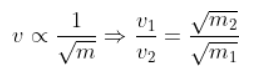
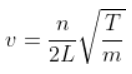
The frequency of the stretched wire is given as:

Exemplar Solutions Class 11 Physics Chapter 15 Img.2

Given that,

No.of harmonic n, length L, and tension T are the same in both cases.

Therefore,

Exemplar Solutions Class 11 Physics Chapter 15 Img.3

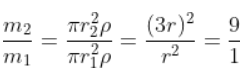
Substituting the values of mass per unit length, we get

Exemplar Solutions Class 11 Physics Chapter 15 Img.4

Solving the above the equation, we get v2 = 1/3 v1

Therefore, the frequency of the sitar is reduced by 1/2 of its actual value.

Q15.23Written answer

At what temperatures will the speed of sound in the air be 3 times its value at 0oC?

Show solutionHide solution
Worked solution

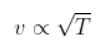
We know that,

Exemplar Solutions Class 11 Physics Chapter 15 Img.5

Given that,

vT = 3v0

Exemplar Solutions Class 11 Physics Chapter 15 Img.6

T = 2457 – 273 = 2184oC

Q15.24Written answer

When two waves of almost equal frequencies, n1 and n2, reach at a point simultaneously, what is the time interval between successive maxima?

Show solutionHide solution
Worked solution

It is given that the two frequencies are almost equal, that is n1 = n2.

For the formation of the beats, the frequencies must be n2 > n1.

The no.of frequencies per second in maxima = n = n2 – n1

Therefore, the time period of the maxima = 1/n = 1/n2 – n1 second.

Short Answers
Q15.25Written answer

A steel wire has a length of 12 m and a mass of 2.10 kg. What will be the speed of a transverse wave on this wire when a tension of 2.06 × 10⁴ N is applied?

Show solutionHide solution
Worked solution

Length, l = 12 m

Total mass, M = 2.10 kg

m = M/l = 2.1/12

Tension, T = 2.06 × 10⁴ N

Therefore, v is given as

Exemplar Solutions Class 11 Physics Chapter 15 Img.7

v = 343.0 m/s

Q15.26Written answer

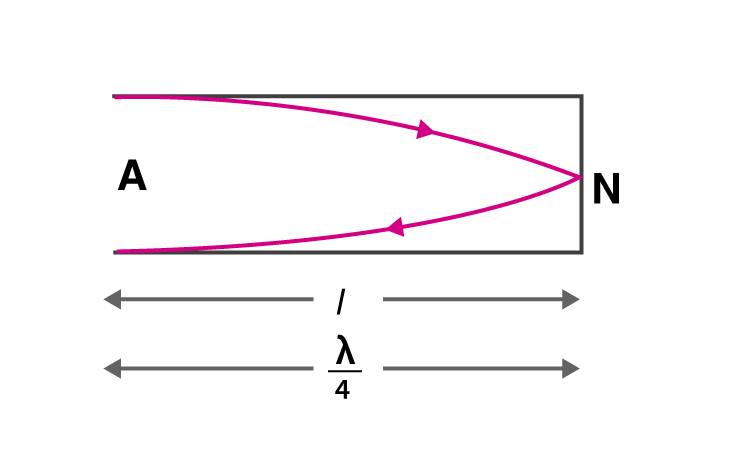
A pipe of 20 cm long is closed at one end. Which harmonic mode of the pipe is resonantly excited by a source of 1237.5 Hz?

Show solutionHide solution
Worked solution

Exemplar Solutions Physics Class 11 Chapter 15 - 4

Given,

Length, l = 20 cm =0.2 m

v = 1237.5 Hz

Assuming that velocity of sound in air = 330 m/s

l = λ/4

λ = 4l

We know that,

v1= v/ λ = v/4l

v1 = 412.5 Hz

v/v1 = 1237.5/412.5 = 3/1

Therefore, the third harmonic will have 1237.5 Hz frequency.

Q15.27Written answer

A train standing at the outer signal of a railway station blows a whistle of frequency 400 Hz still air. The train beings to move at a speed of 10 m/s towards the platform. What is the frequency of the sound for an observer standing on the platform?

Show solutionHide solution
Worked solution

v0 = 400 Hz

vz = 10 m/s

The velocity of sound in air, va = 330 m/s

v’ is the frequency heard by the observer standing on the platform

v’ = (330)(400)/320 = 412.5 Hz

Q15.28Written answer

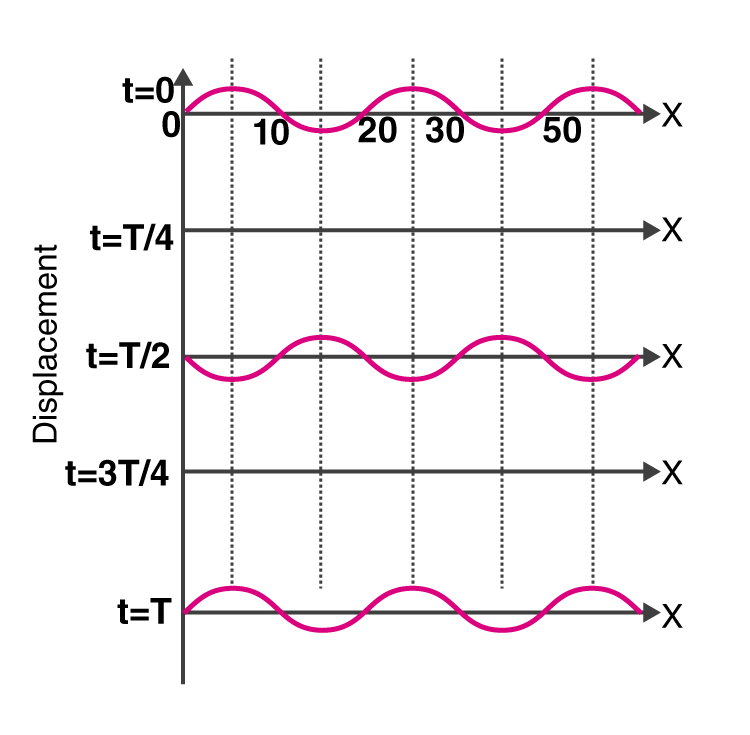
The wave pattern on a stretched string is shown in the figure. Interpret what kind of wave this is and find its wavelength.

Exemplar Solutions Physics Class 11 Chapter 15 - 5

Show solutionHide solution
Worked solution

When particles at t = T/4 and 3T/4 are at rest on a stationary wave which is at its mean position.

The nodes in the graph when the wave is at x = 10, 20, 30, 40 cm have a distance with the successive node is λ/2.

λ/2 = 30 – 20 = 20

λ = 20 cm

Q15.29Written answer

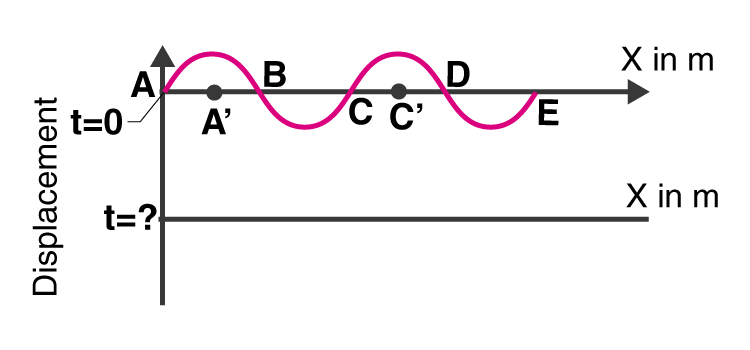
The pattern of standing waves formed on a stretched string at two instants of time is shown in the figure. The velocity of two waves superimposing to form stationary waves is 360 m/s, and their frequencies are 256 Hz.

Exemplar Solutions Physics Class 11 Chapter 15 - 6

a) calculate the time at which the second curve is plotted

b) mark nodes and antinodes on the curve

c) calculate the distance between A’ and C’

Show solutionHide solution
Worked solution

The frequency of the wave, v = 256 Hz

T = 1/v = 1/256 sec = 0.00390

T = 3.9 × 10⁻³ sec

a) When the particle’s mean position changes after T/4, the time is calculated as

t = T/4 = (3.9 10-3)/4 = 0.975 × 10⁻³ sec

t = 9.8 × 10⁻⁴ sec

b) Nodes: A, B, C, D, E

Antinode: A’, C’

c) The distance between A’ and C’ is

λ = v/f = 360/256 = 1.41 m

Q15.30Written answer

A tuning fork vibrating with a frequency of 512 Hz is kept close to the open end of a tube filled with water. The water level in the tube is gradually lowered. When the water level is 17 cm below the open end, the maximum intensity of sound is heard. If the room temperature is 20oC, calculate

a) speed of sound in air at room temperature

b) speed of sound in air at 0oC

c) if the water in the tube is replaced with mercury, will there be any difference in your observations?

Exemplar Solutions Physics Class 11 Chapter 15 - 7

Show solutionHide solution
Worked solution

Exemplar Solutions Physics Class 11 Chapter 15 - 8

Given,

The frequency of the tuning fork, f = 512 Hz

a) When the first maxima is considered, the length in the air column is, l = λ/4

λ = 4l

Speed of sound, v = f λ = 348.16 m/s

b) We know that,

Exemplar Solutions Class 11 Physics Chapter 15 Img.8

Exemplar Solutions Class 11 Physics Chapter 15 Img.9