My Cart
Your Cart 0

    Your cart is empty.

  • Total (Amount) ₹0.00
NCERT Exemplar · Class 11 · Physics

Chapter 15: Waves

Practice each question, then open the answer or worked solution.

Questions

36 questions
Q15.11Written answer

A transverse harmonic wave on a string is described by y (x,t) = 3.0 sin (36t + 0.018x + π/4) where x and y are in cm and t is in s. The positive direction of x is from left to right

a) the wave is travelling from right to left

b) the speed of the wave is 20 m/s

c) frequency of the wave is 5.7 Hz
d) the least distance between two successive crests in the wave is 2.5 cm

Show solutionHide solution
Worked solution

The correct answers  are

a) the wave is travelling from right to left

b) the speed of the wave is 20 m/s

c) frequency of the wave is 5.7 Hz
Q15.12Written answer

The displacement of a string is given by y(x,t) = 0.06 sin (2πx/3) cos (120πt) where x and y are in m and t in s. The length of the string is 1.5 m and its mass is 3.0 × 10⁻²kg.

a) it represents a progressive wave of frequency 60 Hz

b) it represents a stationary wave of frequency 60 Hz

c) it is the result of the superposition of two waves of wavelength 3 m, frequency 60 Hz each travelling with a speed of 180 m/s in the opposite direction

d) amplitude of this wave is constant

Show solutionHide solution
Worked solution

The correct answers are

b) it represents a stationary wave of frequency 60 Hz

c) it is the result of the superposition of two waves of wavelength 3 m, frequency 60 Hz each travelling with a speed of 180 m/s in the opposite direction

Q15.13Written answer

Speed of sound waves in a fluid depends upon

a) directly on the density of the medium

b) square of bulk modulus of the medium

c) inversely on the square root of density

d) directly on the square root of bulk modulus of the medium

Show solutionHide solution
Worked solution

The correct answers are

c) inversely on the square root of density

d) directly on the square root of bulk modulus of the medium

Q15.14Written answer

During propagation of a plane progressive mechanical wave

a) all the particles are vibrating in the same phase

b) amplitude of all the particles is equal

c) particles of the medium executes SHM

d) wave velocity depends upon the nature of the medium

Show solutionHide solution
Worked solution

The correct answers are

b) amplitude of all the particles is equal

c) particles of the medium executes SHM

d) wave velocity depends upon the nature of the medium

Q15.15Written answer

The transverse displacement of a string is given by y(x,t) = 0.06 sin (2πx/3) cos (120πt). All the points on the string between two consecutive nodes vibrate with

a) same frequency

b) same phase

c) same energy

d) different amplitude

Show solutionHide solution
Worked solution

The correct answers are

a) same frequency

b) same phase

d) different amplitude

Q15.16Written answer

A train, standing in a station yard, blows a whistle of frequency 400 Hz in still air. The wind starts blowing in the direction from the yard to the station with a speed of 10 m/s. Given that the speed of sound in still air is 340 m/s

a) the frequency of sound as heard by an observer standing on the platform is 400 Hz

b) the speed of sound for the observer standing on the platform is 350 m/s

c) the frequency of sound as heard by the observer standing on the platform will increase

d) the frequency of sound as heard by the observer standing on the platform will decrease

Show solutionHide solution
Worked solution

The correct answers are

a) the frequency of sound as heard by an observer standing on the platform is 400 Hz

b) the speed of sound for the observer standing on the platform is 350 m/s

Q15.17Multiple choice

Which of the following statements is true for a stationary wave?

e) there are some particles which are always at rest

Show solutionHide solution
Worked solution

The correct answers are

a) every particle has a fixed amplitude which is different from the amplitude of its nearest particle

b) all the particles cross their mean position at the same time

d) there is no net transfer of energy across any plane

e) there are some particles which are always at rest

Very Short Answer
Q15.18Written answer

A sonometer wire is vibrating in resonance with a tuning fork. Keeping the tension applied the same, the length of the wire is doubled. Under what conditions would the tuning fork still be at resonance with the wire?

Show solutionHide solution
Worked solution

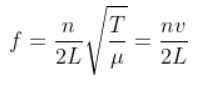
The length of the wire used in a sonometer is twice when it vibrates. Therefore, if the tuning fork resonates at L, the sonometer resonates at 2L. The following equation is used to express the frequency of the sonometer

Exemplar Solutions Class 11 Physics Chapter 15 Img.1

The velocity of the wave from the sonometer is constant. The resonance between the tuning fork and the wire will remain even after the change in the length of the wire.

Then,

n/L = constant

Which also means that,

n1/L1 = n2/L2

n1/L1 = n2/2L2

n2 = 2n1

Therefore, when the wire length is doubled, the resonance also gets doubled.

Q15.19Written answer

An organ pipe of length L open at both ends is found to vibrate in its first harmonic when sounded with a tuning fork of 480 Hz. What should be the length of a pipe closed at one end, so that it also vibrates in its first harmonic with the same tuning fork?

Show solutionHide solution
Worked solution

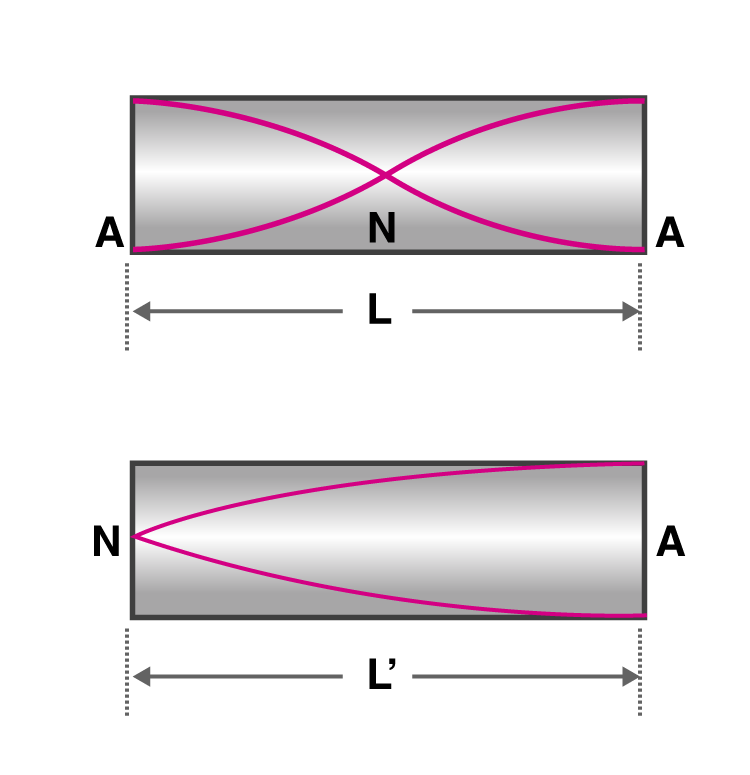
Exemplar Solutions Physics Class 11 Chapter 15 - 3

From the harmonic is open, L = λ/2

λ = 2L

v/f0 = 2L

(f0)open = v/2L

where v is the speed of the sound wave in the air.

When the harmonic is closed, L’ = λ/4

λ = 4L’

(f0)closed = v/4L’

v/2L = v/4L’

L’ = L/2

Q15.20Written answer

A tuning fork A, marked 512 Hz, produces 5 beats per second, where sounded with another unmarked tuning fork B. If B is loaded with wax, the number of beats is again 5 per second. What is the frequency of the tuning fork B when not loaded?

Show solutionHide solution
Worked solution

When tuning fork B is loaded with the wax, the frequency of the tuning fork becomes less than its original frequency. When the tuning fork is marked 512 Hz, let’s assume that the tuning fork B is marked to 517 Hz because it produces 5 beats per second and when it is loaded, the frequency is less than 512 Hz. So it can be said that when the tuning fork is not loaded, the frequency remains the same, that is, 517 Hz.