My Cart
Your Cart 0

    Your cart is empty.

  • Total (Amount) ₹0.00
NCERT Exemplar · Class 11 · Physics

Chapter 6: Work, Energy and Power

Practice each question, then open the answer or worked solution.

Questions

48 questions
Q6.1Written answer

An electron and a proton are moving under the influence of mutual forces. In calculating the change in the kinetic energy of the system during motion, one ignores the magnetic force of one on another. This is because,

a) the two magnetic forces are equal and opposite, so they produce no net effect

b) the magnetic forces do no work on each particle

c) the magnetic forces do equal and opposite work on each particle

d) the magnetic forces are necessarily negligible

Show solutionHide solution
Worked solution

Answer: b) the magnetic forces do no work on each particle
Q6.2Multiple choice

A proton is kept at rest. A positively charged particle is released from rest at a distance d in its field. Consider two experiments; one in which the charged particles is also a proton and in another, a positron. In the same time t, the work done on the two moving charged particles is

Show answerHide answer
Correct option: C
Show solutionHide solution
Worked solution

Answer: c) more for the case of a positron, as the positron moves away from a larger distance

Q6.3Written answer

A man squatting on the ground gets straight up and stand. The force of reaction of ground on the man during the process is

a) constant and equal to mg in magnitude

b) constant and greater than mg in magnitude

c) variable but always greater than mg

d) at first greater than mg, and later becomes equal to mg

Show solutionHide solution
Worked solution

Answer: d) at first greater than mg, and later becomes equal to mg


Q6.4Written answer

A bicyclist comes to a skidding stop in 10 m. During this process, the force on the bicyclist due to the road is 200 N and is directly opposed to the motion. The work done by the cycle on the road is

a) +2000 J

b) -200 J

c) zero

d) -20,000 J

Show solutionHide solution
Worked solution

Answer: c) zero

Q6.5Multiple choice

A body is falling freely under the action of gravity alone in a vacuum. Which of the following quantities remain constant during the fall?

Show answerHide answer
Correct option: C
Show solutionHide solution
Worked solution

Answer: c) total mechanical energy

Q6.6Multiple choice

During inelastic collision between two bodies, which of the following quantities always remain conserved?

Show answerHide answer
Correct option: C
Show solutionHide solution
Worked solution

Answer: c) total linear momentum

Q6.7Multiple choice

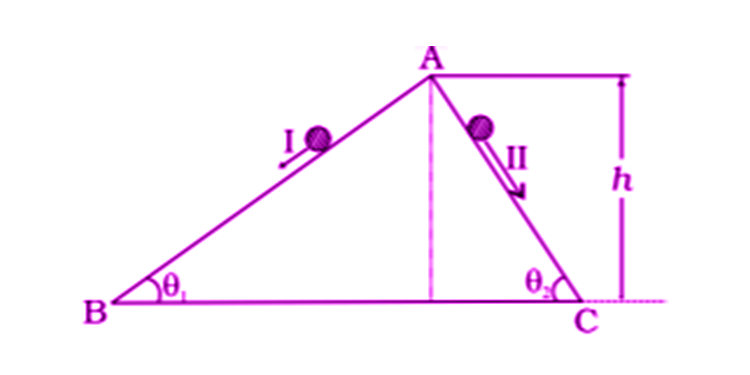
Two inclined frictionless tracks, one gradual and the other steep, meet at A, from where two stones are allowed to slide down from rest, one on each track as shown in the figure. Which of the following statement is correct?

Exemplar Solutions Physics Class 11 Chapter 6 - 1

Show answerHide answer
Correct option: C
Show solutionHide solution
Worked solution

Answer: c) both the stones reach the bottom with the same speed and stone II reaches the bottom earlier than stone I

Q6.8Multiple choice

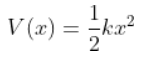
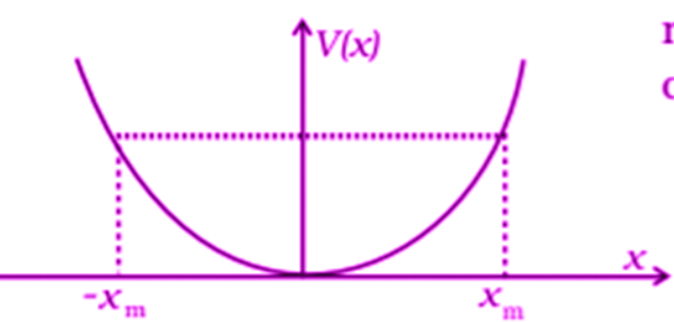
The potential energy function for a particle executing linear SHM is given by
Exemplar Solutions Physics Class 11 Chapter 6 - 2 where k is the force constant of the oscillator. For k = 0.5 N/m, the graph of V(x) versus x is shown in the figure. A particle of total energy E turns back when it reaches x = ±xm, then which of the following is correct?
Exemplar Solutions Physics Class 11 Chapter 6 - 3

Show answerHide answer
Correct option: B
Show solutionHide solution
Worked solution

Answer: b) V = E, K = O

Q6.9Written answer

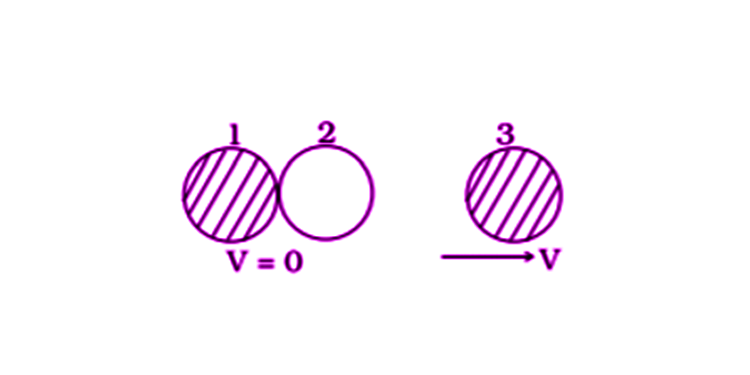
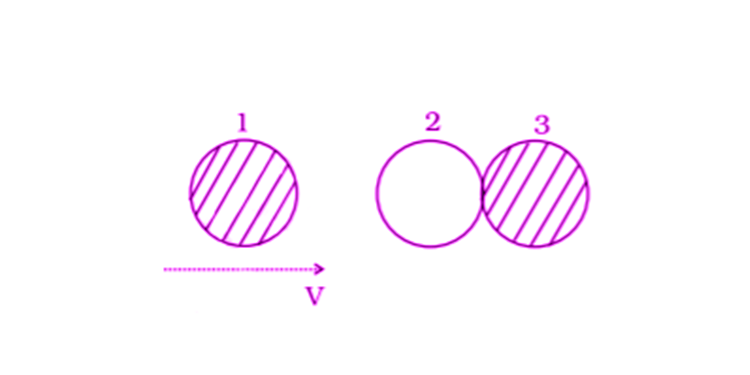
Two identical ball bearings in contact with each other and resting on a frictionless table are hit head-on by another ball bearing of the same mass moving initially with a speed V as shown:

Exemplar Solutions Physics Class 11 Chapter 6 - 4

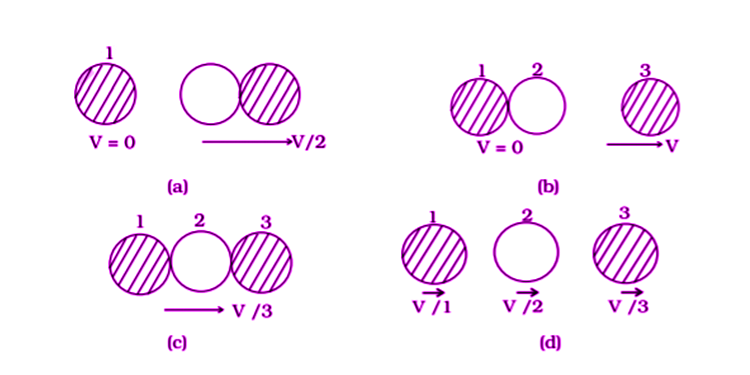
If the collision is elastic, which of the following is a possible result after collision?

Exemplar Solutions Physics Class 11 Chapter 6 - 5

Show solutionHide solution
Worked solution

b)

Exemplar Solutions Physics Class 11 Chapter 6 - 7

Q6.10Written answer

A body of mass 0.5 kg travels in a straight line with velocity v = ax3/2 where a = 5 m-1/2s-1. The work done by the net force during its displacement from x = 0 to x = 2 m is

a) 1.5 J

b) 50 J

c) 10 J

d) 100 J

Show solutionHide solution
Worked solution

Answer: b) 50 J