My Cart
Your Cart 0

    Your cart is empty.

  • Total (Amount) ₹0.00
NCERT Exemplar · Class 11 · Physics

Chapter 6: Work, Energy and Power

Practice each question, then open the answer or worked solution.

Questions

48 questions
Q6.21Written answer

Two blocks M1 and M2 having equal mass are free to move on a horizontal frictionless surface. M2 is attached to a massless spring as shown in the figure. Initially, M2 is at rest and M1 is moving toward M2 with speed v and collides head-on with M2.
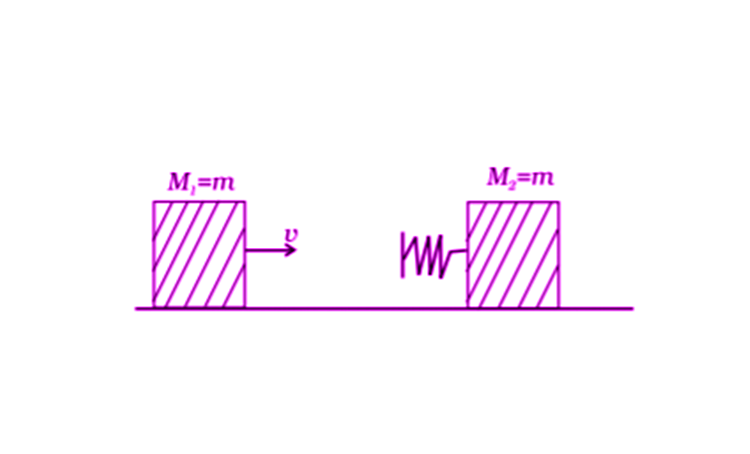
Exemplar Solutions Physics Class 11 Chapter 6 - 18

a) while spring is fully compressed all the KE of M1 is stored as PE of spring

b) while spring is fully compressed the system momentum is not conserved, though final momentum is equal to the initial momentum

c) if spring is massless, the final state of the M1 is the state of rest

d) if the surface on which blocks are moving has friction, then a collision cannot be elastic

Show solutionHide solution
Worked solution

c) if spring is massless, the final state of the M1 is a state of rest

d) if the surface on which blocks are moving has friction, then a collision cannot be elastic

Very Short Answer
Q6.22Written answer

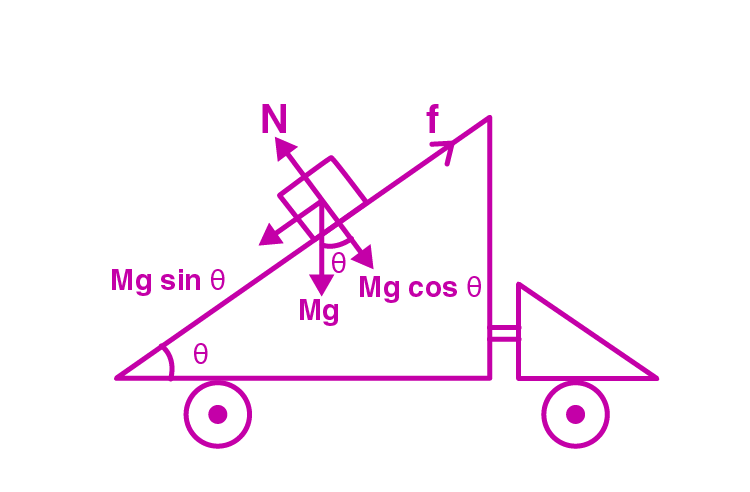
A rough inclined plane is placed on a cart moving with a constant velocity u on horizontal ground. A block of mass M rests on the incline. Is any work done by a force of friction between the block and incline? Is there then a dissipation of energy?

Show solutionHide solution
Worked solution

Exemplar Solutions Physics Class 11 Chapter 6 - 19

From the above figure, it is clear that the block is inclined on the plane. There is no work done, as there is no displacement happening and no dissipation energy takes place.

Q6.23Written answer

Why is electrical power required at all when the elevator is descending? Why should there be a limit on the number of passengers in this case?

Show solutionHide solution
Worked solution

There is a limit on the number of passengers in case of an elevator descending as it is not a free fall and moves down with a uniform speed.

Q6.24Written answer

A body is being raised to a height h from the surface of the earth. What is the sign of work done by

a) applied force

b) gravitational force

Show solutionHide solution
Worked solution

a) The work done by the applied force is positive

b) The work done by the gravitational force is negative

Q6.25Written answer

Calculate the work done by a car against gravity in moving along a straight horizontal road. The mass of the car is 400 kg and the distance moved is 2m.

Show solutionHide solution
Worked solution

WD = Fs cos θ

WD = Fs cos 90o = 0

Therefore, the work done by the car against the gravity is zero.

Q6.26Written answer

A body falls towards earth in the air. Will its total mechanical energy be conserved during the fall? Justify.

Show solutionHide solution
Worked solution

The total mechanical energy of the free-falling body is no conserved as this energy is used against the force of friction from the air molecules.

Q6.27Written answer

A body is moved along a closed loop. Is the work done in moving the body necessarily zero? If not, state the condition under which work done over a closed path is always zero.

Show solutionHide solution
Worked solution

The work done by the moving body is zero when the conservative force is acting on the body during the motion. The work done by the moving body is non-zero when the non-conservative force is acting on the body.

Q6.28Written answer

In an elastic collision of two billiard balls, which of the following quantities remain conserved during the short time of collision of the balls

a) kinetic energy

b) total linear momentum

Give a reason for your answer in each case.

Show solutionHide solution
Worked solution

The kinetic energy and the total linear momentum of the billiard balls are conserved as there is no non-conservative force.

Q6.29Written answer

Calculate the power of a crane in watts, which lifts a mass of 100 kg to a height of 10 min 20 sec.

Show solutionHide solution
Worked solution

P = WD/time = Fs cos θ/t = mgh cos θ/t

h = 10 m

t = 20 sec

F = mg = 1000

Therefore, P = 500 Watts

Q6.30Written answer

The average work done by a human heart while it beats once is 0.5 J. Calculate the power used by heart if it beats 72 times in a minute.

Show solutionHide solution
Worked solution

P = WD/time

WD is one beat of heart = 0.5 J

WD in 72 beats = 36 J

P = WD/t = 0.6 W