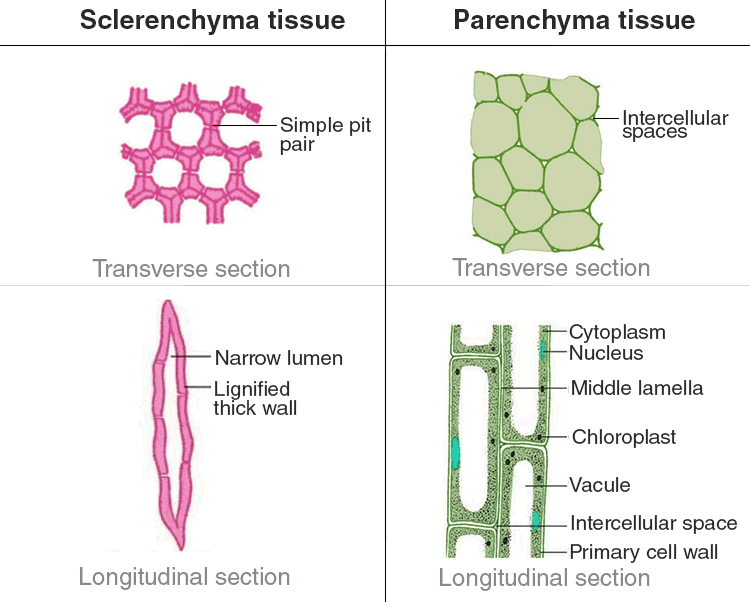
Differentiate between sclerenchyma and parenchyma tissues. Draw well labelled diagram.
| Parenchyma | Sclerenchyma |
| Consists of living cells | Consists of dead cells |
| Consists of thin walled cell | Consists of uniformly thickened cellwalls |
| Cellwall is made up of cellulose | Cellwall is made up of complex lignin |
| Serves as packing tissue | Serves as mechanical tissue |
| Stores food and perform photosynthesis | Gives strength, rigidity and protects from parasites. |
50. Describe the structure and function of different types of epithelial tissues. Draw diagram of each type of epithelial tissue.
Epithelial cells are the thin protective coverings that line most organs and cavities within the body. It also forms a barrier to keep different body systems separate. The skin, the lining of the mouth, the lining of blood vessels, lung alveoli and kidney tubules are all made of epithelial tissue. Epithelial tissue cells are tightly packed and form a continuous sheet.
They have only a small amount of cementing material between them and almost no intercellular spaces.
Obviously, anything entering or leaving the body must cross at least one layer of epithelium. As a result, the permeability of the cells of various epithelia plays an important role in regulating the exchange of materials between the body and the external environment and also between different parts of the body. Regardless of the type, all epithelium is usually separated from the underlying tissue by an extracellular fibrous basement membrane.
Epithelial cells are the protective coverings that line most organs and cavities of our body. Epithelial cells form a barrier that keeps different body systems separate. Skin, the lining of blood vessels, alveoli of the lung, kidney tubules etc are made of epithelial tissue. Cells in the epithelial tissue are tightly packed and form a continuous sheet.
Epithelial tissue has only a small amount of cementing material between them and almost no intercellular spaces. It is obvious that anything entering or leaving the body must cross at least one layer of epithelium. This results in the permeability of the cells of various epithelia to play an important role in regulating the exchange of materials between the body and the external environment and between different parts of the body.
The epithelium is usually separated from the underlying tissue by an extracellular fibrous basement membrane.
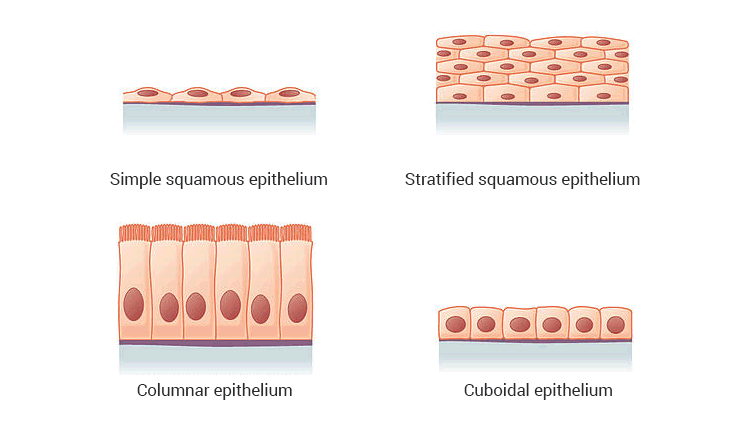
Depending on the shape and function, epithelial cells are classified into a) Squamous epithelial tissue b) Stratified squamous epithelial tissue c) Cuboidal epithelial tissue d) Columnar( Ciliated) epithelial tissue.
a) Squamous epithelial tissue:
In cells lining blood vessels or lung alveoli transportation of substances occurs through a selectively permeable surface, this epithelium is a flat kind of epithelium. This is called the simple squamous epithelium. Simple squamous epithelial cells are extremely thin and flat and form a delicate lining. The oesophagus and the lining of the mouth are also covered with squamous epithelium. The skin, which protects the body, is also made of squamous epithelium. Skin epithelial cells are arranged in many layers to prevent wear and tear. Since they are arranged in a pattern of layers, the epithelium is called stratified squamous epithelium.
b) Stratified squamous epithelium: Skin epithelial cells are arranged in many layers to prevent wear and tear. Since they are arranged in a pattern of layers, the epithelium is called stratified squamous epithelium.
c) Columnar epithelium: Where absorption and secretion occur, as, in the inner lining of the intestine, these tall epithelial cells are present. This columnar epithelial facilitates movement across the epithelial barrier. In the respiratory tract, the columnar epithelial tissue also has cilia, which are hair-like projections on the outer surfaces of epithelial cells. These cilia can move and their movement pushes the mucus forward to clear it. This type of epithelium is thus ciliated columnar epithelium.
d) Cuboidal epithelium: These form the lining of the kidney tubules and ducts of salivary glands where these provide mechanical support. Sometimes, a portion of the epithelial tissue folds inward and a multicellular gland is formed. This is the glandular epithelium.
51. Draw well labelled diagrams of various types of muscles found in human body.
Soln:
52. Give reasons for
(a) Meristematic cells have a prominent nucleus and dense cytoplasm but they lack vacuole.
(b) Intercellular spaces are absent in sclerenchymatous tissues.
(c) We get a crunchy and granular feeling, when we chew pear fruit.
(d) Branches of a tree move and bend freely in high wind velocity.
(e) It is difficult to pull out the husk of a coconut tree.
Soln:
a) Meristamatic tissue cells are continuously dividing and they have a prominent nucleus and a dese cytoplasm. Since they are diving rigorously they need not store food or waste products hence they lack vacuoles.
b) Cellwall of sclerenchyma are lignified and are packed densely to protect the plant and to give mechanical strength hence intercellular spaces are absent in sclerenchymatous tissues.
c) In pear fruit sclerenchyma cells are called stone cells. They are small, thick and hard. Due to this, we get a crunchy and granular feeling, when we chew pear fruit.
d) Junction of the tree branch composed of collenchyma cells which provide rigidity and flexibility to the branches. Hence, branches of a tree move and bend freely in high wind velocity.
e) Husk of coconut tree is sclerenchyma which is hard. Hence it is difficult to pull out the husk of a coconut tree.
53. List the characteristics of cork. How are they formed? Mention their role.
Soln:
- Cork cells are mature and dead
- They are compactly arranged
- They do not have intercellular spaces
- They are thick and have several layers.
Outer protective tissue of the plant undergoes changes with age. The epidermis of the stem is replaced by a secondary meristem call phellogen or cork cambium .It is a simple tissue which consists of rectangular cells whose protoplasts are vacuolated. Cork cells contain tannins and chloroplasts.
Cork cambium forms cork on the outer side and secondary cortex on the inner side by giving off new cells on both its sides. The layer of cells which is cut by cork cambium on the outer side ultimately becomes several layered thick cork (bark) of trees.
Cork cells are compactly arranged dead cells and they lack intercellular spaces. Walls of cork cells are thickened with suberin which is fat. Due to Suberin, these cells are impermeable to water and gases.
Role of cork
Cork provides protection to plant and it prevents loss of water from plant body. Cork protects the plants from infection and mechanical injury. Cork is light in weight and it cannot catch fire. Because of this property, it is used as insulators. Cork is hard in nature hence it is used to make sports goods.
54. Why are xylem and phloem called complex tissues? How are they different from one other?
Soln
A complex tissue is the one which has more than one type of cells having a common origin which coordinates to perform a common function.
Xylem and phloem are made of different types of cells hence they are called complex tissues.
Xylem is made up of four different types of cells (elements), namely
(i)tracheids- Tracheids are elongated cells in the xylem of vascular plants that serve in the transport of water and mineral salts.
(ii)vessels- A vessel element (trachea) is one of the cell types found in xylem, the water-conducting tissue of plants. Vessel elements are found in flowering plants
(iii) xylem parenchyma- xylem parenchyma. live plant cells that are short, lignified and generally thin-walled. They surround conducting elements and assist directly or indirectly in the conduction of water upwards through vessels and tracheids, and also serve for food storage.
(iv) xylem sclerenchyma (or fibre)- Xylem fibres are mainly supportive in function.
Phloem is also made of four different types of elements
(i) sieve tubes- Sieve tube, in flowering plants, elongated living cells (sieve-tube elements) of the phloem, the nuclei of which have fragmented and disappeared and the transverse end walls of which are pierced by sievelike groups of pores (sieve plates). They are the channels of food (mostly sugar) transport.
(ii) companion cells- companion cell A type of cell found within the phloem of flowering plants. Companion cell is usually closely associated with a sieve element. Its function is uncertain, though it appears to regulate the activity of the adjacent sieve element and to take part in loading and unloading sugar into the sieve element.
(iii) phloem parenchyma
(iv) phloem fibre
55. (a) Differentiate between meristematic and permanent tissues in plants (b) Define the process of differentiation. Name any two simple and two complex permanent tissues in plants.
Soln:
The basic differences between meristematic and permanent tissues of plants are tabulated below
| Meristematic tissue | Permanent tissue | |
| 1 | Its component cells are living, small, spherical or polygonal and un-differentiated | Its components cells may be living or dead. They are large, differentiated with different shapes. |
| 2 | The cytoplasm is dense and vacuoles are nearly absent as they are metabolically active. | Large central vacuole occurs in living permanent cells as, they are less metabolically active. |
| 3 | Intercellular spaces are absent. | Intercellular spaces are often present. |
| 4 | The cell wall of its cells is thin and elastic. | The cell wall of its cells may either thin or thick. |
| 5 | The nucleus of each cell of this tissue is large and prominent. | The nucleus is less conspicuous. |
| 6 | Its cells grow and divide regularly. | Its cells do not normally divide. |
| 7 | It is a simple tissue. | It can be simple, complex or specialized, |
| 8 | Cell organelles of its cells are simple | Cell organelles of its cells are well- developed. |
| 9 | The cell contains crystals and other inclusions. | Cells crystals and other inclusions |
| 10 | It provides growth to the plant. | It provides protection. Support, conduction photosynthesis, storage, etc. |
(b) Cells derived from the division of meristematic tissues take up specific roles and gradually lose their ability to divide. Thus, they form permanent tissue. Differentiation is a process by which the cells divide meristematically to take a permanent shape, size and function
(c) Parenchyma and collenchyma are two simple permanent tissues, whereas xylem and phloem are two complex permanent tissues.
Show solutionHide solution
Solution coming soon.