Note is a sound
(a) of mixture of several frequencies
(b) of mixture of two frequencies only
(c) of a single frequency
(d) always unpleasant to listen
Soln:
Answer is (a) of mixture of several frequencies
Explanation:
Sound is a mixture of several frequencies which can be produced by vibrating objects.
2. A key of a mechanical piano struck gently and then struck again but much harder this time. In the second case
(a) sound will be louder, but the pitch will not be different
(b) sound will be louder, and the pitch will also be higher
(c) sound will be louder, but the pitch will be lower
(d) both loudness and pitch will remain unaffected
Soln:
Answer is (a) sound will be louder, but the pitch will not be different
Explanation:
Pitch depends on the frequency particular key, and loudness depends on the force by which the key is pressed.
3. In SONAR, we use
(a) ultrasonic waves
(b) infrasonic waves
(c) radio waves
(d) audible sound waves
Soln:
Answer is (a) ultrasonic waves
4. Sound travels in air if
(a) particles of medium travel from one place to another
(b) there is no moisture in the atmosphere
(c) disturbance moves
(d) both particles as well as disturbance, travel from one place to another.
Soln:
Answer is (c) disturbance moves
Explanation:
Sound waves propagate by vibrating in their own position. Whereas disturbance created by the vibration of particles moves from one place to another.
5. When we change feeble sound to loud sound, we increase its
(a) frequency
(b) amplitude
(c) velocity
(d) wavelength
Soln:
Answer is (b) amplitude
Explanation:
The Loudness of sound is proportional to amplitude. When amplitude increases, feeble sound changes to loud sound.
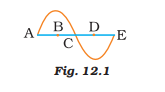
6. In the curve (Fig.12.1), half the wavelength is
(a) A B
(b) B D
(c) D E
(d) A E
Soln:
Answer is (b) B D
Explanation:
Wavelength is the distance between two consecutive troughs. In the graph half, the wavelength will be BD.
7. Earthquake produces which kind of sound before the main shock wave begins
(a) ultrasound
(b) infrasound
(c) audible sound
(d) none of the above
Soln:
Answer is (b) infrasound
Explanation:
It is due to infrared rays, few animals sense the earthquake, and they behave abnormally before the earthquake.
8. Infrasound can be heard by
(a) dog
(b) bat
(c) rhinoceros
(d) human beings
Soln:
Answer is (c) rhinoceros
Explanation:
Infrasound has a frequency less than 20 Hz, and Rhinoceroses communicate using Infrasound waves of the frequency of 5 Hz hence rhinoceros is the right answer.
9. Before playing the orchestra in a musical concert, a sitarist tries to adjust the tension and pluck the string suitably. By doing so, he is adjusting
(a) intensity of sound only
(b) amplitude of sound only
(c) frequency of the sitar string with the frequency of other musical instruments
(d) loudness of sound
Soln:
Answer is (c) frequency of the sitar string with the frequency of other musical instruments
Explanation:
Artists adjust the frequencies before beginning to play instruments because musical instruments should be tuned in with other musical instruments to produce pleasant music.
Show solutionHide solution
Solution coming soon.