Animals of colder regions and fishes of cold water have thicker layer of subcutaneous fat. Describe why?
Soln:
Animals of colder regions and fishes of cold water have a thicker layer of subcutaneous fat because fats act as an insulator and prevent the escape of heat from their body. This will help the animals in resisting low temperature in cold climates.
35. Match the column (A) with the column (B)
(A) – (B)
(a) Fluid connective tissue – (i) Subcutaneous layer
(b) Filling of space inside the organs – (ii) Cartilage
(c) Striated muscle – (iii) Skeletal muscle
(d) Adipose tissue – (iv) Areolar tissue
(e) Surface of joints – (v) Blood
(f) Stratified squamous epithelium – (vi) Ski
Soln:
(A) – (B)
(a) Fluid connective tissue – (v) Blood
(b) Filling of space inside the organs – (iv) Areolar tissue
(c) Striated muscle – (iii) Skeletal muscle
(d) Adipose tissue – (i) Subcutaneous layer
(e) Surface of joints – (ii) Cartilage
(f) Stratified squamous epithelium – (vi) Ski
36. Match the column (A) with the column (B)
(A) – (B)
(a) Parenchyma – (i) Thin-walled, packing cells
(b) Photosynthesis – (ii) Carbon fixation
(c) Aerenchyma – (iii) Localized thickenings
(d) Collenchyma – (iv) Buoyancy
(e) Permanent tissue – (v) Sclerenchyma
Soln:
(A) – (B)
(a) Parenchyma – (i) Thin-walled, packing cells
(b) Photosynthesis – (ii) Carbon fixation
(c) Aerenchyma – (iv) Buoyancy
(d) Collenchyma – (iii) Localized thickenings
(e) Permanent tissue – (v) Sclerenchyma
37. If a potted plant is covered with a glass jar, water vapours appear on the wall of glass jar. Explain why?
Soln:
Because of a process called transpiration, the water is released from the plants in the form of vapours. These vapours appear on the glass jar if a potted plant is covered with the glass jar.
38. Name the different components of xylem and draw a living component?
Soln:
Xylem comprises tracheids, vessels, xylem parenchyma and xylem fibres. The only living component of xylem is xylem parenchyma.
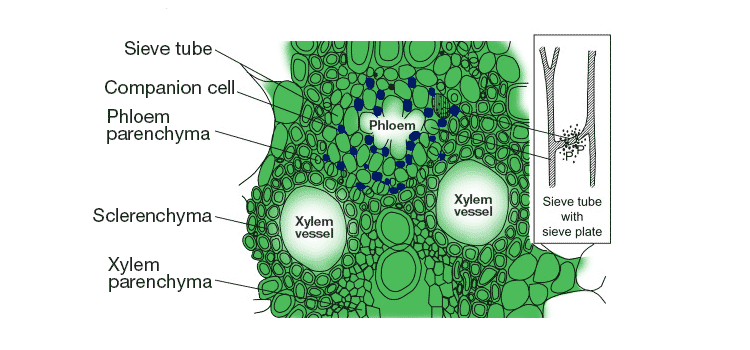
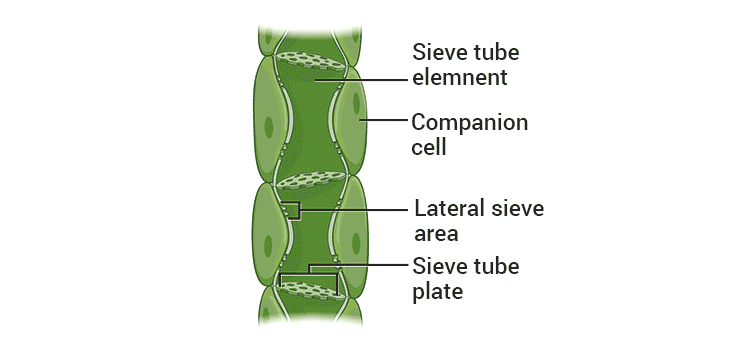
39. Draw and identify different elements of phloem.
Soln:
40. Write true (T) or false (F)
(a) Epithelial tissue is protective tissue in animal body.
(b) The lining of blood vessels, lung alveoli and kidney tubules are all made up of epithelial tissue.
(c) Epithelial cells have a lot of intercellular spaces.
(d) Epithelial layer is permeable layer.
(e) Epithelial layer does not allow regulation of materials between body and external environment.
Soln:
a. True
b. True
c. Epithelial cells have a lot of intercellular spaces
d. True
e. False
41. Differentiate between voluntary and involuntary muscles. Give one example of each type.
Soln:
| Voluntary muscles | Involuntary muscles |
| They are also called striated muscles since they show stripes or striations | They are also called non-striated muscles since they lack striations. |
| Their cells are long and cylindrical | Their cells are small and spindle shaped. |
| They have multinucleate cells | They have uninucleate cells |
| They are under our will or control. | They are not under our will or control. |
| They get tired and need rest at intervals. | They can work continuously without getting tired |
| Ex: Limb muscles | Ex: Cardiac muscles |
42. Differentiate the following activities on the basis of voluntary (V) or involuntary (I V) muscles.
(a) Jumping of frog
(b) Pumping of the heart
(c) Writing with hand
(d) Movement of chocolate in your intestine
Soln:
a-v, b-iv, c-v, d-iv
(a) Jumping of frog – is an activity of voluntary muscles
(b) Pumping of the heart- is a function of involuntary muscles
(c) Writing with hand- is a function of voluntary muscles
(d) Movement of chocolate in your intestine- is a function of involuntary muscles
43. Fill in the blanks
(a) Lining of blood vessels is made up of———.
(b) Lining of small intestine is made up of ———.
(c) Lining of kidney tubules is made up of———.
(d) Epithelial cells with cilia are found in———of our body
Soln:
a. Lining of blood vessels is made up of squamous epithelium
b. Lining of small intestine is made up of columnar epithelium
c. Lining of kidney tubules is made up of cuboidal epithelium
d. Epithelial cells with cilia are found in respiratory tract of our body
44. Water hyacinth float on water surface. Explain.
Soln:
Water hyacinth float on the water surface because of the presence of the air cavities present in the parenchyma tissue.
45. Which structure protects the plant body against the invasion of parasites?
Soln:
The epidermis is the structure that protects the plant body against the invasion of parasites. It has thick cuticle and dermal tissue which help in preventing the attack from parasites.
46. Fill in the blanks
(a) Cork cells possesses———on their walls that makes it impervious to gases and water.
(b) ——— have tubular cells with perforated walls and are living in nature.
(c) Bone possesses a hard matrix composed of———and ———.
Soln:
(a) Cork cells possesses Suberin on their walls that makes it impervious to gases and water.
(b) Sieve tubes have tubular cells with perforated walls and are living in nature.
(c) Bone possesses a hard matrix composed of calcium and Phosphorus.
47. Why is epidermis important for the plants?
Soln:
The epidermis is important for it gives protection against water loss. Epidermal cell present on the aerial parts of the plant often secretes a waxy, water-resistant layer on their outer surface. This provides protection against loss of water, mechanical injury and invasion by parasitic fungi. Epidermal tissue forms a continuous layer which helps to avoid mechanical stress.
48. Fill in the blanks (a) ———are forms of complex tissue. (b) ———have guard cells. (c) Cells of cork contain a chemical called——— (d) Husk of coconut is made of ———tissue. (e) ———gives flexibility in plants. (f) ———and———are both conducting tissues. (g) Xylem transports———and———from soil. (h) Phloem transport———from———to other parts of the plant
Soln:
a. Xylem and Phloem
b. Stomata
c. Suberin
d. Sclenchyma
e. Collenchyma
f. Xylem;Phloem
g. Water and minerals
h. Food, leaf
Show solutionHide solution
Solution coming soon.