My Cart
Your Cart 0

    Your cart is empty.

  • Total (Amount) ₹0.00
NCERT Exemplar · Class 9 · Maths

Chapter 6: Lines and Angles

Practice each question, then open the answer or worked solution.

Exercise 6.3

Textbook page 58 · 5 questions
Q1Written answer

In Fig. 6.9, OD is the bisector of ∠AOC, OE is the bisector of ∠BOC and OD ⊥ OE. Show that points A, O and B are collinear.
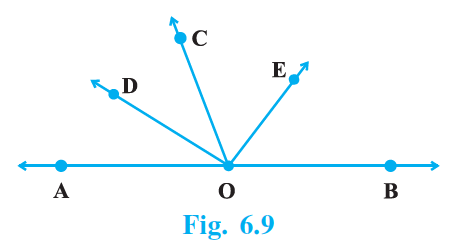
NCERT Exemplar Solutions For Class 9 Maths Chapter 6 Exercise 6.3-1

Show solutionHide solution
Worked solution

According to the question,

In figure,

OD ⊥ OE,

OD and OE are the bisectors of ∠AOC and ∠BOC.

To prove: Points A, O and B are collinear

i.e., AOB is a straight line.

Proof:

Since OD and OE bisect angles ∠AOC and ∠BOC, respectively.

∠AOC = 2∠DOC …(eq.1)

And ∠COB = 2∠COE …(eq.2)

Adding (eq.1) and (eq.2), we get

∠AOC = ∠COB = 2∠DOC + 2∠COE

∠AOC +∠COB = 2(∠DOC +∠COE)

∠AOC + ∠COB = 2∠DOE

Since, OD⊥OE

We get,

∠AOC +∠COB = 2×90o

∠AOC +∠COB =180o

∠AOB =180o

So, ∠AOC + ∠COB form linear pair.

Therefore, AOB is a straight line.

Hence, points A, O and B are collinear.
Q2Written answer

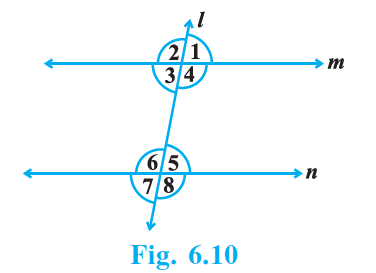
In Fig. 6.10, ∠1 = 60° and ∠6 = 120°. Show that the lines m and n are parallel.

NCERT Exemplar Solutions For Class 9 Maths Chapter 6 Exercise 6.3-2

Show solutionHide solution
Worked solution

According to the question,

We have from the figure ∠1 = 60° and ∠6 = 120°

Since, ∠1 = 60° and ∠6 = 120°

Here, ∠1 = ∠3 [since they are vertically opposite angles]

∠3 = ∠1 = 60°

Now, ∠3 + ∠6 = 60° + 120°

⇒ ∠3 + ∠6 = 180°

We know that,

If the sum of two interior angles on the same side of l is 180°, then the lines are parallel.

Therefore, m || n

Q3Written answer

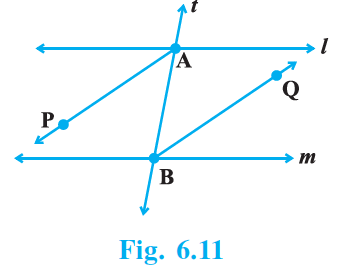
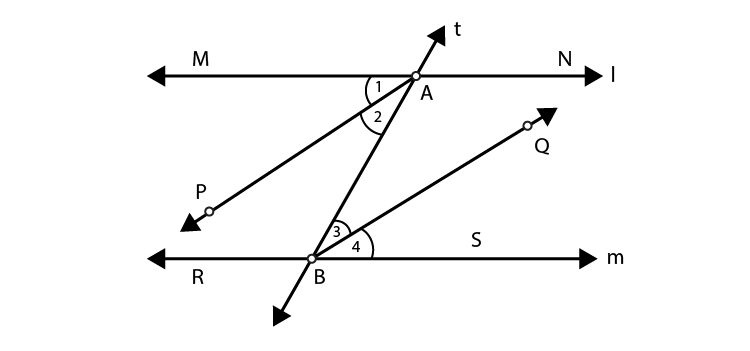
AP and BQ are the bisectors of the two alternate interior angles formed by the intersection of a transversal t with parallel lines l and m (Fig. 6.11). Show that AP || BQ.

NCERT Exemplar Solutions For Class 9 Maths Chapter 6 Exercise 6.3-3

Show solutionHide solution
Worked solution

NCERT Exemplar Solutions For Class 9 Maths Chapter 6 Exercise 6.3-4

l || m and t is the transversal

∠MAB = ∠SBA [alternate angles]

⇒ ½ ∠MAB = ½ ∠SBA

⇒ ∠PAB = ∠QBA

⇒ ∠2 = ∠3

But, ∠2 and ∠3 are alternate angles.

Hence, AP||BQ.

Q4Written answer

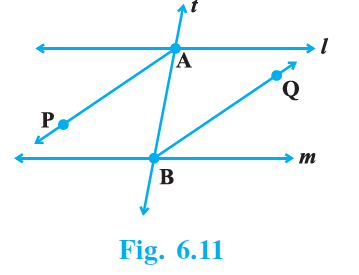
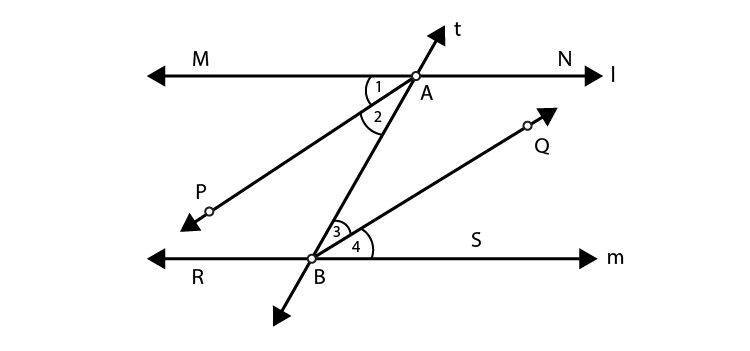
If in Fig. 6.11, bisectors AP and BQ of the alternate interior angles are parallel, then show that l || m.

NCERT Exemplar Solutions For Class 9 Maths Chapter 6 Exercise 6.3-5

Show solutionHide solution
Worked solution

AP is the bisector of ∠MAB

BQ is the bisector of ∠SBA.

Given: AP||BQ.

As AP||BQ,

We have,

NCERT Exemplar Solutions For Class 9 Maths Chapter 6 Exercise 6.3-6

So ∠2 = ∠3 [Alternate angles]

2∠2 = 2∠3

⇒ ∠2 + ∠2 = ∠3 +∠3

From figure, we have ∠1= ∠2and ∠3 = ∠4

⇒ ∠1+ ∠2 = ∠3 +∠4

⇒ ∠MAB = ∠SBA

But, we know that these are alternate angles.

Hence, the lines l and m are parallel, i.e., l ||m.

Q5Written answer

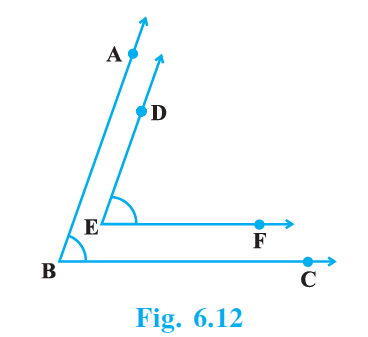
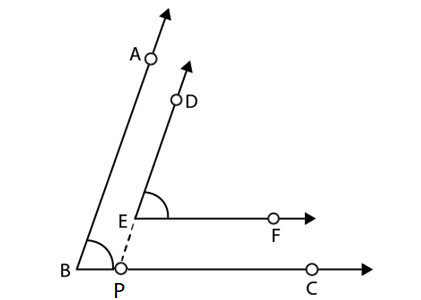
In Fig. 6.12, BA || ED and BC || EF. Show that ∠ABC = ∠DEF [Hint: Produce DE to intersect BC at P (say)].

NCERT Exemplar Solutions For Class 9 Maths Chapter 6 Exercise 6.3-7

Show solutionHide solution
Worked solution

Construction:

Extend DE to intersect BC at point, P.

Given, EF||BC and DP are the transversal,

∠DEF = ∠DPC …(eq.1) [Corresponding angles]

Also given, AB||DP and BC is the transversal,

∠DPC = ∠ABC …(eq.2) [Corresponding angles]

NCERT Exemplar Solutions For Class 9 Maths Chapter 6 Exercise 6.3-8

From (eq.1) and (eq.2), we get

∠ABC = ∠DEF

Hence, Proved.