My Cart
Your Cart 0

    Your cart is empty.

  • Total (Amount) ₹0.00
NCERT Exemplar · Class 9 · Maths

Chapter 6: Lines and Angles

Practice each question, then open the answer or worked solution.

Exercise 6.2

Textbook page 56 · 5 questions
Q1Written answer

For what value of x + y in Fig. 6.4 will ABC be a line? Justify your answer.
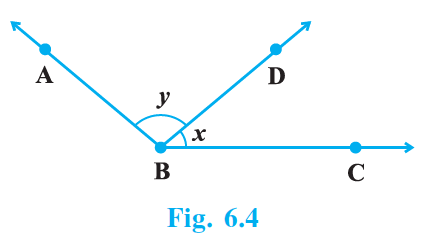
NCERT Exemplar Solutions For Class 9 Maths Chapter 6 Exercise 6.2-1

Show solutionHide solution
Worked solution

The value of x + y should be 180o for ABC to be a line.

Justification:

From the figure, we can say that,

BD is a ray that intersects AB and BC at the point B, which results in

∠ABD = y

and, ∠DBC = x

We know,

If a ray stands on a line, then the sum of two adjacent angles so formed is 180°.

⇒ If the sum of two adjacent angles is 180°, then a ray stands on a line.

Thus, for ABC to be a line,

The sum of ∠ABD and ∠DBC should be equal to 180°.

⇒ ∠ABD + ∠DBC = 180°

⇒ x + y = 180°

Therefore, the value of x + y should be equal to 180° for ABC to be a line.

Q2Written answer

Can a triangle have all angles less than 60°? Give reasons for your answer.

Show solutionHide solution
Worked solution

No. A triangle cannot have all angles less than 60°

Justification:

According to the angle sum property,

We know that the sum of all the interior angles of a triangle should be = 180o.

Suppose, all the angles are 60o,

Then we get, 60o + 60o + 60o = 180o.

Now, considering angles less than 60o,

Let us take 59o, which is the highest natural number less than 60o.

Then we have,

59o +59o + 59o = 177o ≠ 180o

Hence, we can say that if all the angles are less than 60o, the measure of the angles won’t satisfy the angle sum property.

Therefore, a triangle cannot have all angles less than 60o.

Q3Written answer

Can a triangle have two obtuse angles? Give reasons for your answer.

Show solutionHide solution
Worked solution

No. A triangle cannot have two obtuse angles

Justification:

According to the angle sum property,

We know that the sum of all the interior angles of a triangle should be = 180o.

An obtuse angle is one whose value is greater than 90° but less than 180°.

Considering two angles to be equal to the lowest natural number greater than 90o, i.e., 91o.

According to the question,

If the triangle has two obtuse angles, then there are two angles which are at least 91° each.

On adding these two angles,

Sum of the two angles = 91° + 91°

⇒ Sum of the two angles = 182°

The sum of these two angles already exceeds the sum of three angles of the triangle, even without considering the third angle.

Therefore, a triangle cannot have two obtuse angles.

Q4Written answer

How many triangles can be drawn having its angles as 45°, 64° and 72°? Give reasons for your answer.

Show solutionHide solution
Worked solution

No triangle can be drawn having its angles 45°, 64° and 72°.

Justification:

According to the angle sum property,

We know that the sum of all the interior angles of a triangle should be = 180o.

But, according to the question,

We have the angles 45°, 64° and 72°.

Sum of these angles = 45° + 64° + 72°

= 181o, which is greater than 180o.

Hence, the angles do not satisfy the angle sum property of a triangle.

Therefore, no triangle can be drawn having its angles 45°, 64° and 72°.

Q5Written answer

How many triangles can be drawn having its angles as 53°, 64° and 63°? Give reasons for your answer.

Show solutionHide solution
Worked solution

Infinitely many triangles can be drawn having its angles as 53°, 64° and 63°.

Justification:

According to the angle sum property,

We know that the sum of all the interior angles of a triangle should be = 180o.

According to the question,

We have the angles 53°, 64°, and 63°.

Sum of these angles = 53° + 64° + 63°

= 180o

Hence, the angles satisfy the angle sum property of a triangle.

Therefore, infinitely many triangles can be drawn having its angles as 53°, 64° and 63°.