My Cart
Your Cart 0

    Your cart is empty.

  • Total (Amount) ₹0.00
NCERT Exemplar · Class 9 · Maths

Chapter 12: Heron’s Formula

Practice each question, then open the answer or worked solution.

Exercise 12.4

Textbook page 118 · 4 questions
Q1Written answer

How much paper of each shade is needed to make a kite given in Fig. 12.4, in which ABCD is a square with diagonal 44 cm.
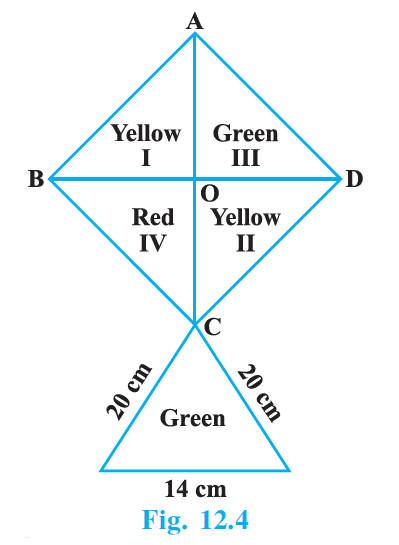
NCERT Exemplar Solutions For Class 9 Maths Chapter 12 Ex. 12.4-1

Show solutionHide solution
Worked solution

According to the figure,

AC = BD = 44cm

AO = 44/2 = 22cm

BO = 44/2 = 22cm

From ΔAOB,

AB2 = AO2 + BO2

⇒ AB2 = 222 + 222

⇒ AB2 = 2 × 222

⇒ AB = 22√ 2 cm

Area of square = (Side)2

= (22√2)2

= 968 cm2

Area of each triangle (I, II, III, IV) = Area of square /4

= 968 /4

= 242 cm2

To find area of lower triangle,

Let a = 28, b = 28, c = 14

s = (a + b + c)/2

⇒ s = (28 + 28 + 14)/2 = 70/2 = 35.

Area of the triangle = √s(s-a)(s-b)(s-c)

= √35(35-28)(35-28)(35-14)

= √35×7×7×21

= 49√15 = 189.77cm2

Therefore,

We get,

Area of Red = Area of IV

= 242 cm2

Area of Yellow = Area of I + Area of II

= 242 + 242

= 484 cm2

Area of Green = Area of III + Area of lower triangle

= 242 + 189.77

= 431.77 cm2
Q2Written answer

The perimeter of a triangle is 50 cm. One side of a triangle is 4 cm longer than the smaller side and the third side is 6 cm less than twice the smaller side. Find the area of the triangle.

Show solutionHide solution
Worked solution

Let the smaller side be = x cm

Then, larger side = (x + 4) cm

And, third side = (2x-6) cm

Given that,

Perimeter = 50 cm

⇒ x + (x + 4) + (2x-6) = 50

⇒ 4x-2 = 50

⇒ 4x = 52

⇒ x = 13

Therefore, smaller side = 13cm

Larger side = x + 4 = 13 + 4 = 17cm

Third side = 2x-6 = 2×13 – 6 = 26-6 = 20cm

To find area of triangle,

Let a = 13, b = 17, c = 20

s = (a + b + c)/2

⇒ s = (13 + 17 + 20)/2 = 50/2 = 25.

Area of triangle = √s(s-a)(s-b)(s-c)

= √25(25-13)(25-17)(25-20)

= √25×12×8×5

= 20√30 cm2

Q3Written answer

The area of a trapezium is 475 cm2 and the height is 19 cm. Find the lengths of its two parallel sides if one side is 4 cm greater than the other.

Show solutionHide solution
Worked solution

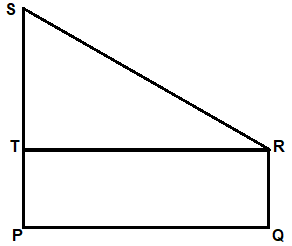
NCERT Exemplar Solutions For Class 9 Maths Chapter 12 Ex. 12.4-2

Let the given trapezium be PQRS, given in the figure.

According to the question,

PQ = 19cm

Let RQ = x cm

Then,

PS = (x + 4)cm

Construction:

Draw a perpendicular from R on PS which will also be parallel to PQ.

Now,

We get,

PQRT is a rectangle,

Area of rectangle PQRT = PQ × QR

⇒ Area(PQRT) = 19×x = 19x

Now,

PS = PT + TS

Since PT = QR = x cm

(x + 4) = x + TS

⇒ TS = 4cm

Area of triangle RST = ½ × RT × ST

Since RT = PQ = 19cm

⇒ Area(ΔRST) = ½ × 19 × 4

= 38cm2

Area(PQRS) = Area(PQRT) + Area(ΔRST)

⇒ 475 = 19x + 38

⇒ 19x = 475 -38

⇒ 19x = 437

⇒ x = 23 cm

(x + 4) = 23 + 4 = 27cm

Therefore, lengths of parallel sides is 23cm and 27cm.

Q4Written answer

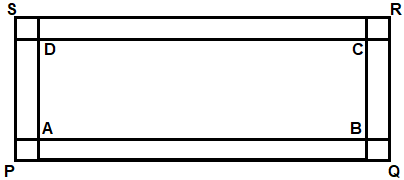
A rectangular plot is given for constructing a house, having a measurement of 40 m long and 15 m in the front. According to the laws, a minimum of 3 m, wide space should be left in the front and back each and 2 m wide space on each of other sides. Find the largest area where house can be constructed.

Show solutionHide solution
Worked solution

NCERT Exemplar Solutions For Class 9 Maths Chapter 12 Ex. 12.4-3

Let the given rectangle be rectangle PQRS,

According to the question,

PQ = 40m and QR = 15m

As 3m is left in both front and back,

AB = PQ -3 -3

⇒ AB = 40 -6

⇒ AB = 34m

Also,

Given that 2m has to be left at both the sides,

BC = QR -2 – 2

⇒ BC = 15 -4

⇒ BC = 11m

Now, Area left for house construction is area of ABCD.

Hence,

Area(ABCD) = AB × CD

= 34 × 11

= 374 m2