My Cart
Your Cart 0

    Your cart is empty.

  • Total (Amount) ₹0.00
NCERT Exemplar · Class 9 · Maths

Chapter 12: Heron’s Formula

Practice each question, then open the answer or worked solution.

Exercise 12.3

Textbook page 117 · 5 questions
Q1Written answer

Find the cost of laying grass in a triangular field of sides 50 m, 65 m and 65 m at the rate of Rs 7 per m2.

Show solutionHide solution
Worked solution

According to the question,

Sides of the triangular field are 50 m, 65 m and 65 m.

Cost of laying grass in a triangular field = Rs 7 per m2

Let a = 50, b = 65, c = 65

s = (a + b + c)/2

⇒ s = (50 + 65 + 65)/2

= 180/2

= 90.

Area of triangle = √s(s-a)(s-b)(s-c)

= √90(90-50)(90-65)(90-65)

= √90×40×25×25

= 1500m2

Cost of laying grass = Area of triangle ×Cost per m2

= 1500×7

= Rs.10500
Q2Written answer

The triangular side walls of a flyover have been used for advertisements. The sides of the walls are 13 m, 14 m and 15 m. The advertisements yield an earning of Rs 2000 per m2 a year. A company hired one of its walls for 6 months. How much rent did it pay?

Show solutionHide solution
Worked solution

According to the question,

The sides of the triangle are 13 m, 14 m and 15 m

Let a = 13, b = 14, c = 15

s = (a + b + c)/2

⇒ s = (13 + 14 + 15)/2

= 42/2

= 21.

Area of triangle = √s(s-a)(s-b)(s-c)

= √21(21-13)(21-14)(21-15)

= √21×8×7×6

= 84m2

Cost of advertisements for a year = Area of triangle × Cost per m2

= 84×2000

= Rs. 168000

Since the board is rented for only 6 months:

Cost of advertisements for 6 months = (6/12) × 168000

= Rs. 84000

Q3Written answer

From a point in the interior of an equilateral triangle, perpendiculars are drawn on the three sides. The lengths of the perpendiculars are 14 cm, 10 cm and 6 cm. Find the area of the triangle.

Show solutionHide solution
Worked solution

According to the question,

The lengths of the perpendiculars are 14 cm, 10 cm and 6 cm.

We know that,

Area of an equilateral triangle of side a = √3/4 a2

We divide the triangle into three triangles,

Area of triangle = (1/2 × a × 14) + (1/2 × a × 10) + (1/2 × a × 6)

√3/4 a2 = ½ × a × (14 + 10 + 6)

√3/4 a2 = ½ × a × 30

a = 60/√3

= 20√3

Area of the triangle = √3/4 a2

=√3/4 (20√3)2

= 300√3 cm2

Q4Written answer

The perimeter of an isosceles triangle is 32 cm. The ratio of the equal side to its base is 3 : 2. Find the area of the triangle.

Show solutionHide solution
Worked solution

According to the question,

Perimeter of the isosceles triangle = 32 cm

It is also given that,

Ratio of equal side to base = 3 : 2

Let the equal side = 3x

So, base = 2x

Perimeter of the triangle = 32

⇒ 3x + 3x + 2x = 32

⇒ 8x = 32

⇒ x = 4.

Equal side = 3x = 3×4 = 12

Base = 2x = 2×4 = 8

The sides of the triangle = 12cm, 12cm and 8cm.

Let a = 12, b = 12, c = 8

s = (a + b + c)/2

⇒ s = (12 + 12 + 8)/2

= 32/2

= 16.

Area of the triangle = √s(s-a)(s-b)(s-c)

= √16(16-12)(16-12)(16-8)

= √16×4×4×8

= 32√2 cm2

Q5Written answer

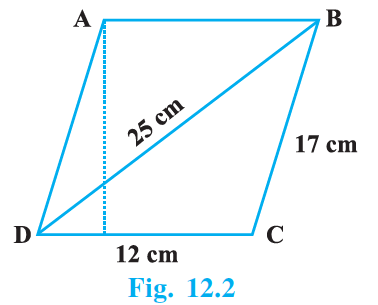
Find the area of a parallelogram given in Fig. 12.2. Also find the length of the altitude from vertex A on the side DC.

NCERT Exemplar Solutions For Class 9 Maths Chapter 12 Ex. 12.3-1

Show solutionHide solution
Worked solution

We know that,

Area of parallelogram(ABCD) = Area(ΔBCD) + Area(ΔABD)

For Area (ΔBCD),

We have,

a = 12, b = 17, c = 25

s = (a + b + c)/2

⇒ s = (12 + 17 + 25)/2 = 54/2 = 27.

Area of (ΔBCD) = √s(s-a)(s-b)(s-c)

= √27(27-12)(27-17)(27-25)

= √27×15×10×2

= 90 cm2

Since, ABCD is a parallelogram,

Area(ΔBCD) = Area(ΔABD)

Area of parallelogram(ABCD) = Area(ΔBCD) + Area(ΔABD)

= 90 + 90

= 180 cm2

Let altitude from A be = x

Also, Area of parallelogram(ABCD) = CD × (Altitude from A)

⇒ 180 = 12 × x

⇒ x = 15 cm