My Cart
Your Cart 0

    Your cart is empty.

  • Total (Amount) ₹0.00
NCERT Exemplar · Class 9 · Maths

Chapter 10: Circles

Practice each question, then open the answer or worked solution.

Exercise 10.4

Textbook page 64 · 5 questions
Q1Written answer

If two equal chords of a circle intersect, prove that the parts of one chord are separately equal to the parts of the other chord.

Show solutionHide solution
Worked solution

According to the question,

AB and CD are two equal chords of a circle with centre O, intersecting each other at M.

To prove:

(i) MB = MC and

(ii) AM = MD
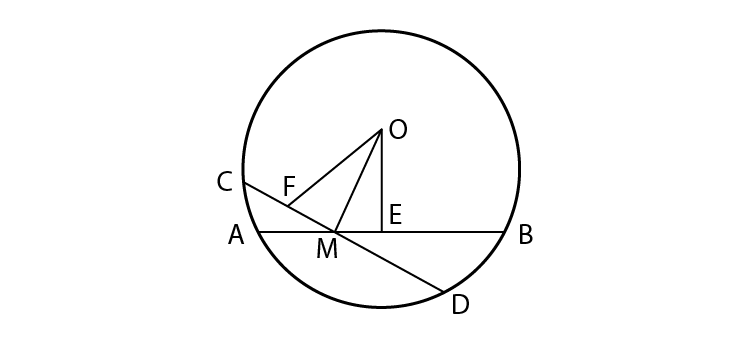
NCERT Exemplar Solutions Class 9 Maths Chapter 10 Exercise 10.4-1

Proof:

AB is a chord and OE ⊥ to AB from the centre O,

Since, perpendicular from the centre to a chord bisect the chord

We get,

AE = ½ AB

Similarly,

FD = ½ CD

It is given that,

AB = CD⇒ ½ AB = ½ CD

So, AE = FD … (1)

Since equal chords are equidistance from the centre,

And AB = CD

So, OE = OF

Now, as proved, in right triangles MOE and MOF,

hyp. OE = hyp. OF [Common side]

OM = OM

ΔMOE ≅ ΔMOF

ME = MF … (2)

Subtracting equations (2) from (1), we get

AE – ME = FD – MF

⇒ AM = MD [Proved part (ii)]

Again, AB = CD [Given]

And AM = MD [Proved]

AB – AM = CD – MD [Equals subtracted from equal]

Hence, MB = MC [Proved part (i)]
Q2Written answer

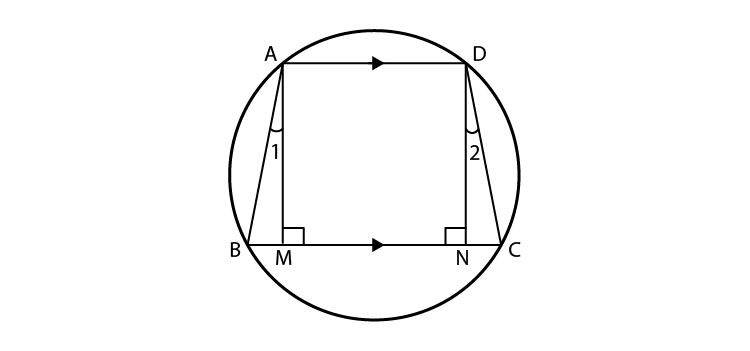
If non-parallel sides of a trapezium are equal, prove that it is cyclic.

Show solutionHide solution
Worked solution

NCERT Exemplar Solutions Class 9 Maths Chapter 10 Exercise 10.4-2

According to the question,

We have,

ABCD is a trapezium in which AD||BC

Non-parallel sides AB and DC of the trapezium ABCD are equal i.e.,

AB = DC.

To prove: Trapezium ABCD is cyclic.

Construction: Draw AM and DN such that they are perpendicular on BC.

Proof: In right triangles AMB and DNC,

∠AMB = ∠DNC = 90o

AB = DC [Given]

Since perpendicular distance between two parallel lines are same,

AM = DN

ΔAMB ≅ ΔDNC [By RHS congruence rule]

∠B = ∠C [CPCT]

And ∠1 = ∠2

∠BAD = ∠1+ 90

= ∠2 + 90

= ∠CDA

Now, in quadrilateral ABCD

∠B +∠C +∠CDA+∠BAD = 360

∠B +∠B +∠CDA+∠CDA = 360

2(∠B +∠CDA) = 360

∠B +∠CDA =180

We know that,

If any pair of opposite angles of a quadrilateral is 180o, then the quadrilateral is cyclic.

Hence, the trapezium ABCD is cyclic.

Q3Written answer

If P, Q and R are the mid-points of the sides BC, CA and AB of a triangle and AD is the perpendicular from A on BC, prove that P, Q, R and D are concyclic.

Show solutionHide solution
Worked solution

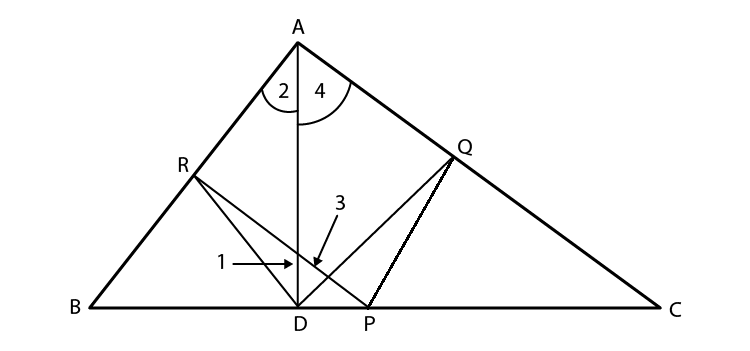
To prove: R, D, P and Q are concyclic.

NCERT Exemplar Solutions Class 9 Maths Chapter 10 Exercise 10.4-3

Construction: Join RD, QD, PR and PQ.

RP joins the mid-point of AB, i.e., R, and the mid-point of BC, i.e., P.

Using midpoint theorem,

RP||AC

Similarly,

PQ||AB.

So, we get,

ARPQ is a parallelogram.

So, ∠RAQ = ∠RPQ [Opposite angles of a ||gm]…(1)

ABD is a right angled triangle and DR is a median,

RA = DR and ∠1 = ∠2 …(2)

Similarly ∠3 = ∠4 …(3)

Adding equations (2) and (3),

We get,

∠1+ ∠3 = ∠2 +∠4

⇒ ∠RDQ = ∠RAQ

∠RPQ [Proved above]

Since ∠D and ∠P are subtended by RQ on the same side of it, we get the points R, D, P and Q concyclic.

Hence, R, D, P and Q are concyclic.

Q4Written answer

ABCD is a parallelogram. A circle through A, B is so drawn that it intersects AD at P and BC at Q. Prove that P, Q, C and D are concyclic.

Show solutionHide solution
Worked solution

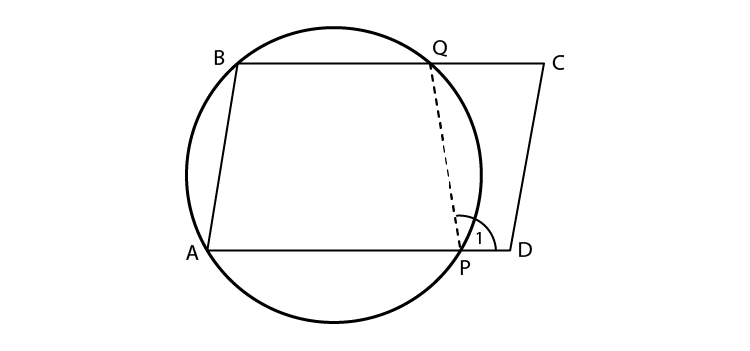
According to the question,

ABCD is a parallelogram.

A circle through A, B is so drawn that it intersects AD at P and BC at Q.

To prove: P, Q, C and D are concyclic.

Construction: Join PQ.

NCERT Exemplar Solutions Class 9 Maths Chapter 10 Exercise 10.4-4

Extend side AP of the cyclic quadrilateral APQB to D.

External angle, ∠1= interior opposite angle, ∠B

Since, BA||CD and BC cuts them

∠B +∠C =180o

Since, Sum of interior angles on the same side of the transversal = 180o

Or ∠1+∠C =180o

So, PDCQ is cyclic quadrilateral.

Hence, the points P, Q, C and D are concyclic.

Q5Written answer

Prove that angle bisector of any angle of a triangle and perpendicular bisector of the opposite side, if intersect, they will intersect on the circumcircle of the triangle.

Show solutionHide solution
Worked solution

According to the question,

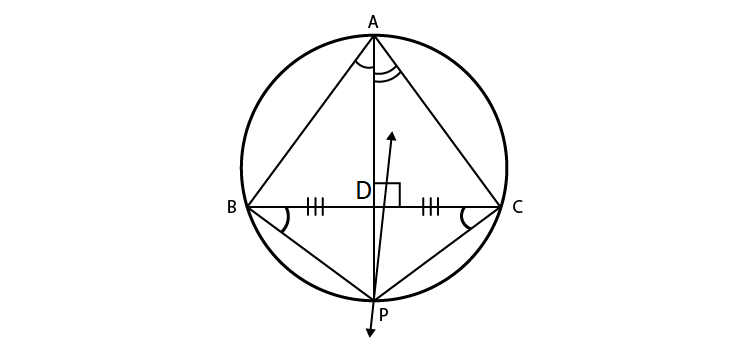
Triangle ABC and l is perpendicular bisector of BC.

NCERT Exemplar Solutions Class 9 Maths Chapter 10 Exercise 10.4-5

To prove:

Angles bisector of ∠A and perpendicular bisector of BC intersect on the circumcircle of ΔABC.

Proof:

Let the angle bisector of ∠A intersect the circumcircle of ΔABC at D.

Construction: Join BP and CP.

Since, angles in the same segment are equal

We have, ∠BAP = ∠BCP

We know that,

AP is bisector of ∠A.

Then,

∠BAP = ∠BCP = ½ ∠A …(1)

Similarly,

We have,

∠PAC = ∠PBC = ½ ∠A …(2)

From equations (1) and (2),

We have

∠BCP = ∠PBC

We know that,

If the angles subtended by two Chords of a circle at the centre are equal, the chords are equal.

So,

BP = CP

Here, P is on the perpendicular bisector of BC.

Hence, the angle bisector of ∠A and the perpendicular bisector of BC intersect on the circumcircle of ΔABC.