My Cart
Your Cart 0

    Your cart is empty.

  • Total (Amount) ₹0.00
NCERT Exemplar · Class 9 · Maths

Chapter 10: Circles

Practice each question, then open the answer or worked solution.

Exercise 10.3

Textbook page 64 · 10 questions
Q1Written answer

If arcs AXB and CYD of a circle are congruent, find the ratio of AB and CD.

Show solutionHide solution
Worked solution

According to the question,

We have,

AXB ≅ CYD.

We know that,

If two arcs of a circle are congruent, then their corresponding arcs are also equal.

So, we have chord AB = chord CD.

Hence, we get,

AB/CD = 1

AB/CD = 1/1

AB : CD = 1:1

Q2Written answer

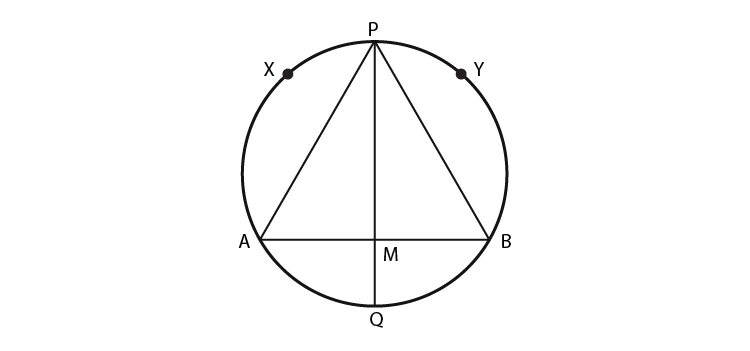
If the perpendicular bisector of a chord AB of a circle PXAQBY intersects the circle at P and Q, prove that arc PXA ∠ Arc PYB.

Show solutionHide solution
Worked solution

NCERT Exemplar Solutions Class 9 Maths Chapter 10 Exercise 10.3-1

According to the question,

We have,

PQ is the perpendicular bisect of AB,

So, we get,

AM = BM …eq.(1)

In △APM and △BPM,

From eq.(1),

AM = BM

∠AMP = ∠BMP = 90o

PM = PM [Common side]

Therefore, △APM ≅ △BPM [By SAS congruence rule]

So, AP = BP [CPCT]

Hence, arc PXA ≅ Arc PYB

Therefore, if two chords of a circle are equal, then their corresponding arcs are congruent.

Q3Written answer

A, B and C are three points on a circle. Prove that the perpendicular bisectors of AB, BC and CA are concurrent.

Show solutionHide solution
Worked solution

According to the question,

Three non-collinear points A, B and C are on a circle.
NCERT Exemplar Solutions Class 9 Maths Chapter 10 Exercise 10.3-2

To prove: Perpendicular bisectors of AB, BC and CA are concurrent.

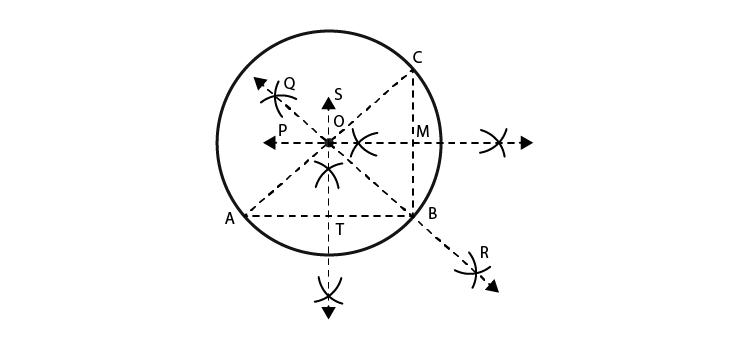
Construction: Join AB, BC and CA.

Draw:

ST, perpendicular bisector of AB,

PM, perpendicular bisector of BC

And, QR perpendicular bisector of CA

As point A, B and C are not collinear, ST, PM and QR are not parallel and will intersect.

Proof:

O lies on ST, the ⊥ bisector of AB

OA = OB … (1)

Similarly, O lies on PM, the ⊥ bisector of BC

OB = OC … (2)

And, O lies on QR, the ⊥ bisector of CA

OC = OA … (3)

From (1), (2) and (3),

OA = OB = OC

Let OA = OB = OC = r

Draw circle, with centre O and radius r, passing through A, B and C.

Hence, O is the only point equidistance from A, B and C.

Therefore, the perpendicular bisectors of AB, BC and CA are concurrent.
Q4Written answer

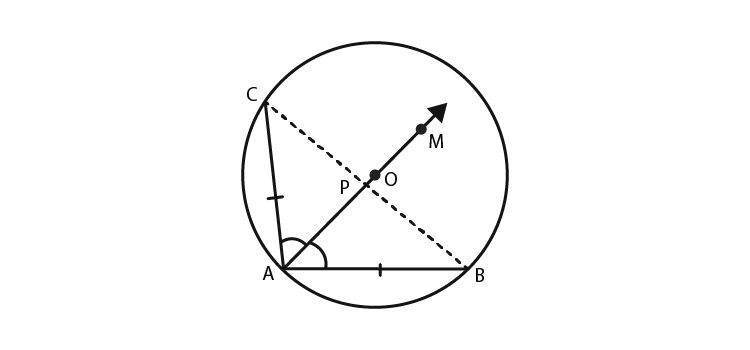
AB and AC are two equal chords of a circle. Prove that the bisector of the angle BAC passes through the centre of the circle.

Show solutionHide solution
Worked solution

NCERT Exemplar Solutions Class 9 Maths Chapter 10 Exercise 10.3-3According to the question,

We have,

AB and AC are two chords which are equal with centre O.

AM is the bisector of ∠BAC.

To prove: AM passes through O.

Construction: Join BC.

Let AM intersect BC at P.

Proof: In DBAP and DCAP

AB = AC [Given]

∠BAP = ∠CAP [Given]

And AP = BP [Common side]

△BAP ≅ △CAP [By SAS]

∠BPA = ∠CPA [CPCT]

We know that,

CP = PB

But, since ∠BPA and ∠CPA are linear pair angles,

We have,

∠BPA+∠CPA =180o

∠BPA = ∠CPA = 90o

Then,

AP is the perpendicular bisector of the chord BC, which will pass through the centre O on being produced.

Therefore, AM passes through O.

Q5Written answer

If a line segment joining mid-points of two chords of a circle passes through the centre of the circle, prove that the two chords are parallel.

Show solutionHide solution
Worked solution

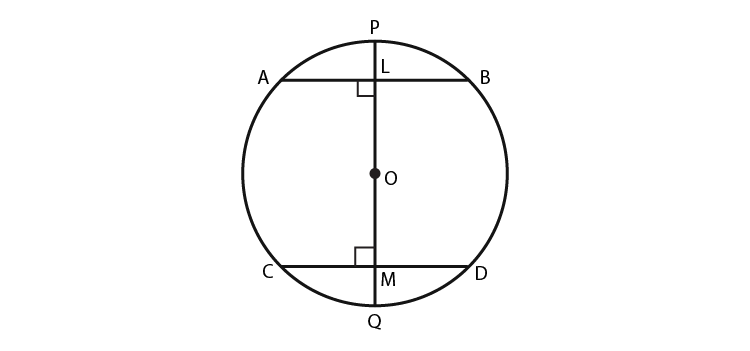
Consider AB and CD to be the chords of the circle with centre O.

NCERT Exemplar Solutions Class 9 Maths Chapter 10 Exercise 10.3-4

Let L be the midpoint of AB.

Let M be the midpoint of CD.

Let PQ be the line passing through these midpoints and the centre of the circle.

Then, PQ is the diameter of the circle.

We know that,

Line joining centre to the midpoint of a chord is always perpendicular to the chord.

Since M is the midpoint of CD,

We have, OM ⊥ CD

⇒ OMD = 90°

Similarly, L is the midpoint of AB,

OL ⊥ AB

⇒ OLA = 90°

But, we know,

∠OLA and ∠OMD are alternate angles.

So, AB ∥ CD.

Hence, proved.

Q6Written answer

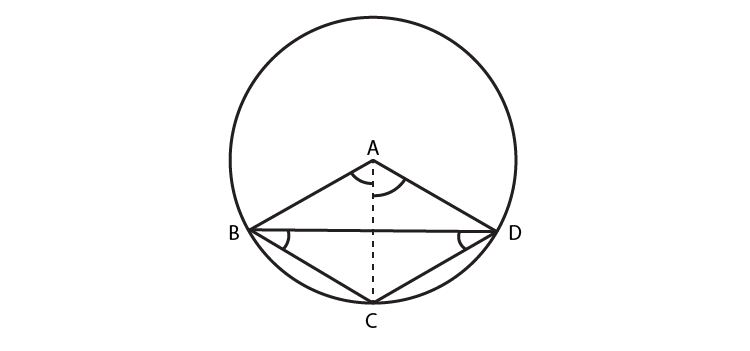
ABCD is such a quadrilateral that A is the centre of the circle passing through B, C and D. Prove that ∠CBD + ∠CDB = ½ ∠BAD

Show solutionHide solution
Worked solution

According to the question,

We have,

A quadrilateral ABCD such that A is the centre of the circle passing through B, C and D.

Construction:

Join CA and BD.

NCERT Exemplar Solutions Class 9 Maths Chapter 10 Exercise 10.3-5

We know that,

In a circle, angle subtended by an arc at the centre is twice the angle subtended by it at any other point in the remaining part of the circle

So,

The arc DC subtends ∠DAC at the centre and ∠CAB at point B in the remaining part of the circle,

We get,

∠DAC = 2∠CBD …(1)

Similarly,

The arc BC subtends ∠CAB at the centre and ∠CDB at point D in the remaining part of the circle,

We get,

∠CAB = 2∠CDB …(2)

From equations (1) and (2),

We have:

DAC + ∠CAB = 2∠CDB + 2∠CBD

⇒ ∠BAD = 2(∠CDB + ∠CBD)

⇒ (∠CDB + ∠CBD) = ½ (∠BAD)

Q7Written answer

O is the circumcentre of the triangle ABC, and D is the mid-point of the base BC. Prove that ∠BOD = ∠A.

Show solutionHide solution
Worked solution

According to the question,

We have,

O is the circumcenter of the triangle ABC and D is the midpoint of BC.

NCERT Exemplar Solutions Class 9 Maths Chapter 10 Exercise 10.3-6

To prove: ∠BOD = ∠A

Construction: Join OB and OC.

In ΔOBD and ΔCD:

OD = OD (common)

DB = DC (D is the midpoint of BC)

OB = OC (radius of the circle)

By SSS congruence rule,

We get,

ΔOBD ≅ ΔOCD.

∠BOD = ∠COD (By CPCT)

Let ∠BOD = ∠COD = x

We know that,

Angle subtended by an arc at the centre of the circle is twice the angle subtended by it at any other point in the remaining part of the circle.

So, we have,

2∠BAC = ∠BOC

⇒ 2∠BAC = ∠BOD + ∠DOC

⇒ 2∠BAC = x + x

⇒ 2∠BAC = 2x

⇒ ∠BAC = x

⇒ ∠BAC = ∠BOD

Hence, proved.

Q8Written answer

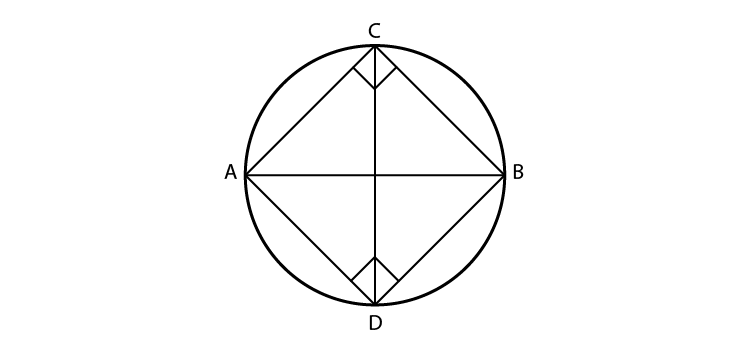
On a common hypotenuse AB, two right triangles ACB and ADB are situated on opposite sides. Prove that ∠BAC = ∠BDC.

Show solutionHide solution
Worked solution

According to the question,

We have,

ACB and ADB are two right triangles.
NCERT Exemplar Solutions Class 9 Maths Chapter 10 Exercise 10.3-7

To Prove: ∠BAC = ∠BDC

We know that,

ACB and ADB are right angled triangles,

Then,

∠C + ∠D = 90° + 90°

∠C + ∠D = 180°

Therefore ADBC is a cyclic quadrilateral as sum of opposite angles of a cyclic quadrilateral = 180°

We also have,

∠BAC and ∠BDC lie in the same segment BC and angles in the same segment of a circle are equal.

∴ ∠BAC = ∠BDC.

Hence Proved.

Q9Written answer

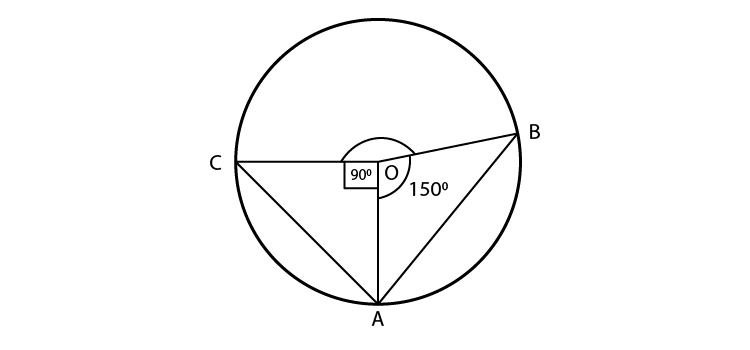
Two chords AB and AC of a circle subtend angles equal to 90º and 150º, respectively at the centre. Find ∠BAC, if AB and AC lie on the opposite sides of the centre.

Show solutionHide solution
Worked solution

According to the question,

We have,

In ΔAOB,

OA = OB (radius of the circle)

NCERT Exemplar Solutions Class 9 Maths Chapter 10 Exercise 10.3-8

Since angle opposite to equal sides are equal, we get,

∠OBA = ∠OAB

We know that,

According to angle sum property, sum of all angles of a triangle = 180o

Using the angle sum property in ΔAOB, we get,

∠OAB + ∠AOB +∠OBA = 180°

⇒ ∠OAB +90° + ∠OAB = 180°

⇒ 2∠OAB = 180° – 90°

⇒ 2∠OAB = 90°

⇒ ∠OAB = 45°

Now, in ΔAOC,

OA = OC (radius of the circle)

Since, angle opposite to equal sides are equal

∴ ∠OCA = ∠OAC

Using the angle sum property in ΔAOB, sum of all angles of the triangle is 180°, we have:

∠OAC + ∠AOC +∠OCA = 180°

⇒ ∠OAC +150° + ∠OAC = 180°

⇒ 2∠OAC = 180° – 150°

⇒ 2∠OAC = 30°

⇒ ∠OAC = 15°

Now, ∠BAC = ∠OAB + ∠OAC

= 45° + 15°

= 60°

∴ ∠BAC = 60°

Q10Written answer

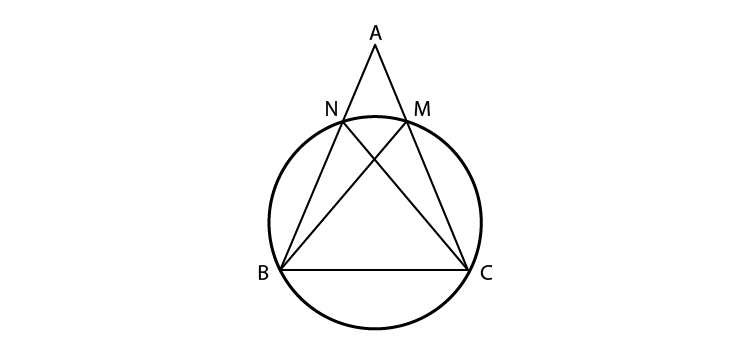
If BM and CN are the perpendiculars drawn on the sides AC and AB of the triangle ABC, prove that the points B, C, M and N are concyclic.

Show solutionHide solution
Worked solution

NCERT Exemplar Solutions Class 9 Maths Chapter 10 Exercise 10.3-9

According to the question,

BM and CN are the perpendiculars drawn on the sides AC and AB of the triangle ABC.

So, we have,

∠BMC = ∠BNC = 90o

We know that,

If a line segment joining two points subtends equal angles on the same side of the line containing the segment, then the four points are concyclic.

Considering the question,

Since BC joins the two points, B and C, subtending equal angles, ∠BMC and ∠BNC, at M and N on the same side BC containing the segment, then B, C, M and N are concyclic.

Hence, we get that,

B, C, M and N are concyclic.