My Cart
Your Cart 0

    Your cart is empty.

  • Total (Amount) ₹0.00
NCERT Exemplar · Class 9 · Maths

Chapter 10: Circles

Practice each question, then open the answer or worked solution.

Exercise 10.1

Textbook page 64 · 5 questions
Q1Written answer

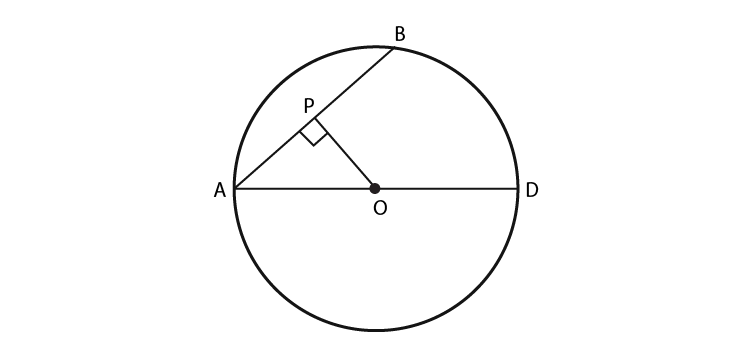
AD is a diameter of a circle and AB is a chord. If AD = 34 cm, AB = 30 cm, the distance of AB from the centre of the circle is :

(A) 17 cm

(B) 15 cm

(C) 4 cm

(D) 8 cm

Show solutionHide solution
Worked solution

NCERT Exemplar Solutions Class 9 Maths Chapter 10 Exercise 10.1-1

(D) 8 cm

Explanation:

Given: Diameter of the circle = d = AD = 34 cm

∴ Radius of the circle = r = d/2 = AO = 17 cm

Length of chord AB = 30 cm

Since the line drawn through the centre of a circle to bisect a chord is perpendicular to the chord, therefore AOP is a right angled triangle with L as the bisector of AB.

∴ AP = 1/2(AB) = 15 cm

In right angled triangle AOB, by Pythagoras theorem, we have:

(AO)2 = (OP)2 + (AP)2

⇒ (17)2 = (OP)2 + (15)2

⇒ (OP)2 = (17)2 – (15)2

⇒ (OP)2 = 289 – 225

⇒ (OP)2 = 64

Take square root on both sides:

⇒ (OP) = 8

∴ The distance of AB from the centre of the circle is 8 cm.

Hence, option D is the correct answer.
Q2Written answer

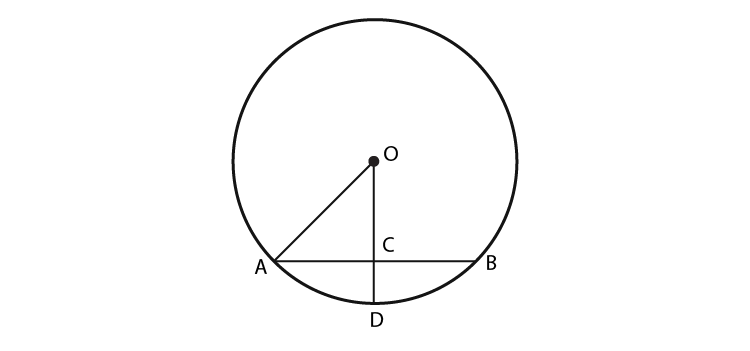
In Fig. 10.3, if OA = 5 cm, AB = 8 cm and OD is perpendicular to AB, then CD is equal to:

(A) 2 cm

(B) 3 cm

(C) 4 cm

(D) 5 cm

Show solutionHide solution
Worked solution

(A) 2 cm

Explanation:

NCERT Exemplar Solutions Class 9 Maths Chapter 10 Exercise 10.1-2

Given:

Radius of the circle = r = AO = 5 cm

Length of chord AB = 8 cm

Since the line drawn through the centre of a circle to bisect a chord is perpendicular to the chord, therefore AOC is a right angled triangle with C as the bisector of AB.

∴ AC = ½ (AB) = 8/2 = 4 cm

In right angled triangle AOC, by Pythagoras theorem, we have:

(AO)2 = (OC)2 + (AC)2

⇒ (5)2 = (OC)2 + (4)2

⇒ (OC)2 = (5)2 – (4)2

⇒ (OC)2 = 25 – 16

⇒ (OC)2 = 9

Take square root on both sides:

⇒ (OC) = 3

∴ The distance of AC from the centre of the circle is 3 cm.

Now, OD is the radius of the circle, ∴ OD = 5 cm

CD = OD – OC

CD = 5 – 3

CD = 2

Therefore, CD = 2 cm

Hence, option A is the correct answer.

Q3Written answer

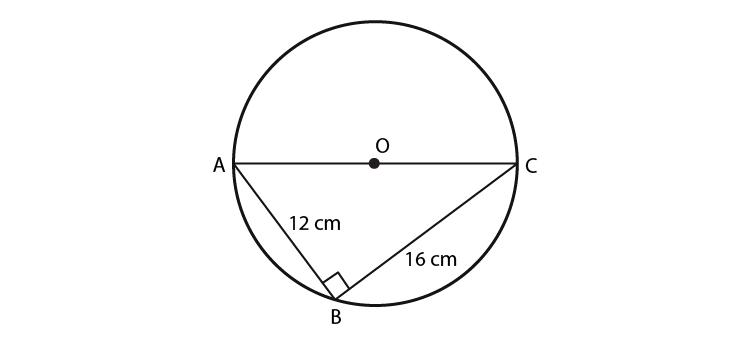
If AB = 12 cm, BC = 16 cm and AB is perpendicular to BC, then the radius of the circle passing through the points A, B and C is :

(A) 6 cm

(B) 8 cm

(C) 10 cm

(D) 12 cm

Show solutionHide solution
Worked solution

(C) 10 cm

Explanation:

NCERT Exemplar Solutions Class 9 Maths Chapter 10 Exercise 10.1-3

According to the question,

AB = 12 cm, BC = 16 cm, AB ⊥ BC.

Therefore,

AC is the diameter of the circle passing through the points A, B and C.

Now, according to the figure,

We get,

ABC is a right angled triangle.

By Pythagoras theorem:

(AC)2 = (CB)2 + (AB)2

⇒ (AC)2 = (16)2 + (12)2

⇒ (AC)2 = 256 + 144

⇒ (AC)2 = 400

Take square root on LHS and RHS,

We get,

(AC) = 20

Diameter of the circle = 20 cm

Thus, the radius of the circle = Diameter/2

= 20/2

= 10 cm

Hence, the radius of the circle = 10 cm

Hence, option C is the correct answer.

Q4Written answer

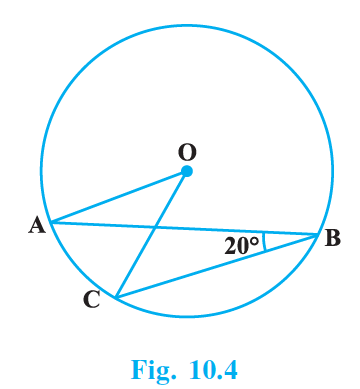
In Fig.10.4, if ∠ABC = 20º, then ∠AOC is equal to:

(A) 20º

(B) 40º

(C) 60º

(D) 10º

NCERT Exemplar Solutions Class 9 Maths Chapter 10 Exercise 10.1-4

Show solutionHide solution
Worked solution

(B) 40º

Explanation:

According to the question,

∠ABC = 20°

We know that,

“The angle subtended by an arc at the centre of a circle is twice the angle subtended by it at the remaining part of the circle.”

According to the theorem, we have,

∠AOC = 2 × ∠ABC

= 2 × 20°

= 40°

Therefore, ∠AOC = 40°

Hence, option B is the correct answer.

Q5Written answer

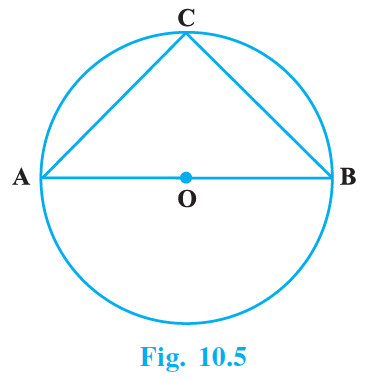
In Fig.10.5, if AOB is a diameter of the circle and AC = BC, then ∠CAB is equal to:

(A) 30º

(B) 60º

(C) 90º

(D) 45º

NCERT Exemplar Solutions Class 9 Maths Chapter 10 Exercise 10.1-5

Show solutionHide solution
Worked solution

(D) 45º

Explanation:

According to the question,

We have,

Diameter of the circle = AOB

AC = BC

Since, angles opposite to equal sides are equal

∠ABC = ∠BAC

Let, ∠ABC = ∠BAC = x

Also, diameter subtends a right angle to the circle,

∠ACB = 90°

We also know that,

By angle sum property of a triangle, sum of all angles of a triangle = 180°.

∠CAB + ∠ABC + ∠ACB = 180°

⇒ x + x + 90° = 180°

⇒ 2x = 90°

⇒ x = 45°

∠CAB = ∠ ABC = 45°

Hence, option D is the correct answer.