My Cart
Your Cart 0

    Your cart is empty.

  • Total (Amount) ₹0.00
NCERT Exemplar · Class 9 · Maths

Chapter 1: Number Systems

Practice each question, then open the answer or worked solution.

Exercise 1.3

Textbook page 9 · 7 questions
Q1Written answer

Find which of the variables x, y, z and u represent rational numbers and which irrational numbers:

(i) x2 = 5

(ii) y2 = 9
(iii) z2 = .04

(iv) 𝑢2 = 17/4

Show solutionHide solution
Worked solution

(i) x2 = 5

On solving, we get

⇒ x = ± √5

Hence, x is an irrational number.

(ii) y2 = 9

On solving, we get

⇒ y = ± 3

Hence, y is a rational number.

(iii) z2 = .04

On solving, we get

⇒ z = ± 0.2

Hence, z is a rational number.

(iv) u2 = 17/4

On solving, we get

⇒ u = ± √17/2

√17 is irrational.

Hence, u is an irrational number

Q2Written answer

Find three rational numbers between

(i) –1 and –2

(ii) 0.1 and 0.11
(iii) 5/7 and 6/7

(iv) 1/4 and 1/5

Show solutionHide solution
Worked solution

(i) –1 and –2

Three rational numbers between –1 and –2 are –1.1, –1.2 and –1.3.

(ii) 0.1 and 0.11

Three rational numbers between 0.1 and 0.11 are 0.101, 0.102 and 0.103.

(iii) 5/7 and 6/7

5/7 can be written as (5 × 10)/(7 × 10) = 50/70

Similarly,

6/7 can be written as (6 × 10)/(7 × 10) = 60/70

Three rational numbers between 5/7 and 6/7 = three rational numbers between 50/70 and 60/70.

Three rational numbers between 5/7 and 6/7 are 51/70, 52/70, 53/70.

(iv) 1/4 and 1/5

Here, according to the question,

LCM of 4 and 5 is 20.

Let us make the denominators common, 80.

(4 × 20) = 80 and (5 × 16) = 80

Hence,

1/4 can be written as (1 × 20)/(4 × 20) = 20/80

Similarly,

1/5 can be written as (1 × 16)/(5 × 16) = 16/80

Three rational numbers between 1/4 and 1/5 = three rational numbers between 16/80 and 20/80.

Therefore, the three rational numbers are 17/80, 18/80 and 19/80.

Q3Written answer

Insert a rational number and an irrational number between the following:

(i) 2 and 3

(ii) 0 and 0.1
(iii) 1/3 and 1/2

(iv) –2/5 and 1/2
(v) 0.15 and 0.16

(vi) √2 and √3
(vii) 2.357 and 3.121
(viii) .0001 and .001
(ix) 3.623623 and 0.484848
(x) 6.375289 and 6.375738.

Show solutionHide solution
Worked solution

(i) 2 and 3

So, the rational number between 2 and 3 = 2.5

And, the irrational number between 2 and 3 = 2.040040004…

(ii) 0 and 0.1

So, the rational number between 0 and 0.1 = 0.05

And, irrational number between 0 and 0.1 = 0.007000700007…

(iii) 1/3 and 1/2

LCM of 3 and 2 is 6.

1/3 = 0.33

1/3 can be written as (1 × 20)/(3 × 20) = 20/60

½ = 0.5

1/2 can be written as (1 × 30)/(2 × 30) = 30/60

So, the rational number between 1/3 and 1/2 = 25/60

And, irrational number between 1/3 and 1/2 = irrational number between 0.33 and 0.5 = 0.414114111…

(iv) – 2/5 and 1/2

LCM of 5 and 2 is 10.

-2/5 = -0.4

-2/5 can be written as (-2 × 2)/(5 × 2) = -4/10

1/2 = 0.5

1/2 can be written as (1 × 5)/(2 × 5) = 5/10

So, rational number between -2/5 and 1/2 = rational number between -4/10 and 5/10 = 1/10

And, irrational number between -2/5 and 1/2 = irrational number between -0.4 and 0.5 = 0.414114111…

(v) 0.15 and 0.16

The rational number between 0.15 and 0.16 = 0.151

The irrational number between 0.15 and 0.16 = 0.151551555…

(vi) √2 and √3

√2 = 1.41 and √3 = 1.732

Rational number between √2 and √3 = rational number between 1.41 and 1.732 = 1.5

The irrational number between √2 and √3 = irrational number between 1.41 and 1.732 = 1.585585558…

(vii) 2.357 and 3.121

The rational number between 2.357 and 3.121 = 3

The irrational number between 2.357 and 3.121 = 3.101101110…

(viii) .0001 and .001

Rational number between .0001 and .001 = 0.00011

The irrational number between .0001 and .001 = 0.0001131331333…

(ix) 3.623623 and 0.484848

The rational number between 3.623623 and 0.484848 = 1

The irrational number between 3.623623 and 0.484848 = 1.909009000…

(x) 6.375289 and 6.375738.

The rational number between 6.375289 and 6.375738 = 6.3753

The irrational number between 6.375289 and 6.375738 = 6.375414114111…

Q4Written answer

Represent the following numbers on the number line:

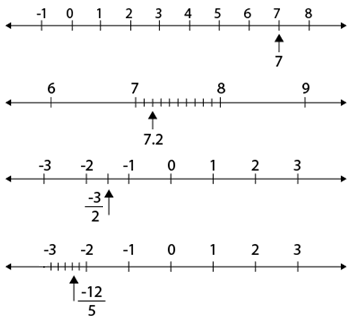
7, 7.2, −3/2, −12/5

Show solutionHide solution
Worked solution

NCERT Exemplar Class 9 Maths Chapter 1- Ex. 1.3-1

Q5Written answer

Locate √5, √10 and √17 on the number line.

Show solutionHide solution
Worked solution

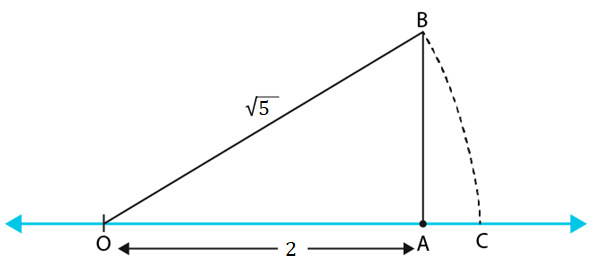
√5 on the number line:

5 can be written as the sum of the square of two natural numbers:

i.e., 5 =1+ 4 =12 + 22

On the number line,

Take OA = 2 units.

Perpendicular to OA, draw BA = 1 unit.

Join OB.

Using the Pythagoras theorem,

We have, OB= √5

Draw an arc with centre O and radius OB using a compass such that it intersects the number line at point C.

Then, we get, C corresponds to √5. Or we can say that OC = √5

NCERT Exemplar Class 9 Maths Chapter 1- Ex. 1.3-2

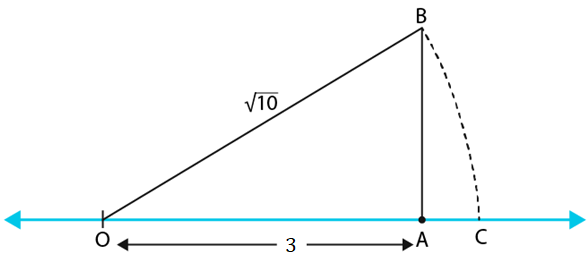
√10 on the number line:

10 can be written as the sum of the square of two natural numbers:

i.e., 10 =1+ 9 =12 + 32

On the number line,

Take OA = 3 units.

Perpendicular to OA, draw BA = 1 unit.

Join OB.

Using the Pythagoras theorem,

We have, OB= √10

Draw an arc with centre O and radius OB using a compass such that it intersects the number line at point C.

Then, point C corresponds to √10. Or we can say that OC = √10

NCERT Exemplar Class 9 Maths Chapter 1- Ex. 1.3-3

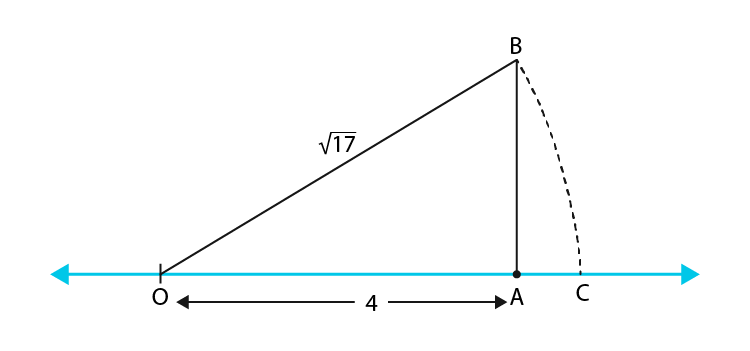
√17 on the number line:

17 can be written as the sum of the square of two natural numbers:

i.e., 17 =1+ 16 =12 + 42

On the number line,

Take OA = 4 units.

Perpendicular to OA, draw BA = 1 unit.

Join OB.

Using the Pythagoras theorem,

We have, OB= √17

Draw an arc with centre O and radius OB using a compass such that it intersects the number line at point C.

Then, point C corresponds to √17. Or, we can say that OC = √17

NCERT Exemplar Class 9 Maths Chapter 1- Ex. 1.3-4

Q6Written answer

Represent geometrically the following numbers on the number line:

(i) √4.5

(ii) √5.6

(iii) √8.1

(iv) √2.3

Show solutionHide solution
Worked solution

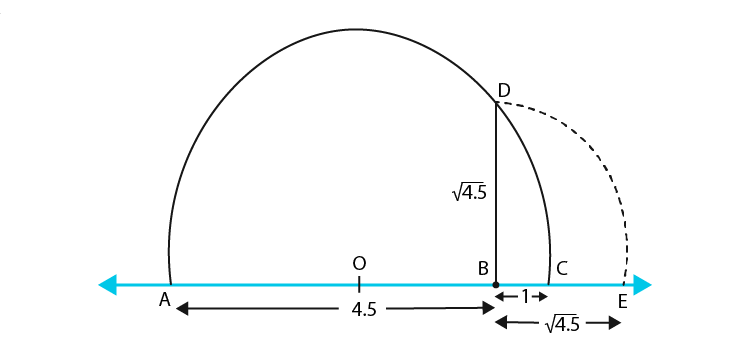
(i) √4.5

Draw a line segment such that AB = 4.5 units.

Mark C at a distance of 1 unit from B.

Mark O is the mid-point of AC.

Draw a semicircle with centre O and radius OC.

Draw a line perpendicular to AC, passing through B and intersecting the semicircle at D.

Now, BD = √4.5.

Draw an arc with centre B and radius BD, meeting AC produced at E.

Then, BE = BD = √4.5 units.

NCERT Exemplar Class 9 Maths Chapter 1- Ex. 1.3-5

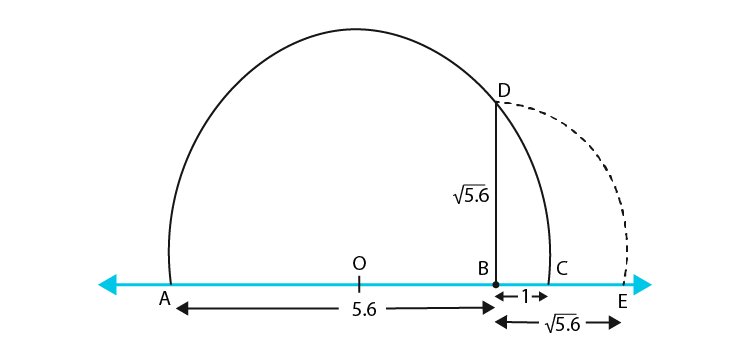
(ii) √5.6

Draw a line segment such that AB = 5.6 units.

Mark C at a distance of 1 unit from B.

Mark O is the mid-point of AC.

Draw a semicircle with centre O and radius OC.

Draw a line perpendicular to AC, passing through B and intersecting the semicircle at D.

Now, BD = √5.6

Draw an arc with centre B and radius BD, meeting AC produced at E.

Then BE = BD = √5.6 units.

NCERT Exemplar Class 9 Maths Chapter 1- Ex. 1.3-6

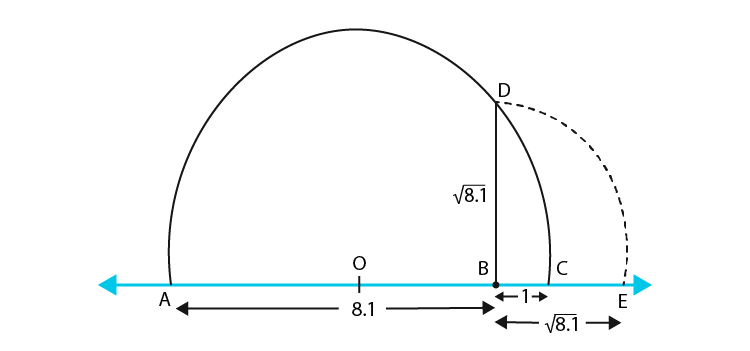
(iii) √8.1

Draw a line segment such that AB = 8.1 units.

Mark C at a distance of 1 unit from B.

Mark O, is the mid-point of AC.

Draw a semicircle with centre O and radius OC.

Draw a line perpendicular to AC, passing through B and intersecting the semicircle at D.

Now, BD = √8.1.

Draw an arc with centre B and radius BD, meeting AC produced at E.

Then BE = BD = √8.1 units.

NCERT Exemplar Class 9 Maths Chapter 1- Ex. 1.3-7

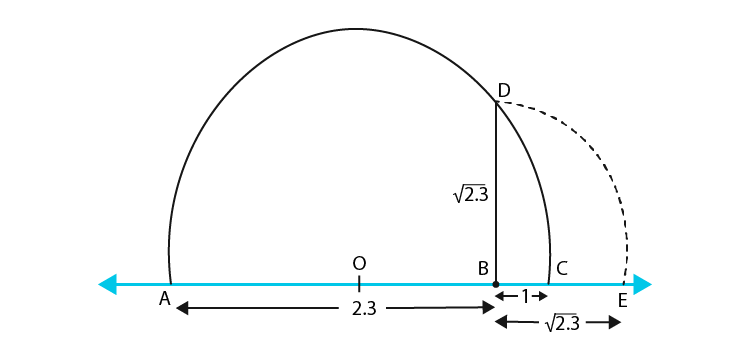
(iv) √2.3

Draw a line segment such that AB = 2.3 units.

Mark C at a distance of 1 unit from B.

Mark O is the mid-point of AC.

Draw a semicircle with centre O and radius OC.

Draw a line perpendicular to AC, passing through B and intersecting the semicircle at D.

Now, BD = √2.3.

Draw an arc with centre B and radius BD, meeting AC produced at E.

Then BE = BD = √2.3 units.

NCERT Exemplar Class 9 Maths Chapter 1- Ex. 1.3-8

Q7Written answer

Express the following in the form p/q, where p and q are integers and q ≠ 0 :

(i) 0.2

(ii) 0.888…

(iii) NCERT Exemplar Class 9 Maths Chapter 1 Exercise 1.3 Question 7 - 1

(iv) NCERT Exemplar Class 9 Maths Chapter 1 Exercise 1.3 Question 7 - 2

(v) 0.2555…

(vi) NCERT Exemplar Class 9 Maths Chapter 1 Exercise 1.3 Question 7 - 3

(vii) .00323232…

(viii) .404040…

Show solutionHide solution
Worked solution

(i) 0.2

We know that,

0/2 can be written as,

0.2 = 2/10 = 1/5

(ii) 0.888…

Assume that 𝑥 = 0.888 …

⇒ 𝑥 = 0.8 ……………. Eq.(1)

Multiply L.H.S and R.H.S by 10,

We get

10 𝑥 = 8.8 ……………. Eq.(2)

Subtracting equation (1) from (2),

We get

10 𝑥 − 𝑥 = 8.8 − 0.8

⇒ 9𝑥 = 8

⇒ 𝑥 = 8/9

(iii)
NCERT Exemplar Class 9 Maths Chapter 1 Exercise 1.3 Question 7 - 1 Solution

Assume that 𝑥 = 5.2 ……………. Eq.(1)

Multiply L.H.S and R.H.S by 10,

We get

10 𝑥 = 52.2 …………… Eq. (2)

Subtracting equation (1) from (2),

We get

10 𝑥 − 𝑥 = 52.2 − 5.2

⇒ 9𝑥 = 47

⇒ 𝑥 = 47/9

(iv)
NCERT Exemplar Class 9 Maths Chapter 1 Exercise 1.3 Question 7 - 2 Solution

Assume that 𝑥 = 0.001 ……………. Eq. (1)

Multiply L.H.S and R.H.S by 1000,

We get

1000 𝑥 = 1.001 …………… Eq. (2)

Subtracting equation (1) from (2),

We get

1000𝑥 − 𝑥 = 1.001 − 0.001

⇒ 999𝑥 = 1

⇒ 𝑥 = 1/999

(v) 0.2555…

Assume that 𝑥 = 0.2555 …

⇒ x = 0.25 ……………. Eq. (1)

Multiply L.H.S and R.H.S by 10,

We get

10 x = 2.5 ……………. Eq. (2)

Multiply L.H.S and R.H.S by 100,

We get

100 x = 25.5 …………. Eq. (3)

Subtracting equation (2) from (3),

We get

100 x-10x = 25.5 – 2.5

⇒ 90𝑥 = 23

⇒ 𝑥 = 23/90

(vi)
NCERT Exemplar Class 9 Maths Chapter 1 Exercise 1.3 Question 7 - 3 Solution

Let 𝑥 = 0.134 ………….…. Eq. (1)

Multiply L.H.S and R.H.S by 10,

We get

10 𝑥 = 1.34 ………………. Eq. (2)

Multiply L.H.S and R.H.S by 1000,

We get

1000 𝑥 = 134.34 …………. Eq. (3)

Subtracting equation (2) from (3),

We get

1000 𝑥 − 10𝑥 = 134.34 − 1.34

⇒ 990𝑥 = 133

⇒ 𝑥 = 133/990

(vii) .00323232…

Let 𝑥 = 0.00323232 …

⇒ x = 0.0032 ………….…. Eq. (1)

Multiply L.H.S and R.H.S by 100,

We get,

100x = 0.32 ……………. Eq. (2)

Multiply L.H.S and R.H.S by 10000,

We get

10000 x = 32.32 …………. Eq. (3)

Subtracting equation (2) from (3),

We get

10000 x-100x = 32.32 – 0.32

⇒ 9900𝑥 = 32

⇒ 𝑥 = 32/9900 = 8/2475

(viii) .404040…

Let 𝑥 = 0.404040 …

⇒ 𝑥 = 0. 40 ………..….…. (1)

Multiply L.H.S and R.H.S by 100,

We get

100 𝑥 = 40.40 ……….…. (2)

Subtracting equation (1) from (2),

We get

100 𝑥 − 𝑥 = 40.40 − 0.40

⇒ 99𝑥 = 40

⇒ 𝑥 = 40/99