My Cart
Your Cart 0

    Your cart is empty.

  • Total (Amount) ₹0.00
NCERT Exemplar · Class 9 · Maths

Chapter 1: Number Systems

Practice each question, then open the answer or worked solution.

Exercise 1.1

Textbook page 2 · 10 questions
Q1Written answer

Every rational number is

(A) a natural number

(B) an integer

(C) a real number

(D) a whole number

Show solutionHide solution
Worked solution

(C) a real number

Explanation:

We know that rational and irrational numbers taken together are known as real numbers. Therefore, every real number is either a rational number or an irrational number. Hence, every rational number is a real number.

Hence, (C) is the correct option.
Q2Written answer

Between two rational numbers

(A) there is no rational number

(B) there is exactly one rational number

(C) there are infinitely many rational numbers

(D) there are only rational numbers and no irrational numbers

Show solutionHide solution
Worked solution

(C) there are infinitely many rational numbers

Explanation:

Between two rational numbers, there is infinitely many rational numbers.

Hence, (C) is the correct option.

Q3Written answer

Decimal representation of a rational number cannot be

(A) terminating

(B) non-terminating

(C) non-terminating repeating

(D) non-terminating non-repeating

Show solutionHide solution
Worked solution

(D) non-terminating non-repeating

Explanation:

The decimal representation of a rational number cannot be non-terminating and non-repeating.

Hence, (D) is the correct option.

Q4Written answer

The product of any two irrational numbers is

(A) always an irrational number

(B) always a rational number

(C) always an integer

(D) sometimes rational, sometimes irrational

Show solutionHide solution
Worked solution

(D) sometimes rational, sometimes irrational

Explanation:

The product of any two irrational numbers is sometimes rational and sometimes irrational.

Hence, (D) is the correct option.

Q5Written answer

The decimal expansion of the number √2 is

(A) a finite decimal

(B) 1.41421

(C) non-terminating recurring

(D) non-terminating non-recurring

Show solutionHide solution
Worked solution

(D) non-terminating non-recurring

Explanation:

The decimal expansion of the number √2 = 1.41421356237…

Hence, (D) is the correct option.

Q6Multiple choice

Which of the following is irrational?

Show answerHide answer
Correct option: C
Show solutionHide solution
Worked solution

(C) √7

Explanation:

(A) √4/√9 = 2/3

(B) √12/√3 = 2√3/√3 = 2

(C) √7 = 2.64575131106

(D) √81 = 9

Here, (C) √7 = 2.64575131106 is a non-terminating decimal expansion.

Hence, (C) is the correct option.

Q7Written answer

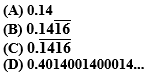
Which of the following is irrational?

NCERT Exemplar Class 9 Maths Chapter 1- Ex. 1.1-1

Show solutionHide solution
Worked solution

(D) 0.4014001400014…

Explanation:

A number is irrational if and only if its decimal representation is non-terminating and non-recurring.

(A) is a terminating decimal and, therefore, cannot be an irrational number.

(B) is a non-terminating and recurring decimal and, therefore, cannot be irrational.

(C) is a non-terminating and recurring decimal and, therefore, cannot be irrational.

(D) is a non-terminating and non-recurring decimal and therefore is an irrational number.

Hence, (D) is the correct option.

Q8Written answer

A rational number between √2 and √3 is

(A) (√2+√3)/2

(B) (√2. √3)/2

(C) 1.5

(D) 1.8

Show solutionHide solution
Worked solution

(C) 1.5

Explanation:

√2 =1.4142135…. and √3 =1.732050807….

(A) (√2+√3)/2 = 1.57313218497… is a non-terminating and non-recurring decimal and, therefore, is an irrational number.

(B) (√2. √3)/2 = 1.22474487139… is a non-terminating and non-recurring decimal and, therefore, is an irrational number.

(C) 1.5 is a terminating decimal and, therefore, is a rational number.

(D) 1.8 is a terminating decimal and, therefore, is a rational number.

Here both 1.5 and 1.8 are rational numbers. But, 1.8 does not lie in between √2 =1.4142135…. and √3 =1.732050807…. Whereas 1.5 lies in between √2 =1.4142135…. and √3 =1.732050807….

Hence, (C) is the correct option.

Q9Written answer

The value of 1.999… in the form p/q, where p and q are integers and q ≠ 0, is

(A) 19/10

(B) 1999/1000

(C) 2

(D) 1/9

Show solutionHide solution
Worked solution

(C) 2

Explanation:

(A) 19/10 = 1.9

(B) 1999/1000= 1.999

(C) 2

(D) 1/9 = 0.111….

Let x = 1.9999….. — (1)

Multiply equation (1) with 10

10x = 19.9999….. — (2)

Subtract equation (1) from equation(2),

We get,

9x = 18

x = 18 / 9

x = 2

Therefore,

x = 1.9999… = 2

Hence, (C) is the correct option.

Q10Written answer

2√3 + √3 is equal to

(A) 2√6

(B) 6

(C) 3√3

(D) 4√6

Show solutionHide solution
Worked solution

(C) 3√3

Explanation:

2√3 + √3

Taking √3 common,

We get,

√3(2+1) = √3(3) = 3√3

Hence, (C) is the correct option.