My Cart
Your Cart 0

    Your cart is empty.

  • Total (Amount) ₹0.00
NCERT Exemplar · Class 11 · Physics

Chapter 3: Motion in a Straight Line

Practice each question, then open the answer or worked solution.

Questions

26 questions
Q3.21Written answer

A ball is dropped from a building of height 45 m. Simultaneously another ball is thrown up with a speed 40 m/s. Calculate the relative speed of the balls as a function of time.

Show solutionHide solution
Worked solution

V = v1 = ?

U = 0

h = 45 m

a = g

t = t

V = u + at

v1 = 0 + gt

v1 = gt

Therefore, when the ball is thrown upward, v1 = -gt

V = v2

u = 40 m/s

a = g

t = t

V = u + at

v2 = 40 – gt

The relative velocity of the ball in the downward direction is – 40 m/s

But when the speed increases due to acceleration, the relative speed remains 40 m/s
Q3.22Written answer

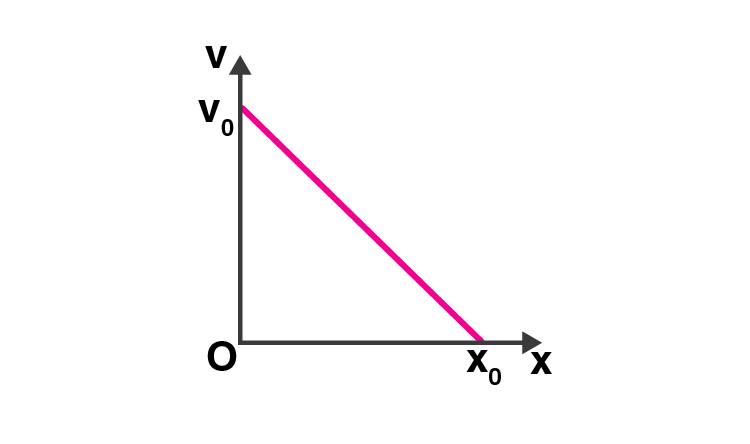
The velocity-displacement graph of a particle is shown in the figure.

Exemplar Solution Class 11 Physics Chapter 3.3

a) Write the relation between v and x.

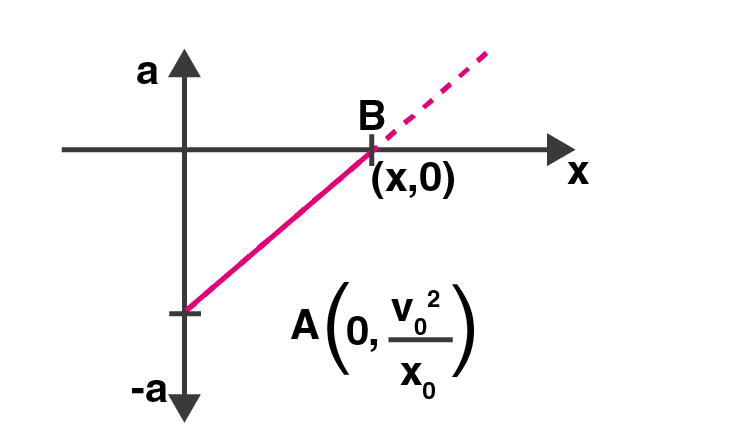
b) Obtain the relation between acceleration and displacement and plot it.

Show solutionHide solution
Worked solution

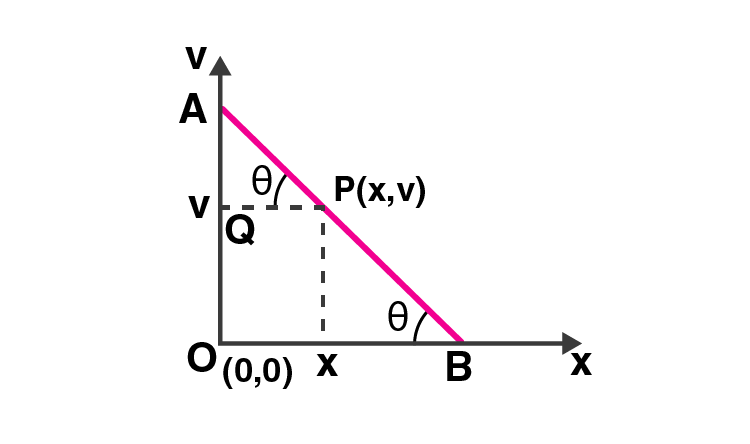
a) Consider the point P(x,v) at any time t on the graph such that angle ABO is θ such that

tan θ = AQ/QP = (v0-v)/x = v0/x0

Exemplar Solution Class 11 Physics Chapter 3.2

When the velocity decreases from v0 to zero during the displacement, the acceleration becomes negative.

a = – tan θ = v0/z0 = (v0-v)/x

v0 – v = (v0/z0)x

v = v0(1-x/x0) is the relation between v and x.

b) a = dv/dt = (dv/dt)(dx/dx) = (dv/dx)(dx/dt)

a = -v0/x0

v = -v0/x0

a = (v02x/x02) – (v02/x0)

Exemplar Solution Class 11 Physics Chapter 3.1

At x = 0

a = – v02/x0

At a = 0

The points are (0, -v02/x0) and B(x0,0)

Long Answers
Q3.23Written answer

It is a common observation that rain clouds can be at about a kilometre altitude above the ground.

a) If a rain drop falls from such a height freely under gravity, what will be its speed? Also, calculate in km/h

b) A typical rain drop is about 4 mm diameter. Momentum is mass x speed in magnitude. Estimate its momentum when it hits ground.

c) Estimate the time required to flatten the drop.

d) Rate of change of momentum is force. Estimate how much force such a drop would exert on you.

e) Estimate the order of magnitude force on umbrella. Typical lateral separation between two rain drops is 5 cm.

Show solutionHide solution
Worked solution

a) Velocity attained by the rain drop which is falling freely through the height h is:

v2 = u2 – 2g(-h)

As u = 0

v = √2gh = 100√2 m/s = 510 km/h

b) Diameter of the drop, d = 2r = 4 mm

Radius of the drop, r = 2 mm = 2 × 10⁻³ m

Mass of the drop, m = Vρ = 3.4 × 10⁻⁵ kg

Momentum of the rain drop, p = mv = 5 × 10⁻³ kg.m/s

c) Time required to flatten the drop is the time taken by the drop to reach the ground

t = d/v = 30 ms

d) Force exerted by a rain drop is, F = change in momentum/time = p-0/t = 168 N

e) Radius of umbrella, R = 1/2 m

Area of umbrella = 0.8 m2

No.of drops striking the umbrella, n = 320

Therefore the net force exerted = 54000N

Q3.24Written answer

A motor car moving at a speed of 72 km/h cannot come to a stop in less than 3 s while for a truck this time interval is 5 s. On a highway the car is behind the truck both moving at 72 km/h. The truck gives a signal that it is going to stop at emergency. At what distance the car should be from the truck so that it does not bump onto the truck. Human response time is 0.5 s.

Show solutionHide solution
Worked solution

For truck, u = 20 m/s

v = 0

a = ?

t = 5s

v = u + at

a = 4 m/s2

For car, t = 3 s

u = 20 m/s

v = 0

a = ac

v = u + at

ac = -20/3 m/s2

Let s be the distance between the car and the truck when the truck gives the signal and t be the time taken to cover the distance.

The human response is 0.5 s and that is the time taken by the car to cover a certain distance with uniform velocity. Therefore, (t-0.5) is the retarded motion of the car.

Velocity of car after time t,

vc = u – at

= 20 – (20/3)(t-0.5)

Velocity of truck after time t,

vt = 20 -4t

The bump between the car and the truck is given as:

20-(20/3)(t-0.5) = 20 – 4t

t = 5/4s

Distance travelled by the truck in time t = 21.875 m

Distance travelled by the car in time t = 23.125 m

The collision between the truck and the car distance = 1.250 m

Q3.25Written answer

A monkey climbs up a slippery pole for 3 seconds and subsequently slips for 3 seconds. Its velocity at time t is given by v(t) = 2t (3 – t); 0<t<3 and v(t) = -(t – 3) ( 6 – t) for 3 < t < 6s on m/s. It repeats this cycle till it reaches the height of 20 m.

a) At what time is its velocity maximum?

b) At what time is its average velocity maximum?

c) At what times is its acceleration maximum in magnitude?

d) How many cycles are required to reach the top?

Show solutionHide solution
Worked solution

a) For maximum velocity v(t)

dv(t)/dt = 0

Substituting the value for v, we get

t = 1.5 seconds

b) For average velocity = total distance/time taken

Average velocity = 3 m

And the average velocity is maximum when time t = 2.36 sec

c) When the acceleration is maximum in a periodic motion, the time is maximum when the body returns to the mean position when v = 0

v(t) = 6t – 2t2

When t = 3 second, acceleration is maximum

d) Distance covered between 0-3 second

s = 9m

v(t) = -(t-3) (6-t)

ds/dt = (t-3)(t-6)

Integrating the equation from 3 to 6, s = -4.5m

The net distance = 9 – 4.5 = 4.5m

Height of climb in three cycle = (4.5)(3) = 13.5m

The remaining height = 20 -13.5 = 6.5 m

Therefore, no.of cycles is 20 when the height of the pole is 4.

Q3.26Written answer

A man is standing on top of a building 100 m high. He throws two balls vertically, one at t = 0 and other after a time interval. The later ball is thrown at a velocity of half the first. The vertical gap between first and second ball is +15m at t = 2s. The gap is found to remain constant. Calculate the velocity with which the balls were thrown and the exact time interval between their throw.

Show solutionHide solution
Worked solution

Let the speed of ball 1 = u1 = 2u m/s

Then the speed of ball 2 = u2 = u m/s

The height covered by ball 1 before coming to rest = h1

The height covered by ball 2 before coming to rest = h2

We know that,

v2 = u2 + 2gh

v2 = 2gh

h = v2/2g

Therefore, h1 = 4u2/2g

h2 = u2/2g

From question, h1 –h2 = 15 m

Therefore,

4u2/2g – u2/2g = 15

u = 10 m/s

h1 = 20 m

h2 = 5 m

And time taken is,

t1 = 2 sec

t2 = 1 sec