My Cart
Your Cart 0

    Your cart is empty.

  • Total (Amount) ₹0.00
NCERT Exemplar · Class 11 · Physics

Chapter 3: Motion in a Straight Line

Practice each question, then open the answer or worked solution.

Questions

26 questions
Q3.11Written answer

A ball is bouncing elastically with a speed 1 m/s between walls of a railway compartment of size 10 m in a direction perpendicular to walls. The train is moving at a constant velocity of 10 m/s parallel to the direction of motion of the ball. As seen from the ground,

a) the direction of motion of the ball changes every 10 seconds

b) speed of ball changes every 10 seconds

c) average speed of ball over any 20 seconds intervals is fixed

d) the acceleration of ball is the same as from the train

Show solutionHide solution
Worked solution

The correct option is b) speed of ball changes every 10 seconds, c) average speed of ball over any 20 seconds intervals is fixed and d) the acceleration of ball is the same as from the train

Very Short Answers

Q3.12Written answer

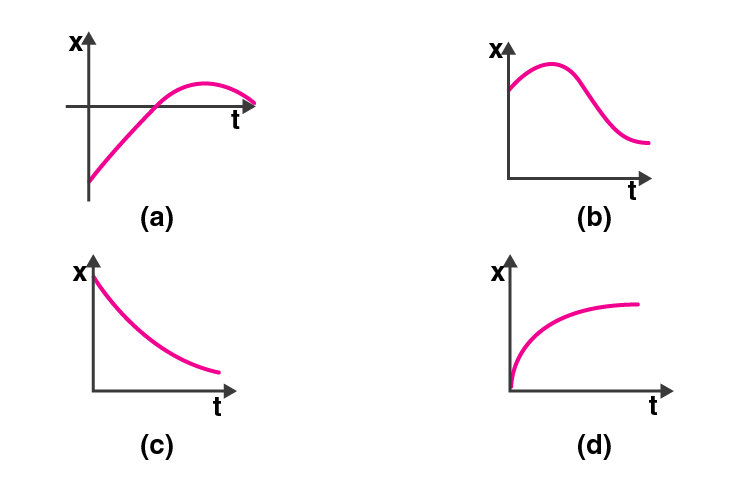
Refer to the graphs below and match the following:

Exemplar Solution Class 11 Physics Chapter 3.10

Graph Characteristics
a) i) has v > 0 and a < 0 throughout
b) ii) has x > 0 throughout and has a point with v = 0 and a point with a = 0
c) iii) has a point with zero displacement for t > 0
d) iv) has v < 0 and a > 0
Show solutionHide solution
Worked solution

a) matches with iii) has a point with zero displacement for t > 0

b) matches with ii) has x>0 throughout and has a point with v = 0 and a point with a = 0

c) matches with iv) has v < 0 and a > 0

d) matches with i) has v > 0 and a < 0 throughout

Q3.13Written answer

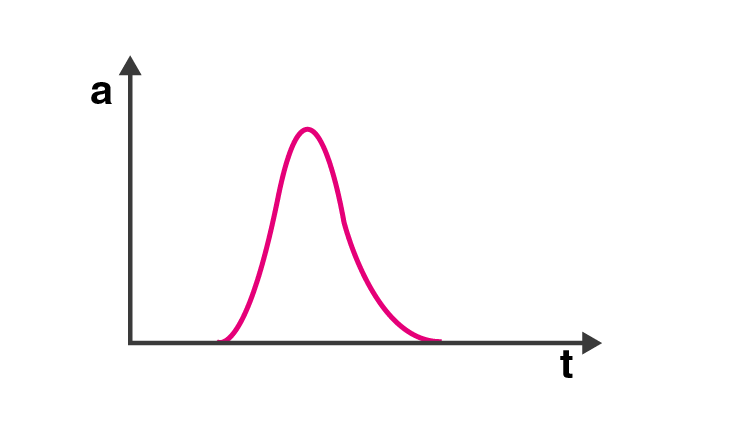
A uniformly moving cricket ball is turned back by hitting it with a bat for a very short time interval. Show the variation of its acceleration with taking acceleration in the backward direction as positive.

Show solutionHide solution
Worked solution

The force which is generated by the bat is known as impulsive force. When the effect of gravity is ignored, it can be said that the ball moves with a uniform speed horizontally and returns back to the bat with the same speed. When the ball hits the bat, the acceleration is zero. Acceleration is generated when the ball strikes the bat and an impulsive force is generated.

Exemplar Solution Class 11 Physics Chapter 3.9

Following is the graph of variation of acceleration with respect to time:

Exemplar Solution Class 11 Physics Chapter 3.8

Q3.14Written answer

Give examples of a one-dimensional motion where

a) the particle moving along positive x-direction comes to rest periodically and moves forward

b) the particle moving along positive x-direction comes to rest periodically and moves backwardπ

Show solutionHide solution
Worked solution

When an equation has sine and cosine functions, the nature is periodic.

a) When the particle is moving in positive x-direction, it is given as t > sin t

When the displacement is as a function of time, it is given as x(t) = t – sin t

When the equation is differentiated with respect to time, we get

Velocity v(t) = dx(t)/dt = 1 – cos t

Differentiating the above equation again with respect to time, we get

Acceleration, a(t) = dv/ dt = sin y

When t = 0, x(t) = 0

When t = π, x(t) = π > 0

When t = 0, x(t) = 2 π > 0

b) The equation is given as

x(t) = sin t

v = (d/dt)x(t) = cos t

a = dv/dt = -sin t

At t = 0, x = 0, v = 1 and a = 0

At t = π/2, x = 1, v = 0 and a = -1

At t = π, x = 0, v = -1, and a = 0

At t = 3 π/2, x = -1, v = 0 and a = 1

Therefore, it can be said that when the particle is moving along the positive x-direction, the particle comes to rest periodically and moves backward. When the displacement and velocity is involved, that is sin t and cos t, the equations are represented periodic in nature.

Q3.15Written answer

Give example of a motion where x>0, v<0, a>0 at a particular instant.

Show solutionHide solution
Worked solution

Let the motion be represented as:

x(t) = A + Be– γ t

Let A>B and γ >0

Velocity is x(t) = dx/dt = -Be– γ t

Acceleration is a(t) = dx/dt = B γ 2e– γ t

Therefore, it can be said that x(t) > 0, v(t) < 0, and a>0

Q3.16Written answer

An object falling through a fluid is observed to have acceleration given by a = g – bv where g = gravitational acceleration and b is constant. After a long time of release, it is observed to fall with constant speed. What must be the value of constant speed?

Show solutionHide solution
Worked solution

The concept used in this question will be based on the behaviour of a spherical object when it is dropped through a viscous fluid. When a spherical body of radius r is dropped, it is first accelerated and gradually the acceleration comes to zero, attaining a constant velocity which is known as terminal velocity.

Given,

a = g – bv

We know that,

a = dv/dt = 0 for uniform motion

g = gravitational acceleration

Therefore, it can be said that as the speed increases, acceleration decreases. When the speed is v0, acceleration will be zero and speed remains constant.

Therefore, a = g – bv0 = 0

v0 = g/b

Short Answers
Q3.17Written answer

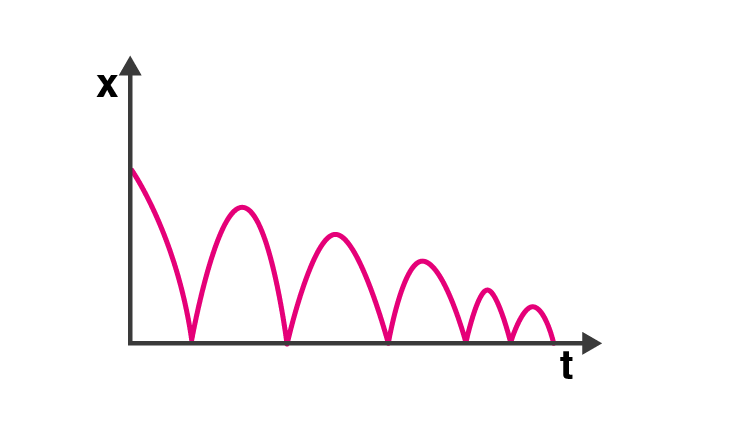
A ball is dropped and its displacement vs time graph is as shown in the figure where displacement x is from the ground and all quantities are positive upwards.

Exemplar Solution Class 11 Physics Chapter 3.7

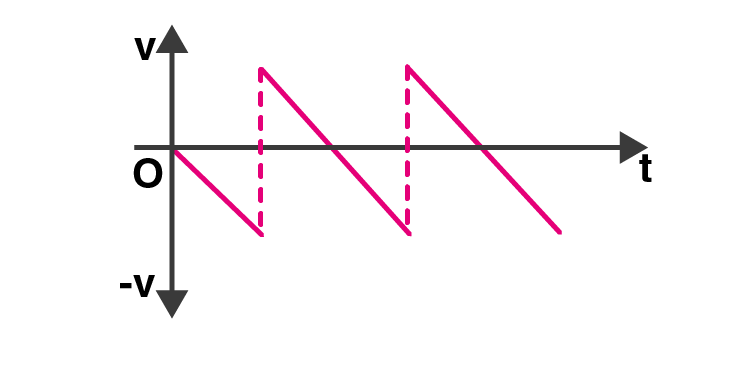
a) Plot qualitatively velocity vs time graph

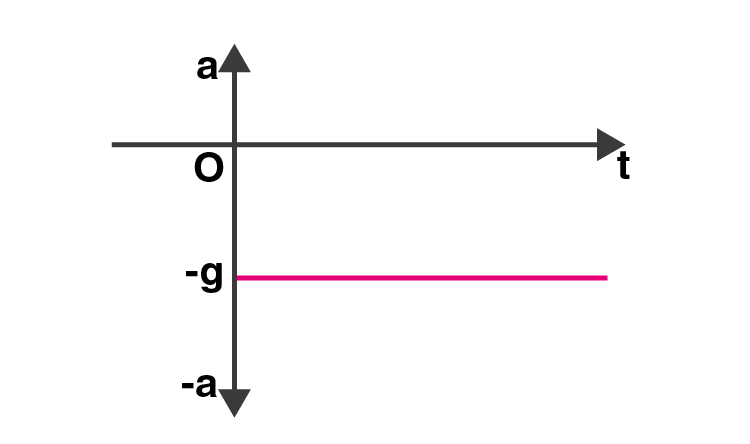
b) Plot qualitatively acceleration vs time graph

Show solutionHide solution
Worked solution

a) At t=0 and v=0 , v-t graph is:

Exemplar Solution Class 11 Physics Chapter 3.6

b) At x = 0, a-t graph is:

Exemplar Solution Class 11 Physics Chapter 3.5

Q3.18Written answer

A particle executes the motion described by x(t) = x0 (1 – e-γt) where t ≥ 0, x0 > 0

a) Where does the particles start and with what velocity?

b) Find maximum and minimum values of x(t), v(t), a(t). Show that x(t) and a(t) increase with time and v(t) decreases with time.

Show solutionHide solution
Worked solution

a) x(t) = x0 (1 – e-γt)

v(t) = dx(t)/dt = +x0 γ e-γt

a(t) = dv/dt = x0 γ2 e-γt

v(0) = x0 γ

b) x(t) is minimum at t = 0 since t = 0 and [x(t)]min = 0

x(t) is maximum at t = ∞ since t = ∞ and [x(t)]max = e-γt = ∞

v(t) is maximum at t = 0 since t = 0 and v(0) = x0γ

v(t) is minimum at t = ∞ since t = ∞ and v(∞) = 0

a(t) is maximum at t = ∞ since t = ∞ and a(∞) = 0

a(t) is minimum at t = 0 since t = 0 and a(0) = -x0 γ2

Q3.19Written answer

A bird is tossing between two cars moving towards each other on a straight road. One car has a speed of 18 m/h while the other has the speed of 27 km/h. The bird starts moving from first car towards the other and is moving with the speed of 36 km/h and when the two cars were separated by 36 km. What is the total distance covered by the bird? What is the total displacement of the bird?

Show solutionHide solution
Worked solution

The relative speed of the cars = 27 + 18 = 45 km/h

When the two cars meet together, time t is given as

t = distance between cars/relative speed of cars

= 36/(27+18)

t = 4/5 h

Therefore, distance covered by the bird in 4/5 hours = (36)(4/5) = 28.8 km

Q3.20Written answer

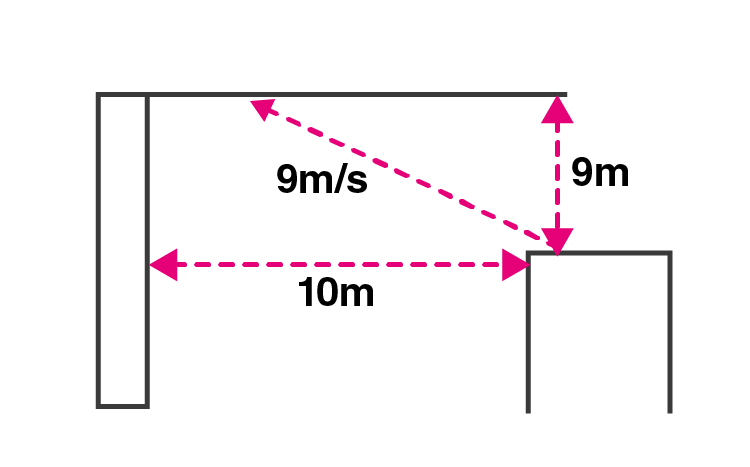
A man runs across the roof-top of a tall building and jumps horizontally with the hope of landing on the roof of the next building which is of a lower height than the first. If his speed is 9 m/s, the distance between the two buildings is 10 m and the height difference is 9 m, will he be able to land on the next building?

Show solutionHide solution
Worked solution

For a free fall at 9m, the horizontal distance covered by the man should be at least 10 m.

Exemplar Solution Class 11 Physics Chapter 3.4

u = 0

a = 10 m/s2

s = 9 m

t = t

s = ut + 1/2 at2

Substituting the values, we get

t = √9/3 = 3/√5 sec

The horizontal distance covered by the person,

vt = (9)( 3/√5) = 12.07 m

Therefore, 12.07 m is the distance covered during a free fall of 9 m.

Therefore, when the free fall is 10 m it is 12.07-10 = 2.07 m