My Cart
Your Cart 0

    Your cart is empty.

  • Total (Amount) ₹0.00
NCERT Exemplar · Class 11 · Physics

Chapter 14: Oscillations

Practice each question, then open the answer or worked solution.

Questions

40 questions
Q14.31Written answer

Find the displacement of a simple harmonic oscillator at which its PE is half of the maximum energy of the oscillator.

Show solutionHide solution
Worked solution

The mean position of the oscillator at x with PE = 1/2 kx2

PE = -m2x2

When PE is maximum, KE = 0 at x = A

E = 1/2 mω2A2

PE = 1/2 total energy

x2 = 1/2 A2

x = ± A/√2
Q14.32Written answer

A body of mass m is situated in a potential field U(x) = U0 (1 – cos αx) when U0 and α are constants. Find the time period of small oscillations.

Show solutionHide solution
Worked solution

The time period of the small oscillation is T = 2π/α √m/U0

Q14.33Written answer

A mass of 2 kg is attached to the spring of spring constant 50 N/m. The block is pulled to a distance of 5 cm from its equilibrium position at x = 0 on a horizontal frictionless surface from rest at t = 0. Write the expression for its displacement at anytime t.

Show solutionHide solution
Worked solution

x = 5 sin 5t

Q14.34Written answer

Consider a pair of identical pendulums, which oscillate with equal amplitude independently such that when one pendulum is at its extreme position making an angle of 2o to the right with the vertical, the other pendulum makes an angle of 1o to the left of the vertical. What is the phase difference between the pendulums?

Show solutionHide solution
Worked solution

θ1 = θ0 sin (wt + δ1)

θ2 = θ0 sin (wt + δ2)

for first, θ = 2o

for second, θ = -1o

δ1 – δ2 = 120o

Long Answers
Q14.35Written answer

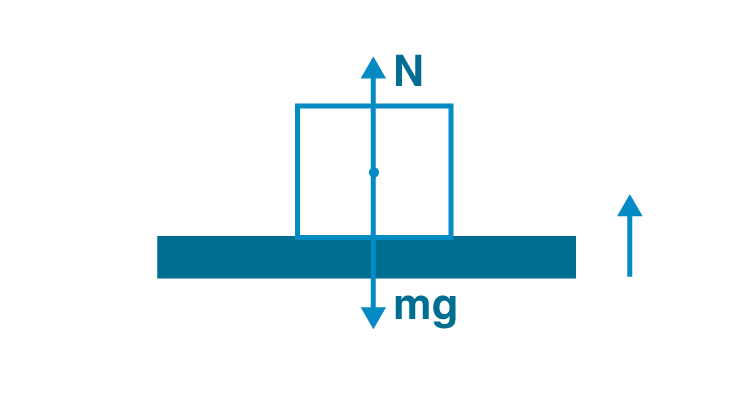
A person normally weighing 50 kg stands on a massless platform which oscillates up and down harmonically at a frequency of 2 s-1 and an amplitude 5 cm. A weighing machine on the platform gives the person’s weight against time.

a) will there be any change in the weight of the body during the oscillation?

b) if the answer to part a) is yes, what will be the maximum and minimum reading in the machine and at which position?

Show solutionHide solution
Worked solution

Exemplar Solutions Class 11 Physics Chapter 14 - 19

a) The change in the weight of the body during the oscillation is 885 N

b) The maximum weight is 885 N, while the minimum weight is 95.5 N.

Q14.36Written answer

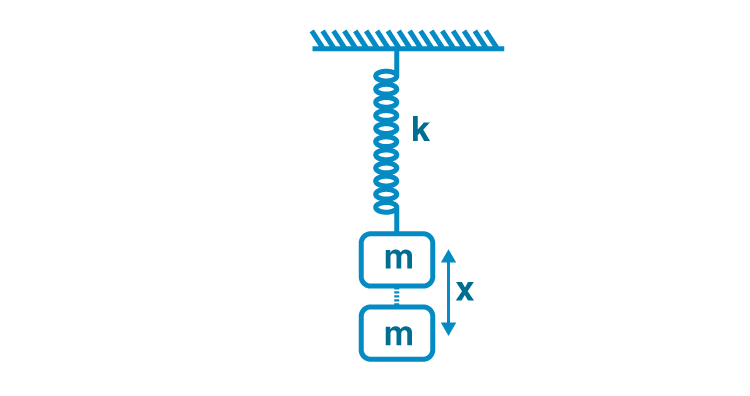
A body of mass m is attached to one end of a massless spring which is suspended vertically from a fixed point. The mass is held in hand so that the spring is neither stretched nor compressed. Suddenly the support of the hand is removed. The lowest position attained by the mass during oscillation is 4 cm below the point, where it was held in hand.

a) what is the amplitude of oscillation?

b) find the frequency of oscillation?

Show solutionHide solution
Worked solution

Exemplar Solutions Class 11 Physics Chapter 14 - 20

The PE of spring = gravitational PE lost by the man

PE = mgx

1/2 kx2 is the PE due to spring

x = 2mg/k

a) the amplitude of the spring is 2cm

b) frequency of oscillation is v = 3.52 Hz

Q14.37Written answer

A cylindrical log of wood of height h and area of cross-section A floats in water. It is pressed and then released. Show that the log would execute SHM with a time period where m is the mass of the body and ρ is the density of the liquid.

Show solutionHide solution
Worked solution

Exemplar Solutions Class 11 Physics Chapter 14 - 22

The SHM executed by the cylindrical wood log is given as

T = 2π√m/Aρg

Q14.38Written answer

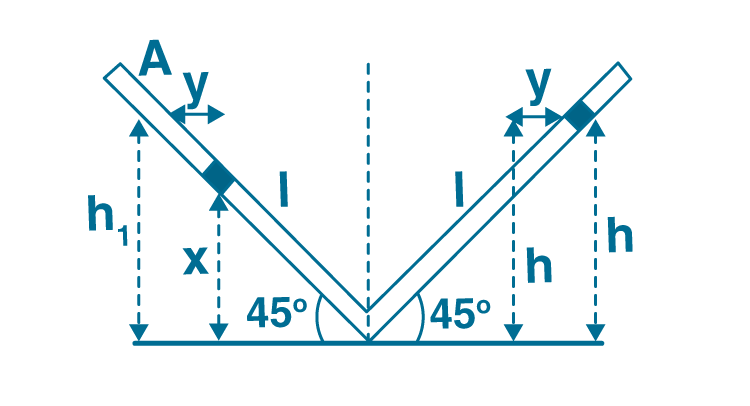
One end of a V-tube containing mercury is connected to a suction pump, and the other end to the atmosphere. The two arms of the tube are inclined horizontally at an angle of 45o each. A small pressure difference is created between two columns when the suction pump is removed. Will the column of mercury in V-tube execute simple harmonic motion? Neglect capillary and viscous forces. Find the time period of oscillation.

Show solutionHide solution
Worked solution

Exemplar Solutions Class 11 Physics Chapter 14 - 23

The initial height of the columns is h0

Let dx be the element that needs to be considered

The mass is dm = A.dx.ρ

PE on the left of dm = (dm)gh

Total PE = A ρg h12/2

When the above equation is differentiated along with KE where KE is A ρlv2

We get the equation of SHM oscillator along with the standard equation of SHM when the total energy is obtained by adding PE and KE

T = 2π√l/g

Q14.39Written answer

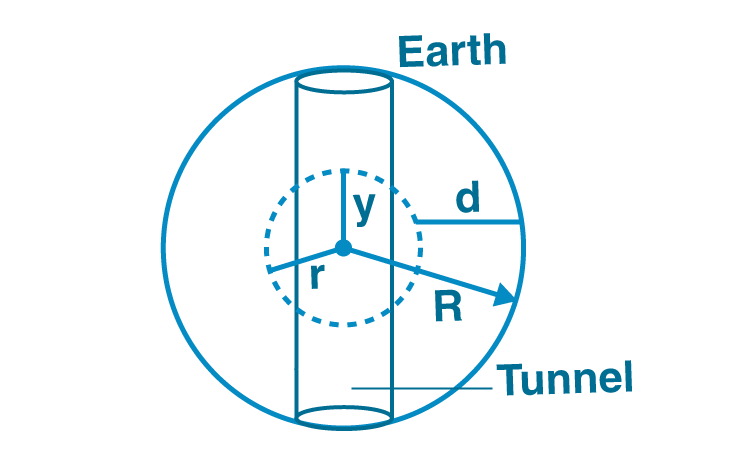
A tunnel is dug through the centre of the earth. Show that a body of mass ‘m’, when dropped from rest from one end of the tunnel, will execute the simple harmonic motion.

Show solutionHide solution
Worked solution

Exemplar Solutions Class 11 Physics Chapter 14 - 24

Acceleration due to gravity of the earth inside the earth is g’

g’ = g(1-d/R)

R-d = y

g’ = g y/R

F = -mg y/R

F is proportional to (-y)

When the body is in a tunnel, the motion is SHM. ma = -mg’

T = 2π √R/g

Q14.40Written answer

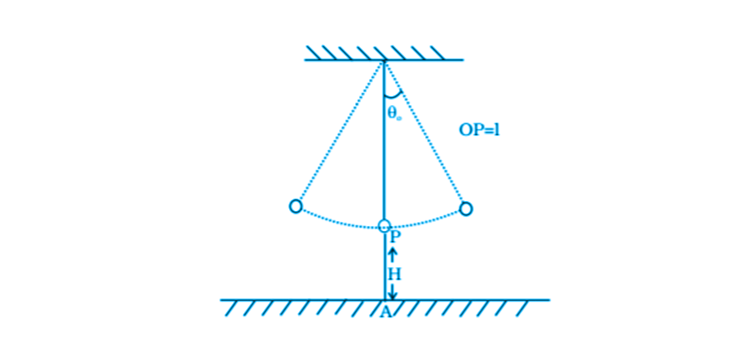
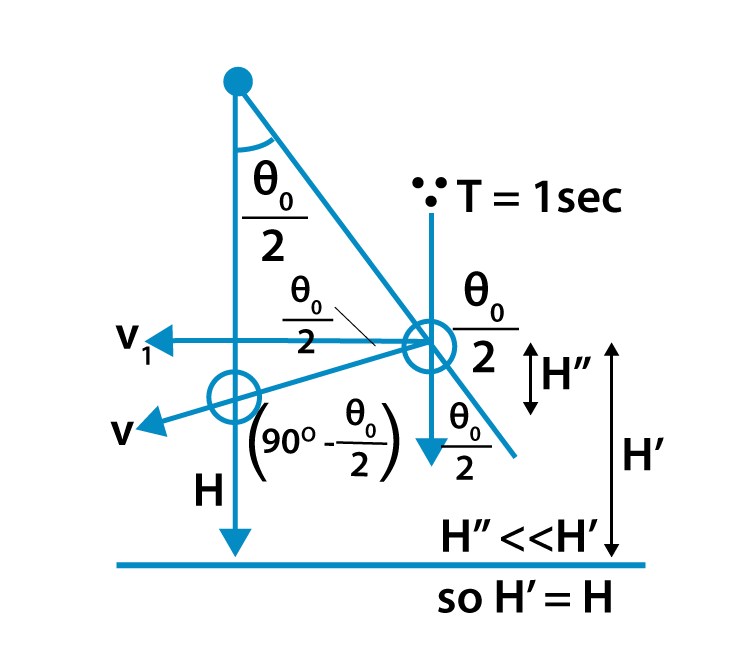
A simple pendulum of time period 1s and length l is hung from a fixed support at O, such that the bob is at a distance H vertically above A on the ground. The amplitude is θo. The string snaps at θ = θ0/2. Find the time taken by the bob to hit the ground. Also, find the distance from A where bob hits the ground. Assume θ0 to be small so that sin θo, θo and cos θ0 1.

Exemplar Solutions Class 11 Physics Chapter 14 - 25

Show solutionHide solution
Worked solution

At t = t1 and θ= θ0/a

T = 1 sec

θ0/2 = θ0 cos 2π/T t1

d θ/dt = – θ0 2π sin 2πt

Exemplar Solutions Class 11 Physics Chapter 14 - 26

At t = 1/6, that is when θ = θ0/2

d θ/dt = – θ0π√3

v/l = – θ0π√3

v = -θ0π√3l

The distance between the bob from A is θ0l [1/2 – π√6H/g]

Oscillation has many different uses and real-life applications, as the examples such as:

  1. Tuning fork
  2. Vibrating string
  3. Torsional vibration
  4. Oscillator
  5. Circadian rhythm
Important Topics of Class 11 Physics Chapter 14 Oscillations
  1. Periodic and oscillatory motions
  2. Simple harmonic motion
  3. Simple harmonic motion and uniform circular motion
  4. Velocity and acceleration in simple harmonic motion
  5. Force law for simple harmonic motion
  6. Energy in simple harmonic motion
  7. Some systems executing SHM Ex
  8. Damped simple harmonic motion
  9. Forced oscillations and resonance.