My Cart
Your Cart 0

    Your cart is empty.

  • Total (Amount) ₹0.00
NCERT Exemplar · Class 11 · Physics

Chapter 14: Oscillations

Practice each question, then open the answer or worked solution.

Questions

40 questions
Q14.1Written answer

The displacement of a particle is represented by the equation y = 3 cos(π/4 – 2ωt). The motion of the particle is

a) simple harmonic with period 2p/w

b) simple harmonic with period π/ω

c) periodic but not simple harmonic

d) non-periodic

Show solutionHide solution
Worked solution

The correct answer is b) simple harmonic with period π/ω

Q14.2Written answer

The displacement of a particle is represented by the equation y = sin3 ωt. The motion is

a) non-periodic

b) periodic but not simple harmonic

c) simple harmonic with period 2π/ω

d) simple harmonic with period π/ω

Show solutionHide solution
Worked solution

The correct answer is c) simple harmonic with period 2π/ω

Q14.3Written answer

The relation between acceleration and displacement of four particles is given below:

a) ax = +2x

b) ax = +2x2

c) ax = -2x2

d) ax = -2x

Which one of the particles is executing simple harmonic motion?

Show solutionHide solution
Worked solution

The correct answer is d) ax = -2x

Q14.4Written answer

Motion of an oscillating liquid column in a U-tube is

a) periodic but not simple harmonic

b) non-periodic

c) simple harmonic and time period are independent of the density of the liquid

d) simple harmonic and time period are directly proportional to the density of the liquid

Show solutionHide solution
Worked solution

The correct answer is c) simple harmonic and time period is independent of the density of the liquid

Q14.5Written answer

A particle is acted simultaneously by mutually perpendicular simple harmonic motions x = a cos ωt and y = a sin ωt. The trajectory of motion of the particle will be

a) an ellipse

b) a parabola

c) a circle

d) a straight line

Show solutionHide solution
Worked solution

The correct answer is c) a circle

Q14.6Written answer

The displacement of a particle varies with time according to the relation y = a sin ωt + b cos ωt

a) the motion is oscillatory but not SHM

b) the motion is SHM with amplitude a + b

c) the motion is SHM with amplitude a2 + b2

d) the motion is SHM with amplitude √a2 + b2

Show solutionHide solution
Worked solution

The correct answer is d) the motion is SHM with amplitude √a2 + b2

Q14.7Written answer

Four pendulums A, B, C, and D are suspended from the same elastic support as shown in the figure. A and C are of the same length, while B is smaller than A and D is larger than A. If A is given a transverse displacement,

Exemplar Solutions Class 11 Physics Chapter 14 - 1

a) D will vibrate with maximum amplitude

b) C will vibrate with maximum amplitude

c) B will vibrate with maximum amplitude

d) all the four will oscillate with equal amplitude

Show solutionHide solution
Worked solution

The correct answer b) C will vibrate with maximum amplitude

Q14.8Written answer

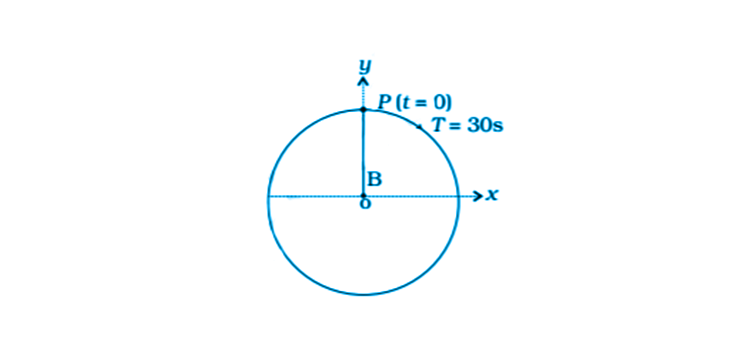
Figure shows the circular motion of a particle. The radius of the circle, the period, sense of revolution, and the initial position are indicated in the figure. The simple harmonic motion of the x-projection of the radius vector of the rotating particle P is

a) x(t) = B sin (2πt/30)

b) x(t) = B cos (πt/15)

c) x(t) = B sin (πt/15 + π/2)

d) x(t) = B cos (πt/15 + π/2)

Exemplar Solutions Class 11 Physics Chapter 14 - 2

Show solutionHide solution
Worked solution

The correct answer a) x(t) = B sin (2πt/30)

Q14.9Written answer

The equation of motion of a particle is x = a cos (αt)2. The motion is

a) periodic but not oscillatory

b) periodic and oscillatory

c) oscillatory but not periodic

d) neither periodic nor oscillatory

Show solutionHide solution
Worked solution

The correct answer c) oscillator but not periodic

Q14.10Written answer

A particle executing SHM has a maximum speed of 30 cm/s and a maximum acceleration of 60 cm/s2. The period of oscillation is

a) πs

b) π/2 s

c) 2 πs

d) π/t s

Show solutionHide solution
Worked solution

The correct answer a) πs