My Cart
Your Cart 0

    Your cart is empty.

  • Total (Amount) ₹0.00
NCERT · Class 8 · Maths

Chapter 3: Understanding Quadrilaterals

Practice each question, then open the answer or worked solution.

Exercise 3.4

Textbook page 55 · 6 questions
Q1Written answer

State whether True or False.


(a) All rectangles are squares.

(b) All rhombuses are parallelograms.

(c) All squares are rhombuses and also rectangles.

(d) All squares are not parallelograms.

(e) All kites are rhombuses.

(f) All rhombuses are kites.

(g) All parallelograms are trapeziums.

(h) All squares are trapeziums.

Show solutionHide solution
Worked solution

(a) False

Because all squares are rectangles but all rectangles are not squares.

(b) True

(c) True

(d) False

Because all squares are parallelograms as opposite sides are parallel and opposite angles are equal.

(e) False.

Because, for example, the length of the sides of a kite are not of the same length.

(f) True

(g) True

(h) True
 

Q2Written answer

Identify all the quadrilaterals that have.

(a) four sides of equal length (b) four right angles

Show solutionHide solution
Worked solution

(a) Rhombus and square have all four sides of equal length.

(b) Square and rectangle have four right angles.


Q3Written answer

Explain how a square is

(i) a quadrilateral (ii) a parallelogram (iii) a rhombus (iv) a rectangle

Show solutionHide solution
Worked solution

(i) Square is a quadrilateral because it has four sides.

(ii) Square is a parallelogram because it’s opposite sides are parallel and opposite angles are equal.

(iii) Square is a rhombus because all the four sides are of equal length and diagonals bisect at right angles.

(iv)Square is a rectangle because each interior angle, of the square, is 90°


Q4Written answer

Name the quadrilaterals whose diagonals.

(i) bisect each other (ii) are perpendicular bisectors of each other (iii) are equal

Show solutionHide solution
Worked solution

(i) Parallelogram, Rhombus, Square and Rectangle

(ii) Rhombus and Square

(iii)Rectangle and Square


Q5Written answer

Explain why a rectangle is a convex quadrilateral.

Show solutionHide solution
Worked solution

A rectangle is a convex quadrilateral because both of its diagonals lie inside the rectangle.

Q6Written answer

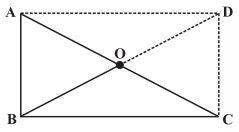
ABC is a right-angled triangle and O is the mid-point of the side opposite to the right angle. Explain why O is equidistant from A, B and C. (The dotted lines are drawn additionally to help you).


NCERT Solution For Class 8 Maths Chapter 3 Image 28

Show solutionHide solution
Worked solution

AD and DC are drawn so that AD || BC and AB || DC

AD = BC and AB = DC

ABCD is a rectangle as opposite sides are equal and parallel to each other and all the interior angles are of 90°.

In a rectangle, diagonals are of equal length and also bisect each other.

Hence, AO = OC = BO = OD

Thus, O is equidistant from A, B and C.