My Cart
Your Cart 0

    Your cart is empty.

  • Total (Amount) ₹0.00
NCERT · Class 8 · Maths

Chapter 3: Understanding Quadrilaterals

Practice each question, then open the answer or worked solution.

Exercise 3.1

Textbook page 41 · 6 questions
Q1Written answer

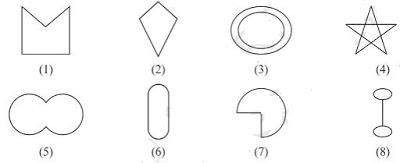
Given here are some figures.


NCERT Solution For Class 8 Maths Chapter 3 Image 1

Classify each of them on the basis of the following.

Simple curve (b) Simple closed curve (c) Polygon

(d) Convex polygon (e) Concave polygon

Show solutionHide solution
Worked solution

a) Simple curve: 1, 2, 5, 6 and 7

b) Simple closed curve: 1, 2, 5, 6 and 7

c) Polygon: 1 and 2

d) Convex polygon: 2

e) Concave polygon: 1

Q2Written answer

How many diagonals does each of the following have?

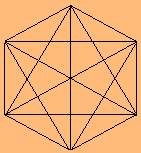
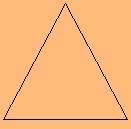
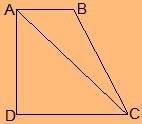
a) A convex quadrilateral (b) A regular hexagon (c) A triangle

Show solutionHide solution
Worked solution

a) A convex quadrilateral: 2.

NCERT Solution For Class 8 Maths Chapter 3 Image 2

b) A regular hexagon: 9.

NCERT Solution For Class 8 Maths Chapter 3 Image 3

c) A triangle: 0

NCERT Solution For Class 8 Maths Chapter 3 Image 4

Q3Written answer

What is the sum of the measures of the angles of a convex quadrilateral? Will this property hold if the quadrilateral is not convex? (Make a non-convex quadrilateral and try!)

Show solutionHide solution
Worked solution

NCERT Solution For Class 8 Maths Chapter 3 Image 5

Let ABCD be a convex quadrilateral.

From the figure, we infer that the quadrilateral ABCD is formed by two triangles,

i.e. ΔADC and ΔABC.

Since we know that sum of the interior angles of a triangle is 180°,

the sum of the measures of the angles is 180° + 180° = 360°

NCERT Solution For Class 8 Maths Chapter 3 Image 6

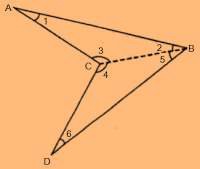
Let us take another quadrilateral ABCD which is not convex .

Join BC, such that it divides ABCD into two triangles ΔABC and ΔBCD. In ΔABC,

∠1 + ∠2 + ∠3 = 180° (angle sum property of triangle)

In ΔBCD,

∠4 + ∠5 + ∠6 = 180° (angle sum property of triangle)

∴, ∠1 + ∠2 + ∠3 + ∠4 + ∠5 + ∠6 = 180° + 180°

⇒ ∠1 + ∠2 + ∠3 + ∠4 + ∠5 + ∠6 = 360°

⇒ ∠A + ∠B + ∠C + ∠D = 360°

Thus, this property holds if the quadrilateral is not convex.

Q4Written answer

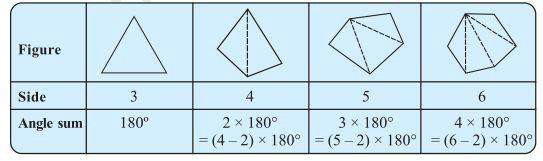
Examine the table. (Each figure is divided into triangles and the sum of the angles deduced from that.)


NCERT Solution For Class 8 Maths Chapter 3 Image 7

What can you say about the angle sum of a convex polygon with number of sides? (a) 7 (b) 8 (c) 10 (d) n

Show solutionHide solution
Worked solution

The angle sum of a polygon having side n = (n-2)×180°

a) 7

Here, n = 7

Thus, angle sum = (7-2)×180° = 5×180° = 900°

b) 8

Here, n = 8

Thus, angle sum = (8-2)×180° = 6×180° = 1080°

c) 10

Here, n = 10

Thus, angle sum = (10-2)×180° = 8×180° = 1440°

d) n

Here, n = n

Thus, angle sum = (n-2)×180°

Q5Written answer

What is a regular polygon?

State the name of a regular polygon of

(i) 3 sides (ii) 4 sides (iii) 6 sides

Show solutionHide solution
Worked solution

Regular polygon: A polygon having sides of equal length and angles of equal measures is called a regular polygon. A regular polygon is both equilateral and equiangular.

(i) A regular polygon of 3 sides is called an equilateral triangle.

(ii) A regular polygon of 4 sides is called a square.

(iii) A regular polygon of 6 sides is called a regular hexagon.

Q6Written answer

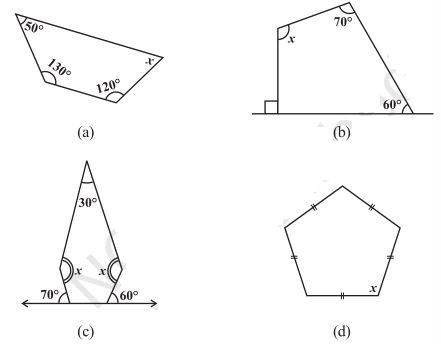
Find the angle measure of x in the following figures.


NCERT Solution For Class 8 Maths Chapter 3 Image 8

Show solutionHide solution
Worked solution

a) The figure has 4 sides. Hence, it is a quadrilateral. Sum of angles of the quadrilateral = 360°

⇒ 50° + 130° + 120° + x = 360°

⇒ 300° + x = 360°

⇒ x = 360° – 300° = 60°

b) The figure has 4 sides. Hence, it is a quadrilateral. Also, one side is perpendicular forming a right angle.

Sum of angles of the quadrilateral = 360°

⇒ 90° + 70° + 60° + x = 360°

⇒ 220° + x = 360°

⇒ x = 360° – 220° = 140°

c) The figure has 5 sides. Hence, it is a pentagon.
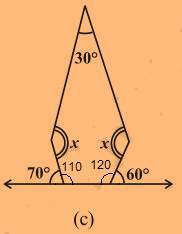
NCERT Solution For Class 8 Maths Chapter 3 Image 9

Sum of angles of the pentagon = 540° Two angles at the bottom are a linear pair.

∴, 180° – 70° = 110°

180° – 60° = 120°

⇒ 30° + 110° + 120° + x + x = 540°

⇒ 260° + 2x = 540°

⇒ 2x = 540° – 260° = 280°

⇒ 2x = 280°

= 140°

d) The figure has 5 equal sides. Hence, it is a regular pentagon. Thus, all its angles are equal.

5x = 540°

⇒ x = 540°/5

⇒ x = 108°

7.
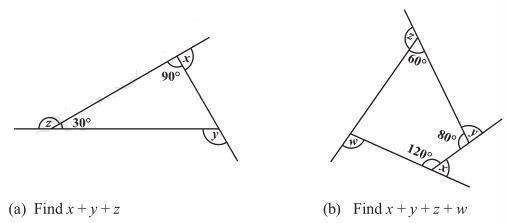
 

NCERT Solution For Class 8 Maths Chapter 3 Image 10

a) Sum of all angles of triangle = 180°

One side of triangle = 180°- (90° + 30°) = 60°

x + 90° = 180° ⇒ x = 180° – 90° = 90°

y + 60° = 180° ⇒ y = 180° – 60° = 120°

z + 30° = 180° ⇒ z = 180° – 30° = 150°

x + y + z = 90° + 120° + 150° = 360°

b) Sum of all angles of quadrilateral = 360°

One side of quadrilateral = 360°- (60° + 80° + 120°) = 360° – 260° = 100°

x + 120° = 180° ⇒ x = 180° – 120° = 60°

y + 80° = 180° ⇒ y = 180° – 80° = 100°

z + 60° = 180° ⇒ z = 180° – 60° = 120°

w + 100° = 180° ⇒ w = 180° – 100° = 80°

x + y + z + w = 60° + 100° + 120° + 80° = 360°