My Cart
Your Cart 0

    Your cart is empty.

  • Total (Amount) ₹0.00
Previous year question hub

Networks, Signals and Systems - Electronics & Communication Engineering Previous Year Questions

Practice Networks, Signals and Systems - Electronics & Communication Engineering previous year questions organised from real papers, with year-wise coverage and clear topic navigation.

26Papers
18Years
333Questions
1Topics

Networks, Signals and Systems question pattern

Every graph below is calculated only from this selection.

Questions by year

Year-wise coverage for Networks, Signals and Systems. Each bar uses a separate theme-derived color.

Difficulty distribution

How the classified questions are distributed by difficulty.

Medium 199 59.8%
Easy 120 36%
Hard 14 4.2%
Question type distribution

MCQ, numerical, multiple-select and other formats found in these papers.

MCQ 252 75.7%
Numerical Answer Type (NAT) 59 17.7%
MSQ 14 4.2%
Fill in the blanks 8 2.4%

Subject weightage

Top subjects by unique question coverage.

Electronics & Communication Engineering
333 Qs

Most asked topics

Top topics across the included previous year papers.

Networks, Signals and Systems
333 Qs

Subtopic coverage

Top subtopics inside this exact selection.

Time and frequency domain analysis of linear circuits
97 Qs
Circuit Analysis
90 Qs
Discrete-time Signals
55 Qs
LTI systems
53 Qs
Continuous-time Signals
38 Qs

Paper coverage

Question coverage for the most populated papers. Every active PYP paper remains listed below.

Electronics and Communication Engineering (EC) 2026
13 Qs
Electronics & Communication Engineering (EC) 2025
11 Qs
Electronics & Communication Engineering (EC) 2024
14 Qs
Electronics & Communication Engineering (EC) 2023
20 Qs
Electronics & Communication Engineering (EC) 2022
13 Qs
Electronics & Communication Engineering (EC) 2021
11 Qs
Electronics & Communication Engineering (EC) 2020
12 Qs
Electronics & Communication Engineering (EC) 2019
11 Qs
Electronics & Communication Engineering (EC) 2018
11 Qs
Electronics & Communication Engineering (EC) 2017
11 Qs
Electronics & Communication Engineering (EC) 2016 [Session 3]
11 Qs
Electronics & Communication Engineering (EC) 2016 [Session 1]
7 Qs
Electronics & Communication Engineering (EC) 2016 [Session 2]
7 Qs
Electronics & Communication Engineering (EC) 2015 [Session 2]
1 Qs
Electronics & Communication Engineering (EC) 2014 [Session 4]
16 Qs
Electronics & Communication Engineering (EC) 2014 [Session 1]
10 Qs
Electronics & Communication Engineering (EC) 2014 [Session 2]
6 Qs
Electronics & Communication Engineering (EC) 2014 [Session 3]
3 Qs
Electronics & Communication Engineering (EC) 2013 [Session 3]
21 Qs
Electronics & Communication Engineering (EC) 2013 [Session 2]
20 Qs
Electronics & Communication Engineering (EC) 2013 [Session 4]
19 Qs
Electronics & Communication Engineering (EC) 2013 [Session 1]
17 Qs
Electronics & Communication Engineering (EC) 2012
15 Qs
Electronics & Communication Engineering (EC) 2011
15 Qs
Electronics & Communication Engineering (EC) 2010
17 Qs
Electronics & Communication Engineering (EC) 2008
21 Qs

Browse by subtopics

Open a focused page built from the same verified paper data.

Included previous year papers

Newest papers appear first. Sort by year, question coverage or name.

PaperYear / sessionQuestions in this viewOpen
Electronics and Communication Engineering (EC) 2026202613View paper
Electronics & Communication Engineering (EC) 2025202511View paper
Electronics & Communication Engineering (EC) 2024202414View paper
Electronics & Communication Engineering (EC) 2023202320View paper
Electronics & Communication Engineering (EC) 2022202213View paper
Electronics & Communication Engineering (EC) 2021202111View paper
Electronics & Communication Engineering (EC) 2020202012View paper
Electronics & Communication Engineering (EC) 2019201911View paper
Electronics & Communication Engineering (EC) 2018201811View paper
Electronics & Communication Engineering (EC) 2017201711View paper
Electronics & Communication Engineering (EC) 2016 [Session 1]20167View paper
Electronics & Communication Engineering (EC) 2016 [Session 2]20167View paper
Electronics & Communication Engineering (EC) 2016 [Session 3]201611View paper
Electronics & Communication Engineering (EC) 2015 [Session 2]20151View paper
Electronics & Communication Engineering (EC) 2014 [Session 1]201410View paper
Electronics & Communication Engineering (EC) 2014 [Session 2]20146View paper
Electronics & Communication Engineering (EC) 2014 [Session 3]20143View paper
Electronics & Communication Engineering (EC) 2014 [Session 4]201416View paper
Electronics & Communication Engineering (EC) 2013 [Session 1]201317View paper
Electronics & Communication Engineering (EC) 2013 [Session 2]201320View paper
Electronics & Communication Engineering (EC) 2013 [Session 3]201321View paper
Electronics & Communication Engineering (EC) 2013 [Session 4]201319View paper
Electronics & Communication Engineering (EC) 2012201215View paper
Electronics & Communication Engineering (EC) 2011201115View paper
Electronics & Communication Engineering (EC) 2010201017View paper
Electronics & Communication Engineering (EC) 2008200821View paper

Sample previous year questions

A varied preview from the papers represented in this selection, with every available option.

1
2008 · Electronics & Communication Engineering · Networks, Signals and Systems · Circuit Analysis
Electronics & Communication Engineering (EC) 2008

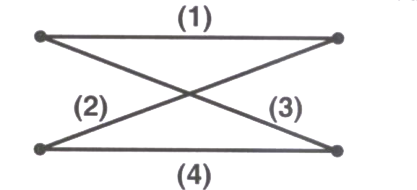
In the following graph, the number of trees (P) and the number of cut-sets (Q) are

Question diagram

Open complete paper
2
2010 · Electronics & Communication Engineering · Networks, Signals and Systems · Continuous-time Signals
Electronics & Communication Engineering (EC) 2010

The trigonometric Fourier series for the waveform f(t) shown below contains

Question diagram

Open complete paper
3
2011 · Electronics & Communication Engineering · Networks, Signals and Systems · Time and frequency domain analysis of linear circuits
Electronics & Communication Engineering (EC) 2011
The differential equation \(100\frac{d^2y}{dt^2} - 20\frac{dy}{dt} + y = x(t)\) describes a system with an input \(x(t)\) and an output \(y(t)\). The system, which is initially relaxed, is excited by a unit step input. The output \(y(t)\) can be represented by the waveform
Open complete paper
4
2012 · Electronics & Communication Engineering · Networks, Signals and Systems · Circuit Analysis
Electronics & Communication Engineering (EC) 2012
In the following figure, \(C_1\) and \(C_2\) are ideal capacitors. \(C_1\) has been charged to 12 V before the ideal switch S is closed at \(t = 0\). The current \(i(t)\) for all t is
Open complete paper
5
2013 · Electronics & Communication Engineering · Networks, Signals and Systems · LTI systems
Electronics & Communication Engineering (EC) 2013 [Session 1]
Two systems with impulse responses \(h_1(t)\) and \(h_2(t)\) are connected in cascade. Then the overall impulse response of the cascaded system is given by
Open complete paper
6
2013 · Electronics & Communication Engineering · Networks, Signals and Systems · Continuous-time Signals
Electronics & Communication Engineering (EC) 2013 [Session 2]
For a periodic signal \( v(t) = 30\sin 100t + 10\cos 300t + 6\sin (500t + \pi / 4) \), the fundamental frequency in rad/s is
Open complete paper