My Cart
Your Cart 0

    Your cart is empty.

  • Total (Amount) ₹0.00
Previous year question hub

Continuous-time Signals - Networks, Signals and Systems - Electronics & Communication Engineering Previous Year Questions

Practice Continuous-time Signals - Networks, Signals and Systems - Electronics & Communication Engineering previous year questions organised from real papers, with year-wise coverage and clear topic navigation.

26Papers
20Years
47Questions
1Topics

Continuous-time Signals question pattern

Every graph below is calculated only from this selection.

Questions by year

Year-wise coverage for Continuous-time Signals. Each bar uses a separate theme-derived color.

Difficulty distribution

How the classified questions are distributed by difficulty.

Easy 24 51.1%
Medium 23 48.9%

Question type distribution

MCQ, numerical, multiple-select and other formats found in these papers.

MCQ 38 80.9%
Numerical Answer Type (NAT) 6 12.8%
MSQ 2 4.3%
Fill in the blanks 1 2.1%

Subject weightage

Top subjects by unique question coverage.

Electronics & Communication Engineering
47 Qs

Most asked topics

Top topics across the included previous year papers.

Networks, Signals and Systems
47 Qs

Subtopic coverage

Top subtopics inside this exact selection.

Continuous-time Signals
47 Qs

Paper coverage

Question coverage for the most populated papers. Every active PYP paper remains listed below.

Electronics and Communication Engineering (EC) 2026
4 Qs
Electronics & Communication Engineering (EC) 2025
3 Qs
Electronics & Communication Engineering (EC) 2024
1 Qs
Electronics & Communication Engineering (EC) 2023
4 Qs
Electronics & Communication Engineering (EC) 2022
1 Qs
Electronics & Communication Engineering (EC) 2021
1 Qs
Electronics & Communication Engineering (EC) 2020
2 Qs
Electronics & Communication Engineering (EC) 2019
1 Qs
Electronics & Communication Engineering (EC) 2018
1 Qs
Electronics & Communication Engineering (EC) 2017 [Session 1]
2 Qs
Electronics & Communication Engineering (EC) 2017
1 Qs
Electronics & Communication Engineering (EC) 2017 [Session 2]
1 Qs
Electronics & Communication Engineering (EC) 2016 [Session 3]
2 Qs
Electronics & Communication Engineering (EC) 2016 [Session 1]
1 Qs
Electronics & Communication Engineering (EC) 2015 [Session 2]
1 Qs
Electronics & Communication Engineering (EC) 2014 [Session 1]
2 Qs
Electronics & Communication Engineering (EC) 2013 [Session 1]
2 Qs
Electronics & Communication Engineering (EC) 2013 [Session 2]
2 Qs
Electronics & Communication Engineering (EC) 2013 [Session 3]
2 Qs
Electronics & Communication Engineering (EC) 2013 [Session 4]
2 Qs
Electronics & Communication Engineering (EC) 2012
1 Qs
Electronics & Communication Engineering (EC) 2011
1 Qs
Electronics & Communication Engineering (EC) 2010
1 Qs
Electronics & Communication Engineering (EC) 2009
2 Qs
Electronics & Communication Engineering (EC) 2008
2 Qs
Electronics & Communication Engineering (EC) 2007
4 Qs

Included previous year papers

Newest papers appear first. Sort by year, question coverage or name.

PaperYear / sessionQuestions in this viewOpen
Electronics and Communication Engineering (EC) 202620264View paper
Electronics & Communication Engineering (EC) 202520253View paper
Electronics & Communication Engineering (EC) 202420241View paper
Electronics & Communication Engineering (EC) 202320234View paper
Electronics & Communication Engineering (EC) 202220221View paper
Electronics & Communication Engineering (EC) 202120211View paper
Electronics & Communication Engineering (EC) 202020202View paper
Electronics & Communication Engineering (EC) 201920191View paper
Electronics & Communication Engineering (EC) 201820181View paper
Electronics & Communication Engineering (EC) 201720171View paper
Electronics & Communication Engineering (EC) 2017 [Session 1]20172View paper
Electronics & Communication Engineering (EC) 2017 [Session 2]20171View paper
Electronics & Communication Engineering (EC) 2016 [Session 1]20161View paper
Electronics & Communication Engineering (EC) 2016 [Session 3]20162View paper
Electronics & Communication Engineering (EC) 2015 [Session 2]20151View paper
Electronics & Communication Engineering (EC) 2014 [Session 1]20142View paper
Electronics & Communication Engineering (EC) 2013 [Session 1]20132View paper
Electronics & Communication Engineering (EC) 2013 [Session 2]20132View paper
Electronics & Communication Engineering (EC) 2013 [Session 3]20132View paper
Electronics & Communication Engineering (EC) 2013 [Session 4]20132View paper
Electronics & Communication Engineering (EC) 201220121View paper
Electronics & Communication Engineering (EC) 201120111View paper
Electronics & Communication Engineering (EC) 201020101View paper
Electronics & Communication Engineering (EC) 200920092View paper
Electronics & Communication Engineering (EC) 200820082View paper
Electronics & Communication Engineering (EC) 200720074View paper

All Continuous-time Signals previous year questions

Practice every matching question in batches of 20, with every available option.

1
2007 · Electronics & Communication Engineering · Networks, Signals and Systems · Continuous-time Signals
Electronics & Communication Engineering (EC) 2007
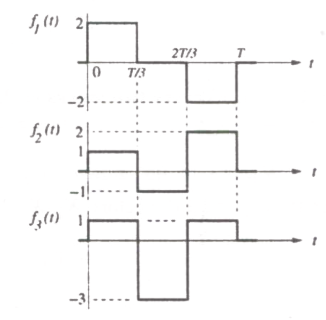
Three functions f₁(t), f₂(t) and f₃(t), which are zero outside the interval [0, T], are shown in the figure. Which of the following statements is correct?

Question diagram

Open complete paper
2
2007 · Electronics & Communication Engineering · Networks, Signals and Systems · Continuous-time Signals
Electronics & Communication Engineering (EC) 2007
The 3-dB bandwidth of the low-pass signal \(e^{-t} u(t)\), where \(u(t)\) is the unit step function, is given by
Open complete paper
3
2007 · Electronics & Communication Engineering · Networks, Signals and Systems · Continuous-time Signals
Electronics & Communication Engineering (EC) 2007
If Vi = Vi sin(ωt) and Vo = Vo sin(ωt + φ), then the minimum and maximum values of φ (in radians) are respectively
Open complete paper
4
2007 · Electronics & Communication Engineering · Networks, Signals and Systems · Continuous-time Signals
Electronics & Communication Engineering (EC) 2007
The current i is

Question diagram

Open complete paper
5
2008 · Electronics & Communication Engineering · Networks, Signals and Systems · Continuous-time Signals
Electronics & Communication Engineering (EC) 2008
The signal \(x(t)\) is described by
\(x(t) = \begin{cases} 1 & \text{for } -1 \le t \le +1 \\ 0 & \text{otherwise} \end{cases}\)
Two of the angular frequencies at which its Fourier transform becomes zero are
Open complete paper
6
2008 · Electronics & Communication Engineering · Networks, Signals and Systems · Continuous-time Signals
Electronics & Communication Engineering (EC) 2008
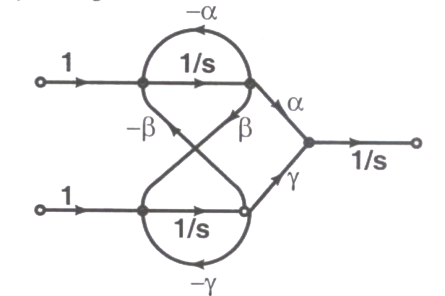
A signal flow graph of a system is given below.\n\nThe set of equations that correspond to this signal flow graph is

Question diagram

Open complete paper
7
2009 · Electronics & Communication Engineering · Networks, Signals and Systems · Continuous-time Signals
Electronics & Communication Engineering (EC) 2009
The Fourier series of a real periodic function has only
P. cosine terms if it is even
Q. sine terms if it is even
R. cosine terms if it is odd
S. sine terms if it is odd
Which of the above statements are correct ?
Open complete paper
8
2009 · Electronics & Communication Engineering · Networks, Signals and Systems · Continuous-time Signals
Electronics & Communication Engineering (EC) 2009
A function is given by \(f(t) = \sin^2 t + \cos 2t\). Which of the following is true ?
Open complete paper
9
2010 · Electronics & Communication Engineering · Networks, Signals and Systems · Continuous-time Signals
Electronics & Communication Engineering (EC) 2010

The trigonometric Fourier series for the waveform f(t) shown below contains

Question diagram

Open complete paper
10
2011 · Electronics & Communication Engineering · Networks, Signals and Systems · Continuous-time Signals
Electronics & Communication Engineering (EC) 2011

The trigonometric Fourier series of an even function does not have the

Open complete paper
11
2012 · Electronics & Communication Engineering · Networks, Signals and Systems · Continuous-time Signals
Electronics & Communication Engineering (EC) 2012
The Fourier transform of a signal \( h(t) \) is \( H(j\omega) = (2\cos\omega)(\sin 2\omega)/\omega \). The value of \( h(0) \) is
Open complete paper
12
2013 · Electronics & Communication Engineering · Networks, Signals and Systems · Continuous-time Signals
Electronics & Communication Engineering (EC) 2013 [Session 1]
For a periodic signal \( v(t) = 30\sin 100t + 10\cos 300t + 6\sin(500t + \pi/4) \), the fundamental frequency in rad/s is
Open complete paper
13
2013 · Electronics & Communication Engineering · Networks, Signals and Systems · Continuous-time Signals
Electronics & Communication Engineering (EC) 2013 [Session 1]

A band-limited signal with a maximum frequency of 5 kHz is to be sampled. According to the sampling theorem, the sampling frequency which is not valid is

Open complete paper
14
2013 · Electronics & Communication Engineering · Networks, Signals and Systems · Continuous-time Signals
Electronics & Communication Engineering (EC) 2013 [Session 2]
For a periodic signal \( v(t) = 30\sin 100t + 10\cos 300t + 6\sin (500t + \pi / 4) \), the fundamental frequency in rad/s is
Open complete paper
15
2013 · Electronics & Communication Engineering · Networks, Signals and Systems · Continuous-time Signals
Electronics & Communication Engineering (EC) 2013 [Session 3]
For a periodic signal \(v(t) = 30 \sin 100t + 10 \cos 300t + 6 \sin(500t + \pi/4)\), the fundamental frequency in rad/s is
Open complete paper
16
2013 · Electronics & Communication Engineering · Networks, Signals and Systems · Continuous-time Signals
Electronics & Communication Engineering (EC) 2013 [Session 4]
For a periodic signal \(v(t) = 30\sin 100t + 10\cos 300t + 6\sin(500t + \pi/4)\), the fundamental frequency in rad/s is
Open complete paper
17
2014 · Electronics & Communication Engineering · Networks, Signals and Systems · Continuous-time Signals
Electronics & Communication Engineering (EC) 2014 [Session 1]
For a function \(g(t)\), it is given that \(\int_{-\infty}^{+\infty} g(t)e^{-j\omega t} dt = \omega e^{-2\omega^2}\) for any real value \(\omega\). If \(y(t) = \int_{-\infty}^{t} g(\tau) d\tau\), then \(\int_{-\infty}^{+\infty} y(t) dt\) is
Open complete paper
18
2014 · Electronics & Communication Engineering · Networks, Signals and Systems · Continuous-time Signals
Electronics & Communication Engineering (EC) 2014 [Session 1]
Consider a random process \(X(t) = \sqrt{2}\sin(2\pi t + \varphi)\), where the random phase \(\varphi\) is uniformly distributed in the interval \([0, 2\pi]\). The auto-correlation \(E[X(t_1)X(t_2)]\) is
Open complete paper
19
2015 · Electronics & Communication Engineering · Networks, Signals and Systems · Continuous-time Signals
Electronics & Communication Engineering (EC) 2015 [Session 2]
The bilateral Laplace transform of a function \( f(t) = \begin{cases} 1 & \text{if } a \leq t \leq b \\ 0 & \text{otherwise} \end{cases} \) is
Open complete paper
20
2016 · Electronics & Communication Engineering · Networks, Signals and Systems · Continuous-time Signals
Electronics & Communication Engineering (EC) 2016 [Session 1]
The Laplace transform of the causal periodic square wave of period T shown in the figure below is

Question diagram

Open complete paper

Showing 20 of 44 questions