My Cart
Your Cart 0

    Your cart is empty.

  • Total (Amount) ₹0.00
Previous year question hub

Discrete-time Signals - Networks, Signals and Systems - Electronics & Communication Engineering Previous Year Questions

Practice Discrete-time Signals - Networks, Signals and Systems - Electronics & Communication Engineering previous year questions organised from real papers, with year-wise coverage and clear topic navigation.

22Papers
14Years
44Questions
1Topics

Discrete-time Signals question pattern

Every graph below is calculated only from this selection.

Questions by year

Year-wise coverage for Discrete-time Signals. Each bar uses a separate theme-derived color.

Difficulty distribution

How the classified questions are distributed by difficulty.

Medium 34 77.3%
Easy 9 20.5%
Hard 1 2.3%
Question type distribution

MCQ, numerical, multiple-select and other formats found in these papers.

MCQ 24 54.5%
Numerical Answer Type (NAT) 14 31.8%
MSQ 6 13.6%

Subject weightage

Top subjects by unique question coverage.

Electronics & Communication Engineering
44 Qs

Most asked topics

Top topics across the included previous year papers.

Networks, Signals and Systems
44 Qs

Subtopic coverage

Top subtopics inside this exact selection.

Discrete-time Signals
44 Qs

Paper coverage

Question coverage for the most populated papers. Every active PYP paper remains listed below.

Electronics and Communication Engineering (EC) 2026
2 Qs
Electronics & Communication Engineering (EC) 2025
1 Qs
Electronics & Communication Engineering (EC) 2024
3 Qs
Electronics & Communication Engineering (EC) 2023
2 Qs
Electronics & Communication Engineering (EC) 2022
2 Qs
Electronics & Communication Engineering (EC) 2021
3 Qs
Electronics & Communication Engineering (EC) 2020
5 Qs
Electronics & Communication Engineering (EC) 2019
3 Qs
Electronics & Communication Engineering (EC) 2018
2 Qs
Electronics & Communication Engineering (EC) 2017
1 Qs
Electronics & Communication Engineering (EC) 2016 [Session 3]
3 Qs
Electronics & Communication Engineering (EC) 2016 [Session 1]
2 Qs
Electronics & Communication Engineering (EC) 2016 [Session 2]
1 Qs
Electronics & Communication Engineering (EC) 2014 [Session 4]
3 Qs
Electronics & Communication Engineering (EC) 2014 [Session 1]
2 Qs
Electronics & Communication Engineering (EC) 2014 [Session 2]
2 Qs
Electronics & Communication Engineering (EC) 2014 [Session 3]
1 Qs
Electronics & Communication Engineering (EC) 2013 [Session 1]
1 Qs
Electronics & Communication Engineering (EC) 2013 [Session 2]
1 Qs
Electronics & Communication Engineering (EC) 2013 [Session 3]
1 Qs
Electronics & Communication Engineering (EC) 2013 [Session 4]
1 Qs
Electronics & Communication Engineering (EC) 2012
2 Qs

Included previous year papers

Newest papers appear first. Sort by year, question coverage or name.

PaperYear / sessionQuestions in this viewOpen
Electronics and Communication Engineering (EC) 202620262View paper
Electronics & Communication Engineering (EC) 202520251View paper
Electronics & Communication Engineering (EC) 202420243View paper
Electronics & Communication Engineering (EC) 202320232View paper
Electronics & Communication Engineering (EC) 202220222View paper
Electronics & Communication Engineering (EC) 202120213View paper
Electronics & Communication Engineering (EC) 202020205View paper
Electronics & Communication Engineering (EC) 201920193View paper
Electronics & Communication Engineering (EC) 201820182View paper
Electronics & Communication Engineering (EC) 201720171View paper
Electronics & Communication Engineering (EC) 2016 [Session 1]20162View paper
Electronics & Communication Engineering (EC) 2016 [Session 2]20161View paper
Electronics & Communication Engineering (EC) 2016 [Session 3]20163View paper
Electronics & Communication Engineering (EC) 2014 [Session 1]20142View paper
Electronics & Communication Engineering (EC) 2014 [Session 2]20142View paper
Electronics & Communication Engineering (EC) 2014 [Session 3]20141View paper
Electronics & Communication Engineering (EC) 2014 [Session 4]20143View paper
Electronics & Communication Engineering (EC) 2013 [Session 1]20131View paper
Electronics & Communication Engineering (EC) 2013 [Session 2]20131View paper
Electronics & Communication Engineering (EC) 2013 [Session 3]20131View paper
Electronics & Communication Engineering (EC) 2013 [Session 4]20131View paper
Electronics & Communication Engineering (EC) 201220122View paper

All Discrete-time Signals previous year questions

Practice every matching question in batches of 20, with every available option.

1
2012 · Electronics & Communication Engineering · Networks, Signals and Systems · Discrete-time Signals
Electronics & Communication Engineering (EC) 2012
If \( x[n] = (1/3)^{|n|} - (1/2)^n u[n] \), then the region of convergence (ROC) of its Z-transform in the Z-plane will be
Open complete paper
2
2012 · Electronics & Communication Engineering · Networks, Signals and Systems · Discrete-time Signals
Electronics & Communication Engineering (EC) 2012
Let \( y[n] \) denote the convolution of \( h[n] \) and \( g[n] \), where \( h[n] = (1/2)^n u[n] \) and \( g[n] \) is a causal sequence. If \( y[0] = 1 \) and \( y[1] = 1/2 \), then \( g[1] \) equals
Open complete paper
3
2013 · Electronics & Communication Engineering · Networks, Signals and Systems · Discrete-time Signals
Electronics & Communication Engineering (EC) 2013 [Session 1]
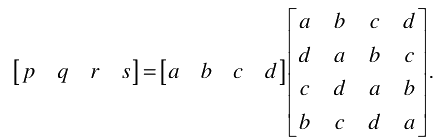
The DFT of a vector [a b c d] is the vector [α β γ δ]. Consider the product
[p q r s] = [a b c d] \begin{bmatrix} a & b & c & d \\ d & a & b & c \\ c & d & a & b \\ b & c & d & a \end{bmatrix}
The DFT of the vector [p q r s] is a scaled version of
Open complete paper
4
2013 · Electronics & Communication Engineering · Networks, Signals and Systems · Discrete-time Signals
Electronics & Communication Engineering (EC) 2013 [Session 2]
The DFT of a vector \([a \quad b \quad c \quad d]\) is the vector \([\alpha \quad \beta \quad \gamma \quad \delta]\). Consider the product \[[p \quad q \quad r \quad s] = [a \quad b \quad c \quad d] \begin{bmatrix} a & b & c & d \\ d & a & b & c \\ c & d & a & b \\ b & c & d & a \end{bmatrix}\] The DFT of the vector \([p \quad q \quad r \quad s]\) is a scaled version of
Open complete paper
5
2013 · Electronics & Communication Engineering · Networks, Signals and Systems · Discrete-time Signals
Electronics & Communication Engineering (EC) 2013 [Session 3]
The DFT of a vector \([a \ b \ c \ d]\) is the vector \([\alpha \ \beta \ \gamma \ \delta]\). Consider the product \[[p \ q \ r \ s] = [a \ b \ c \ d] \begin{bmatrix} a & b & c & d \\ d & a & b & c \\ c & d & a & b \\ b & c & d & a \end{bmatrix}\] The DFT of the vector \([p \ q \ r \ s]\) is a scaled version of
Open complete paper
6
2013 · Electronics & Communication Engineering · Networks, Signals and Systems · Discrete-time Signals
Electronics & Communication Engineering (EC) 2013 [Session 4]
The DFT of a vector [a b c d] is the vector [α β γ δ]. Consider the product [p q r s] = [a b c d] ⎡⎢⎢⎢⎣a b c d d a b c c d a b b c d a⎤⎥⎥⎥⎦ The DFT of the vector [p q r s] is a scaled version of

Question diagram

Open complete paper
7
2014 · Electronics & Communication Engineering · Networks, Signals and Systems · Discrete-time Signals
Electronics & Communication Engineering (EC) 2014 [Session 1]
A discrete-time signal x[n] = sin(π²n), n being an integer, is
Open complete paper
8
2014 · Electronics & Communication Engineering · Networks, Signals and Systems · Discrete-time Signals
Electronics & Communication Engineering (EC) 2014 [Session 1]
Let $x[n] = \left(-\frac{1}{3}\right)^n u(n) - \left(\frac{1}{3}\right)^n u(-n-1)$. The Region of Convergence (ROC) of the z-transform of $x[n]$
Open complete paper
9
2014 · Electronics & Communication Engineering · Networks, Signals and Systems · Discrete-time Signals
Electronics & Communication Engineering (EC) 2014 [Session 2]
An FIR system is described by the system function
H(z) = 1 + 7/2 z⁻¹ + 3/2 z⁻²
The system is
Open complete paper
10
2014 · Electronics & Communication Engineering · Networks, Signals and Systems · Discrete-time Signals
Electronics & Communication Engineering (EC) 2014 [Session 2]
Let $x[n] = x[-n]$. Let $X(z)$ be the z-transform of $x[n]$. If $0.5 + j 0.25$ is a zero of $X(z)$, which one of the following must also be a zero of $X(z)$.
Open complete paper
11
2014 · Electronics & Communication Engineering · Networks, Signals and Systems · Discrete-time Signals
Electronics & Communication Engineering (EC) 2014 [Session 3]
For an all-pass system \(H(z) = \frac{(z^{-1} - b)}{(1 - az^{-1})}\), where \(|H(e^{-j\omega})| = 1\) for all \(\omega\). If \(\text{Re}(a) \neq 0\), \(\text{Im}(a) \neq 0\), then \(b\) equals
Open complete paper
12
2014 · Electronics & Communication Engineering · Networks, Signals and Systems · Discrete-time Signals
Electronics & Communication Engineering (EC) 2014 [Session 4]
A Fourier transform pair is given by \[\left(\frac{2}{3}\right)^n u[n+3] \stackrel{FT}{\longleftrightarrow} \frac{A e^{-j6\pi f}}{1 - \left(\frac{2}{3}\right)e^{-j2\pi f}}\] where \(u[n]\) denotes the unit step sequence. The values of \(A\) is ________.
Open complete paper
13
2014 · Electronics & Communication Engineering · Networks, Signals and Systems · Discrete-time Signals
Electronics & Communication Engineering (EC) 2014 [Session 4]
The sequence \(x[n] = 0.5^n u[n]\), where \(u[n]\) is the unit step sequence, is convolved with itself to obtain \(y[n]\). Then \(\sum_{n=-\infty}^{\infty} y[n]\) is ________.
Open complete paper
14
2014 · Electronics & Communication Engineering · Networks, Signals and Systems · Discrete-time Signals
Electronics & Communication Engineering (EC) 2014 [Session 4]
The \(N\)-point DFT \(X\) of a sequence \(x[n]\), \(0 \le n \le N-1\) is given by \[X[k] = \frac{1}{\sqrt{N}} \sum_{n=0}^{N-1} x[n] e^{j\frac{2\pi}{N}nk}, \quad 0 \le k \le N-1.\] Denote this relation as \(X = DFT(x)\). For \(N=4\), which one of the following sequences satisfies \(DFT(DFT(x)) = x\)?
Open complete paper
15
2016 · Electronics & Communication Engineering · Networks, Signals and Systems · Discrete-time Signals
Electronics & Communication Engineering (EC) 2016 [Session 1]
A sequence x[n] is specified as \[\begin{bmatrix} x[n] \\ x[n-1] \end{bmatrix} = \begin{bmatrix} 1 & 1 \\ 1 & 0 \end{bmatrix}^n \begin{bmatrix} 1 \\ 0 \end{bmatrix}, \text{ for } n \geq 2.\] The initial conditions are x[0] = 1, x[1] = 1, and x[n] = 0 for n < 0. The value of x[12] is ______
Open complete paper
16
2016 · Electronics & Communication Engineering · Networks, Signals and Systems · Discrete-time Signals
Electronics & Communication Engineering (EC) 2016 [Session 1]
Consider the signal \(x[n] = 6 \delta[n+2] + 3 \delta[n+1] + 8 \delta[n] + 7 \delta[n-1] + 4 \delta[n-2]\).
If \(X(e^{j\omega})\) is the discrete-time Fourier transform of \(x[n]\), then \(\frac{1}{\pi} \int_{-\pi}^{\pi} X(e^{j\omega}) \sin^2(2\omega) d\omega\) is equal to ______
Open complete paper
17
2016 · Electronics & Communication Engineering · Networks, Signals and Systems · Discrete-time Signals
Electronics & Communication Engineering (EC) 2016 [Session 2]
The Discrete Fourier Transform (DFT) of the 4-point sequence
$x[n] = \{x[0], x[1], x[2], x[3]\} = \{3, 2, 3, 4\}$ is
$X[k] = \{X[0], X[1], X[2], X[3]\} = \{12, 2j, 0, -2j\}$.
If $X_1[k]$ is the DFT of the 12-point sequence $x_1[n] = \{3, 0, 0, 2, 0, 0, 3, 0, 0, 4, 0, 0\}$,
the value of $\left| \frac{X_1[8]}{X_1[11]} \right|$ is ________
Open complete paper
18
2016 · Electronics & Communication Engineering · Networks, Signals and Systems · Discrete-time Signals
Electronics & Communication Engineering (EC) 2016 [Session 3]
A continuous-time speech signal \(x_a(t)\) is sampled at a rate of 8 kHz and the samples are subsequently grouped in blocks, each of size \(N\). The DFT of each block is to be computed in real time using the radix-2 decimation-in-frequency FFT algorithm. If the processor performs all operations sequentially, and takes 20 μs for computing each complex multiplication (including multiplications by 1 and –1) and the time required for addition/subtraction is negligible, then the maximum value of \(N\) is __________
Open complete paper
19
2016 · Electronics & Communication Engineering · Networks, Signals and Systems · Discrete-time Signals
Electronics & Communication Engineering (EC) 2016 [Session 3]
The direct form structure of an FIR (finite impulse response) filter is shown in the figure. The filter can be used to approximate a
Open complete paper
20
2016 · Electronics & Communication Engineering · Networks, Signals and Systems · Discrete-time Signals
Electronics & Communication Engineering (EC) 2016 [Session 3]
A discrete-time signal \(x[n] = \delta[n-3] + 2\delta[n-5]\) has z-transform \(X(z)\). If \(Y(z) = X(-z)\) is the z-transform of another signal \(y[n]\), then
Open complete paper

Showing 20 of 44 questions