My Cart
Your Cart 0

    Your cart is empty.

  • Total (Amount) ₹0.00
NCERT Exemplar · Class 9 · Science

Chapter 2: Is Matter around Us Pure?

Practice each question, then open the answer or worked solution.

Long Answer Questions

10 questions
Q33Written answer

Fractional distillation is suitable for the separation of miscible liquids with a boiling point difference of about 25 K or less. What part of the fractional distillation apparatus makes it efficient and possesses an advantage over a simple distillation process? Explain using a diagram.

Show solutionHide solution
Worked solution

The fractional column is the most important part of the fractional distillation apparatus. It is provided with glass beads in it. This column helps to obstruct the upward movement of the vapours of the two liquids. The vapours of high boiling liquid get condensed earlier at a lower level. Latent heat released helps to take the vapours of low boiling liquid to a height in the fractionating column.
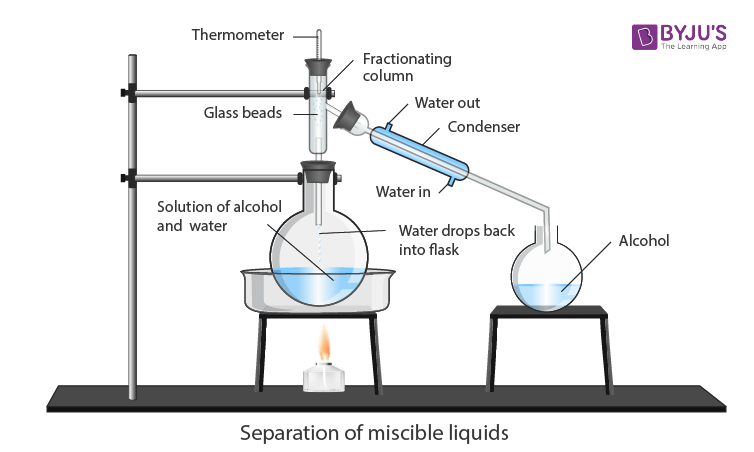
Separation of miscible liquids

The advantages are as given below:

  1. This method can separate the liquids with a boiling point difference of about or less than 25 K,
  2. During the process, both evaporation and condensation take place simultaneously.
  3. A mixture (like petroleum) can also be separated by the fractional distillation process, which contains several components.
Q34Written answer

(a)Under which category of mixtures will you classify alloys and why?

(b) A solution is always a liquid. Comment.

(c) Can a solution be heterogeneous?

Show solutionHide solution
Worked solution

a) An alloy is a homogenous mixture of two or more elements. Elements can be two metals or metals with non-metals.

An alloy is classified as a homogenous mixture because it shows the properties of two or more elements it is made of. Its constituents are in varied compositions. For example, brass is an alloy which shows characteristics of copper and Zinc, and their composition varies from 20 to 35 %.

b) The solution is usually a liquid, but not always. It might also include a mixture of two solids, like in alloys, and a mixture of gases, such as air.

(c) Yes, solutions can be heterogeneous.

Q35Written answer

Iron filings and sulphur were mixed together and divided into two parts, ‘A’ and ‘B’. Part ‘A’ was heated strongly, while Part ‘B’ was not heated. Dilute hydrochloric acid was added to both Parts and the evolution of gas was seen in both cases. How will you identify the gases evolved?

Show solutionHide solution
Worked solution

When iron fillings and sulphur is heated, it will give the following reaction

Fe(s)+S(s) → FeS

When HCl is added to this mixture, ferric chloride is produced, and Hydrogen Sulphide gas is produced. A foul rotten egg smell of Hydrogen sulphide is the indicator of H2S production.

When dilute HCL is added to setup B, Hydrogen gas is evolved, and sulphur does not take part in the reaction. When a burning matchstick is brought near the evolved gas, the matchstick burns with a pop. This is the indication of the production of Hydrogen gas.

Q36Written answer

A child wanted to separate the mixture of dyes constituting a sample of ink. He marked a line by the ink on the filter paper and placed the filter paper in a glass containing water as shown in Fig.2.3. The filter paper was removed when the water moved near the top of the filter paper.

(i) What would you expect to see, if the ink contains three different coloured components?

(ii) Name the technique used by the child.

(iii) Suggest one more application of this technique.

Show solutionHide solution
Worked solution

(i) If the ink contains three different coloured components, then you can observe three different bands on the paper

(ii) Child uses the technique of paper chromatography

(iii) Paper chromatography is used to separate different pigments present in the chlorophyll.

Q37Written answer

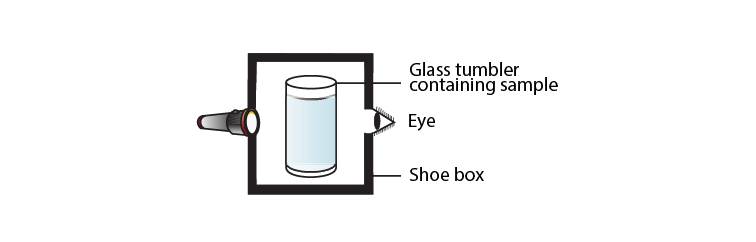
A group of students took an old shoe box and covered it with a black paper from all sides. They fixed a source of light (a torch) at one end of the box by making a hole in it and making another hole on the other side to view the light. They placed a milk sample contained in a beaker/tumbler in the box, as shown in Fig.2.4. They were amazed to see that milk taken in the tumbler was illuminated. They tried the same activity by taking a salt solution but found that light simply passed through it.

Illumination

(a) Explain why the milk sample was illuminated. Name the phenomenon involved.

(b) Same results were not observed with a salt solution. Explain.

(c) Can you suggest two more solutions which would show the same effect as shown in the milk solution?

Show solutionHide solution
Worked solution

a) Milk is a colloidal substance. Particulate matter present in the milk makes the light scatter, which results in the Tyndall effect. Because of the Tyndall effect, the milk got illuminated.

b) Salt is a homogenous solution. Small particles present in salt solution do not scatter light rays hence there will be no Tyndall effect. Since the salt solution did not exhibit the Tyndall effect, light is not illuminated.

c) Detergent solution and sulphur solution exhibit the Tyndall effect.

Q38Written answer

Classify each of the following as a physical or a chemical change. Give reasons.

(a) Drying of a shirt in the sun.

(b) Rising of hot air over a radiator.

(c) Burning of kerosene in a lantern.

(d) Change in the colour of black tea by adding lemon juice to it.

(e) Churning of milk cream to get butter.

Show solutionHide solution
Worked solution

a) Drying of the shirt in the sun is a physical phenomenon because there are no chemical reactions or any chemical changes involved in this process.

b) Rising of hot air over the radiator is a physical change. Water in a radiator converts to vapours. Hot air becomes lighter and rises.

c) Burning of kerosene in a lantern is a chemical change because kerosene burns by using atmospheric oxygen and produces carbon dioxide.

d) Change in the colour of black tea on adding lemon juice to it is a chemical change. Lemon juice is a source of citric acid, ascorbic acid and malic acid. This acid reacts with Flavin antioxidants present in black tea to change the colour of the tea.

e) Churning of milk cream to get butter is a physical change as there is no involvement of a chemical reaction. Here, the principle is centrifugation which turns the milk cream into butter.

Q39Written answer

During an experiment, the students were asked to prepare a 10% (Mass/Mass) solution of sugar in water. Ramesh dissolved 10g of sugar in 100g of water while Sarika prepared it by dissolving 10g of sugar in water to make 100g of the solution. (a) Are the two solutions of the same concentration (b) Compare the mass % of the two solutions.

Show solutionHide solution
Worked solution

Mass % = Mass of solute  Mass of solute + Mass of solvent ×100

The solution made by Ramesh

Mass % = 10/ 100 +10 x 100 = 10 /110 x100 = 9.09%

Solution made by Sarika = Mass %  = 10 /100 ×100 = 10%

The solution prepared by Sarika has a higher mass % than that prepared by Ramesh.

Q40Written answer

You are provided with a mixture containing sand, iron filings, ammonium chloride and sodium chloride. Describe the procedures you would use to separate these constituents from the mixture.

Show solutionHide solution
Worked solution
  1. Using Magnet: Move the magnet over the mixture, which will result in the sticking of iron fillings to the magnet. Like this, iron fillings get separated from the mixture.
  2. Sublimation: The remaining mixture is heated in a china dish. Ammonium chloride is a sublimating substance, and it will evaporate without passing through the liquid phase. Ammonium chloride can collect an inverted funnel over china-dish.
  3. Sedimentation, decantation and filtration: The remaining mixture is dissolved in water and allowed to settle down. Sand will settle at the bottom. The liquid should be decanted into another beaker. Then it is filtered to remove traces of sand.
  4. The filtered solution is heated to evaporate the water. Once all the water gets evaporated, salt remains in the beaker.
Q41Multiple choice

Arun has prepared a 0.01% (by mass) solution of sodium chloride in water. Which of the following correctly represents the composition of the solutions?

Show solutionHide solution
Worked solution

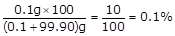
Here,

mass percentage

41 solution

which is equal to the percentage of sodium chloride in water prepared by Arun. So, option (c) is correct.

In option (a), mass% =
41 solution

Q42Written answer

Calculate the mass of sodium sulphate required to prepare its 20% (mass per cent) solution in 100g of water?

Show solutionHide solution
Worked solution

In option (b), mass% =
42 solution

In option (d), mass% =
42 solution

Hence, the other three representations are incorrect.