My Cart
Your Cart 0

    Your cart is empty.

  • Total (Amount) ₹0.00
NCERT Exemplar · Class 9 · Science

Chapter 2: Is Matter around Us Pure?

Practice each question, then open the answer or worked solution.

Short Answer Questions

23 questions
Q10Written answer

Suggest separation technique(s) one would need to employ to separate the following mixtures.

(a) Mercury and water

(b) Potassium chloride and ammonium chloride

(c) Common salt, water and sand

(d) Kerosene oil, water and salt

Show solutionHide solution
Worked solution

Answers are a) decantation, b) Sublimation, c) Filtration and evaporation, d) decantation and evaporation

Explanation
a) Decantation method is used to separate the mixture of Mercury and water. Here Mercury is heavier than water hence it forms a separate layer which can be easily separated in a separating funnel.
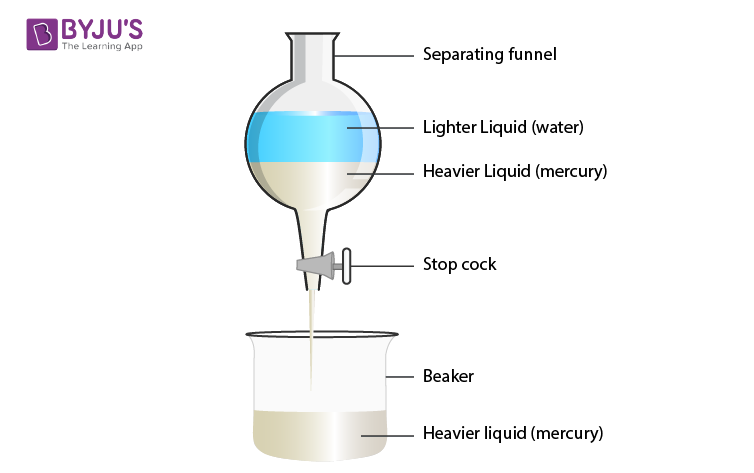
Decantation method

b) Potassium chloride and ammonium chloride are separated by sublimation method because ammonium chloride is a sublimate, sublimes leaving behind the potassium chloride.
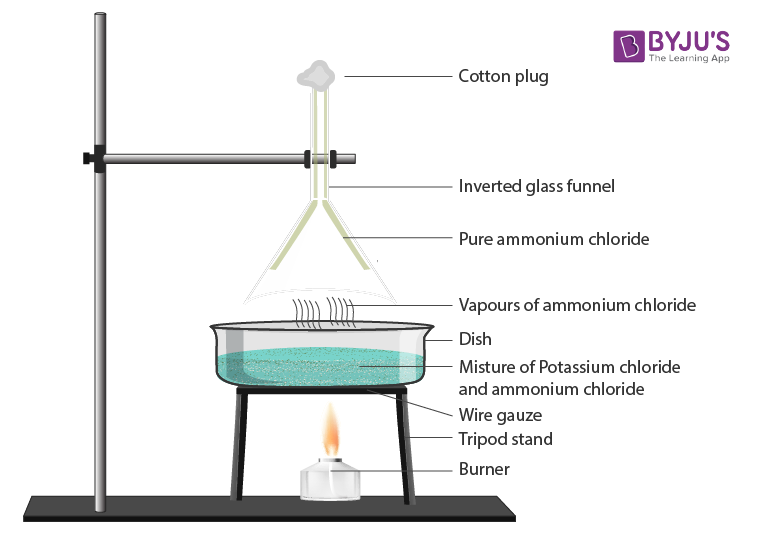
Sublimation method

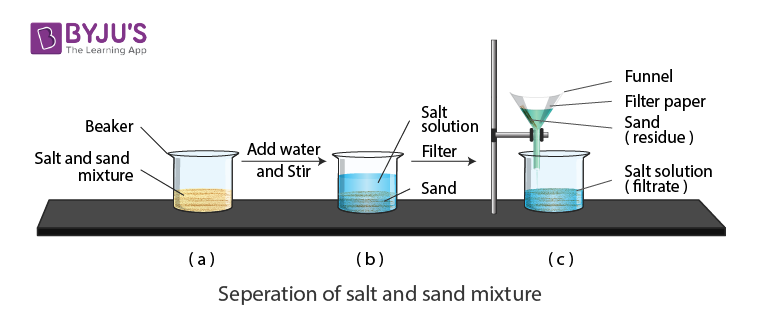
Seperation of salt and mixture
c) Common salt, water and sand are separated by filtration and evaporation processes. Common salt, water and sand are filtrated to separate the sand from the salt solution. Then, salt solution is heated to evaporate the water leaving behind salt.
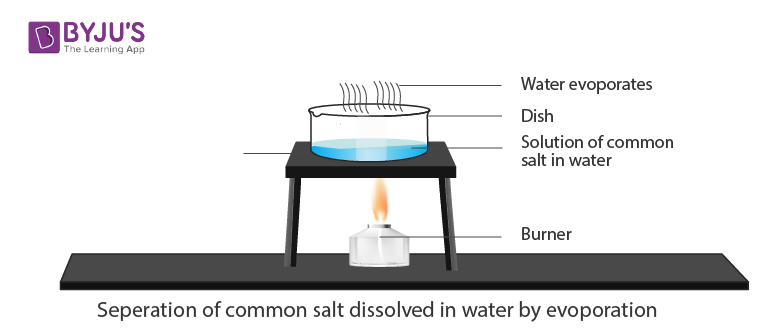
Seperation of common salt

(d) Kerosene is separated from salt solution in water by decantation using a separating funnel. Kerosene being heavier, forms a separate layer. Salt from water is further removed by evaporation.

Q11Written answer

Which of the tubes in Fig. 2.1

(a) and (b) will be more effective as a condenser in the distillation apparatus?

Distillation apparatus

Show solutionHide solution
Worked solution

The answer is: tube (a)

Explanation

Beads in tube A provide an increased surface area for cooling of the vapours that come in contact with them. Hence, it is a good condenser.

Q12Written answer

Salt can be recovered from its solution by evaporation. Suggest some other technique for the same.

Show solutionHide solution
Worked solution

Answer is crystallization

Explanation:

Salt can be recovered from its solution by crystallization. Crystallization is a more efficient process as it removes soluble impurities, which cannot be done by evaporation.

Q13Written answer

The ‘seawater’ can be classified as a homogeneous as well as heterogeneous mixture. Comment.

Show solutionHide solution
Worked solution

If we consider the seawater on the surface, it comprises water and salts hence it is a homogenous mixture. If we consider the seawater from the deep sea, it consists of salts, water, mud, decayed plants etc, which will be a heterogeneous mixture.

Q14Written answer

While diluting a solution of salt in water, a student, by mistake, added acetone (boiling point 56°C). What technique can be employed to get back the acetone? Justify your choice.

Show solutionHide solution
Worked solution

Fractional Distillation can be used to separate acetone from the mixture of salt and water.

Explanation

There are considerable differences in the boiling points of acetone (56°C) and water (100°C). When the solution is heated, acetone evaporates first. The water is collected in the distillation flask. The vapours of acetone are then condensed to obtain acetone.

Q15Written answer

What would you observe when

(a) a saturated solution of potassium chloride prepared at 60°C is allowed to cool to room temperature?

(b) an aqueous sugar solution is heated to dryness>

(c) a mixture of iron filings and sulphur powder is heated strongly?

Show solutionHide solution
Worked solution

a) Sodium potassium chloride will separate from the saturated solution when the temperature of the solution is reduced from 60°C to room temperature. The solubility of the solid state is affected by the change in temperature.
b) When aqueous sugar solution is heated, first water gets evaporated up to some extent then sugar gets charred.
c) Iron combines with sulphur and forms iron sulphide (FES).

Q16Written answer

Explain why particles of a colloidal solution do not settle down when left undisturbed, while in the case of a suspension, they do.

Show solutionHide solution
Worked solution

The size of the particles in suspension is relatively larger than the size of the particles in a solution. Moreover, in suspension, molecular interaction is weaker to keep the molecules in suspended form. Hence the particles settle down. Similarly, in colloidal solution, molecular interaction is strong hence they remain in suspended form.

Q17Written answer

Smoke and fog are both aerosols. In what way are they different?

Show solutionHide solution
Worked solution

Both smoke and fog have gas as the dispersion medium (continuous phase). But the difference lies in the dispersed phase. The dispersed phase in fog is liquid, whereas, in smoke, it is solid (particulate matter).

Q18Written answer

Classify the following as physical or chemical properties:

(a) The composition of a sample of steel is 98% iron, 1.5% carbon and 0.5% other elements.

(b) Zinc dissolves in hydrochloric acid with the evolution of hydrogen gas.

(c) Metallic sodium is soft enough to be cut with a knife.

(d) Most metal oxides form alkalis on interacting with water.

Show solutionHide solution
Worked solution

Answers: Physical properties are a) and c). Chemical properties are b) and d)

Explanation

a) Composition of a sample of steel is 98% iron, 1.5% carbon and 0.5% other elements. It is a chemical property because no new compound is formed as steel is an alloy and alloy and is a homogeneous mixture of two or more metals or of metallic elements with non-metallic elements.

b) It is a chemical property because zinc reacts with HCL to give out zinc chloride and hydrogen gas.

c) The cutting knife will not involve any chemical reaction and did not form a new compound hence it is a physical property.

d) It is chemical property as the new compound is formed by the interaction of metal oxides with alkalis.

Q19Written answer

The teacher instructed three students, ‘A’, ‘B’ and ‘C’, respectively, to prepare a 50% (mass by volume) solution of sodium hydroxide (NaOH). ‘A’ dissolved 50g of NaOH in 100 mL of water, ‘B’ dissolved 50g of NaOH in 100g of water, while ‘C’ dissolved 50g of NaOH in water to make 100 mL of solution. Which one of them has made the desired solution and why?

Show solutionHide solution
Worked solution

The answer is student C because both B and A have made the solution of 150 ml, whereas student C prepared the required quantity.

Explanation

Students A and B prepared 150 ml solution, so student c made the desired solution because he added water to make 100 ml solution and from the calculation,

%w/v = 100 × weight of sub (solute)

volume of solution

∴ %50 = 100 × weight of sub / 100 ml

weight of sub = 50 ×100 ml / 100

∴  weight of sub = 50 g

Here the 50g NaOH required for 50% w/v 100ml solution of NaOH