My Cart
Your Cart 0

    Your cart is empty.

  • Total (Amount) ₹0.00
NCERT Exemplar · Class 9 · Maths

Chapter 7: Triangles

Practice each question, then open the answer or worked solution.

Exercise 7.4

Textbook page 69 · 10 questions
Q1Written answer

Find all the angles of an equilateral triangle.

Show solutionHide solution
Worked solution

In equilateral triangle,

All the sides are equal.

Therefore, all angles are also equal

Let the angles of an equilateral triangle = x

According to angle sum property,

We know that the sum of the interior angles is equal to 180o.

x+x+x=180o

3x=180

x=60°

Therefore, all the angles of an equilateral triangle are 60°
Q2Written answer

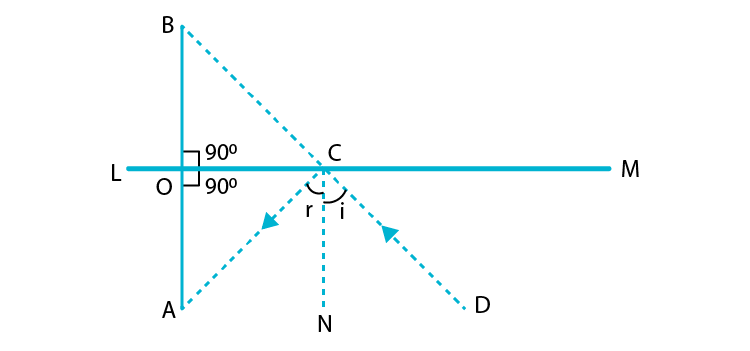
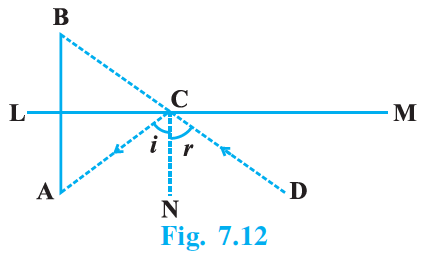
The image of an object placed at a point A before a plane mirror LM is seen at the point B by an observer at D as shown in Fig. 7.12. Prove that the image is as far behind the mirror as the object is in front of the mirror.

[Hint: CN is normal to the mirror. Also, angle of incidence = angle of reflection].

NCERT Exemplar Solutions For Class 9 Maths Chapter 7 Exercise 7.4-1

Show solutionHide solution
Worked solution

Let AB intersect LM at O. We have to prove that AO = BO.

Now, ∠i = ∠r …(1)

∠B = ∠i [Corresponding angles] …(2)

And ∠A = ∠r [Alternate interior angles] …(3)

NCERT Exemplar Solutions For Class 9 Maths Chapter 7 Exercise 7.4-2

From (1), (2) and (3), we get

∠B = ∠A

⇒ ∠BCO = ∠ACO

In ΔBOC and ΔAOC we have

∠1 = ∠2 [Each = 90o]

OC = OC [Common side]

And ∠BCO = ∠ACO [Proved above]

ΔBOC ≅ ΔAOC [ASA congruence rule]

Hence, AO = BO [CPCT]

Q3Written answer

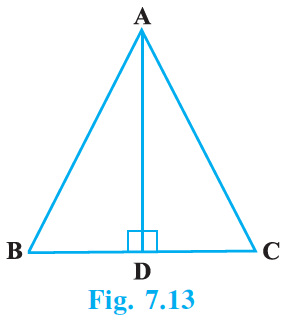
ABC is an isosceles triangle with AB = AC and D is a point on BC such that AD ⊥ BC (Fig. 7.13). To prove that ∠BAD = ∠CAD, a student proceeded as follows:

In Δ ABD and Δ ACD,

AB = AC (Given)

∠B = ∠C (because AB = AC)

And ∠ADB = ∠ADC

Therefore, Δ ABD Δ Δ ACD (AAS)

So, ∠BAD = ∠CAD (CPCT)

NCERT Exemplar Solutions For Class 9 Maths Chapter 7 Exercise 7.4-3

What is the defect in the above arguments?

[Hint: Recall how ∠B = ∠C is proved when AB = AC].

Show solutionHide solution
Worked solution

NCERT Exemplar Solutions For Class 9 Maths Chapter 7 Exercise 7.4-4

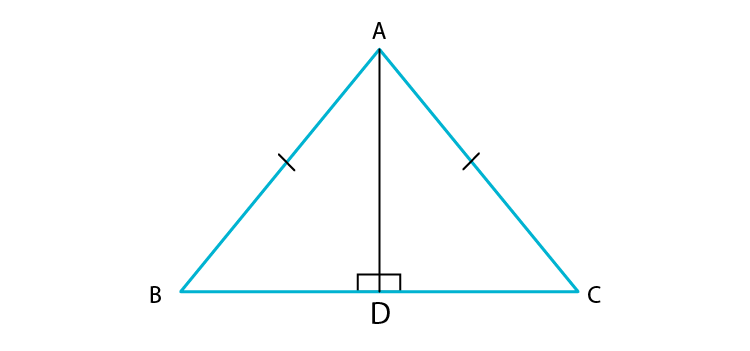
In Δ ABD and Δ ADC, we have

∠ADB = ∠ADC

According to the question,

AB = BC

AD = AD [Common side]

By RHS criterion of congruence,

We have,

Δ ABD ≅ Δ ACD

∠BAD = ∠CAD [CPCT]

Hence Proved.

Q4Written answer

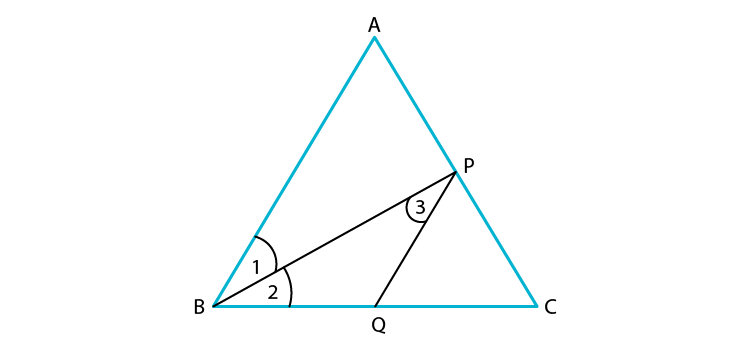
P is a point on the bisector of ∠ABC. If the line through P, parallel to BA meet BC at Q, prove that BPQ is an isosceles triangle.

Show solutionHide solution
Worked solution

NCERT Exemplar Solutions For Class 9 Maths Chapter 7 Exercise 7.4-5

To prove: BPQ is an isosceles triangle.

According to the question,

Since, BP is the bisector of ∠ABC,

∠1 = ∠2 … (1)

Now, PQ is parallel to BA and BP cuts them

∠1 = ∠3 [Alternate angles] … (2)

From equations, (1) and (2),

We get

∠2 = ∠3

In Δ BPQ,

We have

∠2 = ∠3

PQ = BQ

Hence, BPQ is an isosceles triangle.

Q5Written answer

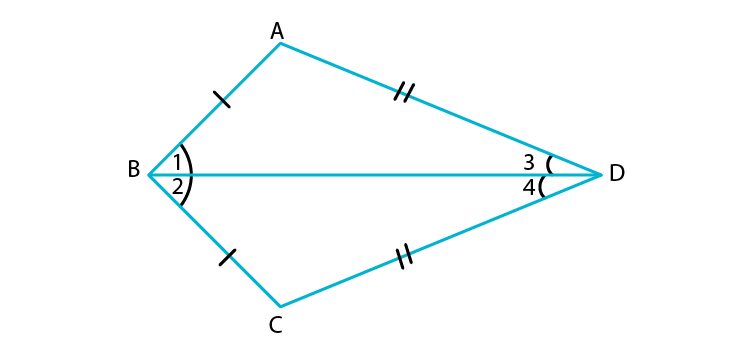
ABCD is a quadrilateral in which AB = BC and AD = CD. Show that BD bisects both the angles ABC and ADC.

Show solutionHide solution
Worked solution

NCERT Exemplar Solutions For Class 9 Maths Chapter 7 Exercise 7.4-6

According to the question,

In ΔABC and ΔCBD,

We have

AB = BC

AD = CD

BD = BD [Common side]

ΔABC ≅ ΔCBD [By SSS congruence rule]

⇒ ∠1 = ∠2 [CPCT]

And ∠3 = ∠4

Hence, BD bisects both ∠ABC and ∠ADC.

Q6Written answer

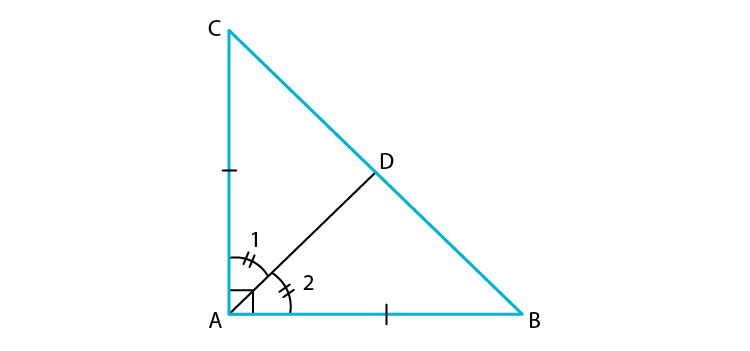
ABC is a right triangle with AB = AC. Bisector of ∠A meets BC at D. Prove that BC = 2 AD.

Show solutionHide solution
Worked solution

Given: A right angles triangle with AB = AC bisector of ∠A meets BC at D.

To prove: BC = 2AD

NCERT Exemplar Solutions For Class 9 Maths Chapter 7 Exercise 7.4-7

Proof:

According to the question,

In right Δ ABC,

AB = AC

Since, hypotenuse is the longest side,

BC is hypotenuse

∠BAC = 90o

Now,

In Δ CAD and Δ BAD,

We have,

AC = AB

Since, AD is the bisector of ∠A,

∠1 = ∠2

AD = AD [Common side]

Now,

By SAS criterion of congruence,

We get,

Δ CAD ≅ Δ BAD

CD = BD [CPCT]

Since, Mid-point of hypotenuse of a right triangle is equidistant from the 3 vertices of a triangle.

AB = BD = CD …(1)

Now, BC = BD + CD

⇒ BC = AD + AD [Using eq.(1)]

⇒ BC = 2AD

Hence, proved.

Q7Written answer

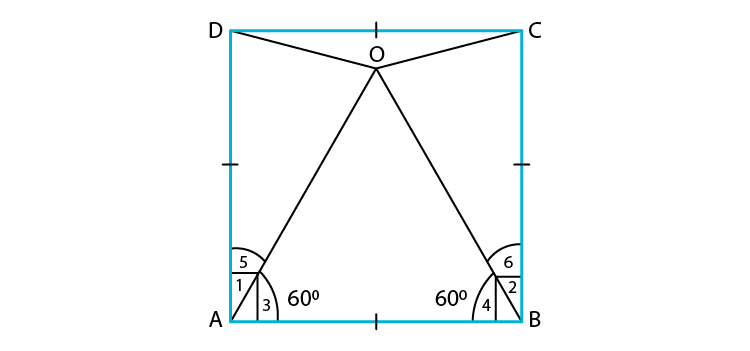
O is a point in the interior of a square ABCD such that OAB is an equilateral triangle. Show that Δ OCD is an isosceles triangle.

Show solutionHide solution
Worked solution

According to the question,

It is given that: A square ABCD and OA = OB = AB.

NCERT Exemplar Solutions For Class 9 Maths Chapter 7 Exercise 7.4-8

To prove: Δ OCD is an isosceles triangle.

Proof:

In square ABCD,

Since ∠1 and ∠2 is equal to 90o

∠1 = ∠2 …(1)

Now, in Δ OAB , we have

Since ∠3 and ∠4 is equal to 60o

∠3 = ∠4 …(2)

Subtracting equations (2) from (1),

We get

∠1−∠3 = ∠2 −∠4

⇒ ∠5 = ∠6

Now,

In Δ DAO and Δ CBO,

AD = BC [Given]

∠5 = ∠6 [Proved above]

OA = OB [Given]

By SAS criterion of congruence,

We have

Δ DAO ≅ Δ CBO

OD = OC

⇒ Δ OCD is an isosceles triangle.

Hence, proved.

Q8Written answer

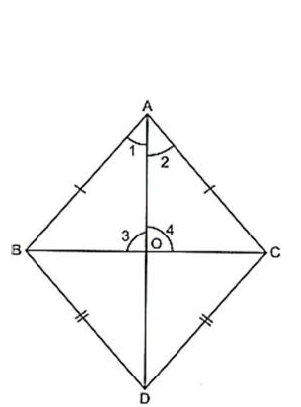
ABC and DBC are two triangles on the same base BC such that A and D lie on the opposite sides of BC, AB = AC and DB = DC. Show that AD is the perpendicular bisector of BC.

Show solutionHide solution
Worked solution

NCERT Exemplar Solutions For Class 9 Maths Chapter 7 Exercise 7.4-9

Given: Δ ABC and Δ DBC on the same base BC. Also, AB = AC and BD = DC.

To prove: AD is the perpendicular bisector of BC i.e., OB = OC

Proof: In Δ BAD and Δ CADwe have

AB = AC [Given]

BD = CD [Given]

AD = AD [common side]

So, by SSS criterion of congruence, we have

Δ BAD ≅ Δ CAD

∠1 = ∠2 [CPCT]

Now, in Δ BAO and Δ CAO, we have

AB = AC [Given]

∠1 = ∠2 [Proved above]

AO = AO [Common side]

So, by SAS criterion of congruence, we have

Δ BAO ≅ Δ CAO

BO = CO [CPCT]

And, ∠3 = ∠4 [CPCT]

But, ∠3+∠4 =180o [Linear pair axiom]

⇒ ∠3+∠3 =180

⇒ 2∠3 =180

⇒ ∠3 =180/2

⇒ ∠3 = 90o

Since BO = CO and ∠3 = 90o,

AD is perpendicular bisector of BC.

Hence, proved.

Q9Written answer

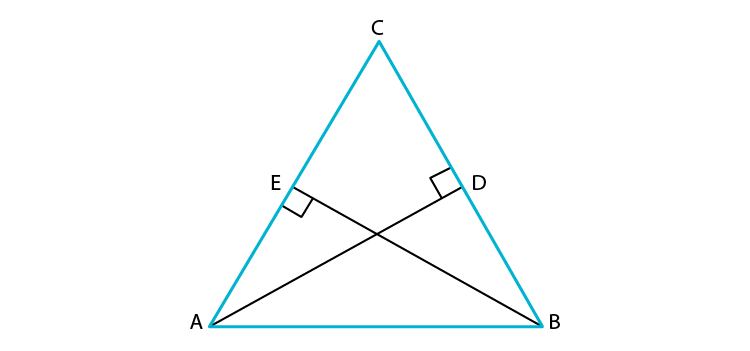
ABC is an isosceles triangle in which AC = BC. AD and BE are respectively two altitudes to sides BC and AC. Prove that AE = BD.

Show solutionHide solution
Worked solution

NCERT Exemplar Solutions For Class 9 Maths Chapter 7 Exercise 7.4-10

According to the question,

In Δ ADC and Δ BEC,

We have

AC = BC [Given] …(1)

Since ∠ADC and ∠BEC = 90o

∠ADC = ∠BEC

∠ACD = ∠BCE [Common angle]

Δ ADC ≅ Δ BEC [By ASA congruence rule]

CE = CD … (2) [CPCT]

Subtracting equation (2) from (1),

We get

AC – CE = BC – CD

⇒ AE = BD

Hence, proved.

Q10Written answer

Prove that sum of any two sides of a triangle is greater than twice the median with respect to the third side.

Show solutionHide solution
Worked solution

According to the question,

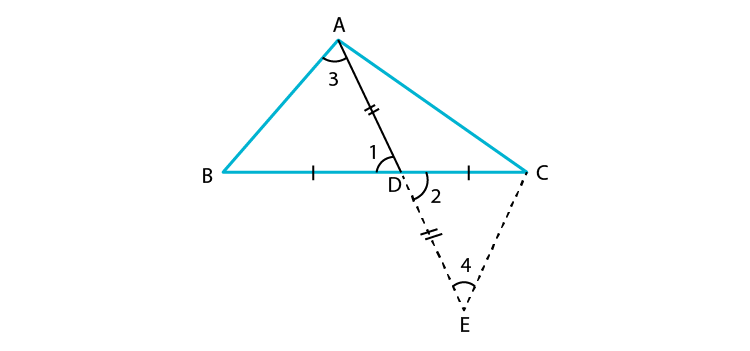
We have, Δ ABC with median AD.

To prove:

AB + AC > 2AD

AB + BC > 2AD

BC + AC > 2AD

Construction:

Extend AD to E such that DE = AD

Join EC.

Proof:

NCERT Exemplar Solutions For Class 9 Maths Chapter 7 Exercise 7.4-11In Δ ADB and Δ EDC ,

AD = ED [By construction]

∠1 = ∠2 [Vertically opposite angles are equal]

DB = DC [Given]

So, by SAS criterion of congruence, we have

Δ ADB ≅ Δ EDC

AB = EC [CPCT]

And ∠3 = ∠4 [CPCT]

Now, in Δ AEC,

Since sum of the lengths of any two sides of a triangle must be greater than the third side,

We have

AC + CE > AE

⇒ AC + CE > AD + DE

⇒ AC +CE > AD+ AD [\AD = DE]

⇒ AC + CE > 2AD

⇒ AC + AB > 2AD [∵AB = CE]

Similarly,

We get,

AB + BC > 2AD and BC + AC >2AD.

Hence, proved.