My Cart
Your Cart 0

    Your cart is empty.

  • Total (Amount) ₹0.00
NCERT Exemplar · Class 9 · Maths

Chapter 2: Polynomials

Practice each question, then open the answer or worked solution.

Exercise 2.3

40 questions
Q21Written answer

Find the value of m so that  $ 2x - 1 $  be a factor of  $ 8{x^4} + 4{x^3} - 16{x^2} + 10x + m $ .

Show solutionHide solution
Worked solution

Ans: Let  $ p\left( x \right) = 8{x^4} + 4{x^3} - 16{x^2} + 10x + m $ 

As,  $ \left( {2x - 1} \right) $  is a factor of  $ p\left( x \right) $ .

Then  $ p\left( {\dfrac{1}{2}} \right) = 0 $ (using factor theorem)

 $  \Rightarrow 8{\left( {\dfrac{1}{2}} \right)^4} + 4{\left( {\dfrac{1}{2}} \right)^3} - 16{\left( {\dfrac{1}{2}} \right)^2} + 10\left( {\dfrac{1}{2}} \right) + m = 0 $ 

 $  \Rightarrow 8\left( {\dfrac{1}{{16}}} \right) + 4\left( {\dfrac{1}{8}} \right) - 16\left( {\dfrac{1}{4}} \right) + 5 + m = 0 $ 

 $  \Rightarrow \dfrac{1}{2} + \dfrac{1}{2} - 4 + 5 + m = 0 $ 

 $  \Rightarrow 1 + 1 + m = 0 $ 

 $  \Rightarrow \,m =  - 2 $ 


Q22Written answer

If  $ x + 1 $  is a factor of  $ a{x^3} + {x^2} - 2x + 4a - 9 $ , find the value of a.

Show solutionHide solution
Worked solution

Ans: Let  $ p\left( x \right) = a{x^3} + {x^2} - 2x + 4a - 9 $ 

As  $ x + 1 $  is a factor of p(x)

Then,

 $ p\left( { - 1} \right) = 0 $  (By factor theorem)

 $  \Rightarrow \,a{\left( { - 1} \right)^3} + {\left( { - 1} \right)^2} - 2\left( { - 1} \right) + 4a - 9 = 0 $ 

 $  \Rightarrow \, - a + 1 + 2 + 4a - 9 = 0 $ 

 $  \Rightarrow \,3a - 6 = 0 $ 

 $  \Rightarrow \,3a = 6 $ 

 $  \Rightarrow \,a = 2 $ 


Q23Written answer

Factorize:

(i)  $ {x^2} + 9x + 18 $ 

(ii)  $ 6{x^2} + 7x - 3 $ 

(iii)  $ 2{x^2} - 7x - 15 $ 

(iv)  $ 84 - 2r - 2{r^2} $ 

Show solutionHide solution
Worked solution

Ans: In order to factorize  $ {x^2} + 9x + 18 $ , we have to split the middle term.

 $  \Rightarrow {x^2} + 9x + 18 $ 

 $  \Rightarrow {x^2} + \left( {6 + 3} \right)x + 18 $ 

 $  \Rightarrow {x^2} + 6x + 3x + 18 $ 

 $  \Rightarrow x\left( {x + 6} \right) + 3\left( {x + 6} \right) $ 

 $  \Rightarrow \left( {x + 3} \right)\left( {x + 6} \right) $ 

Ans: In order to factorize  $ 6{x^2} + 7x - 3 $ , we have to split the middle term.

 $  \Rightarrow 6{x^2} + 7x - 3 $ 

 $  \Rightarrow 6{x^2} + \left( {9 - 2} \right)x - 3 $ 

 $  \Rightarrow 6{x^2} + 9x - 2x - 3 $ 

 $  \Rightarrow 3x\left( {2x + 3} \right) - 1\left( {2x + 3} \right) $ 

 $  \Rightarrow \left( {3x - 1} \right)\left( {2x + 3} \right) $ 

Ans:  If we want to factorise  $ 2{x^2} - 7x - 15 $ , we have to split the middle term.

 $  \Rightarrow 2{x^2} - 7x - 15 $ 

 $  \Rightarrow 2{x^2} - \left( {10 - 3} \right)x - 15 $ 

 $  \Rightarrow 2{x^2} - 10x + 3x - 15 $ 

 $  \Rightarrow 2x\left( {x - 5} \right) + 3\left( {x - 5} \right) $ 

 $  \Rightarrow \left( {2x + 3} \right)\left( {x - 5} \right) $ 

Ans: If we want to factorise  $ 84 - 2r - 2{r^2} $ , we have to split the middle term.

 $  \Rightarrow  - \left( {2{r^2} + 2r - 84} \right) $ 

 $  \Rightarrow  - 2\left( {{r^2} + r - 42} \right) $ 

 $  \Rightarrow  - 2\left( {{r^2} + \left( {7 - 6} \right)r - 42} \right) $ 

 $  \Rightarrow  - 2\left( {{r^2} + 7r - 6r - 42} \right) $ 

 $  \Rightarrow  - 2\left( {r\left( {r + 7} \right) - 6\left( {r + 7} \right)} \right) $ 

 $  \Rightarrow 2\left( {6 - r} \right)\left( {r + 7} \right) $ 


Q24Written answer

Factorise:

(i)  $ 2{x^3} - 3{x^2} - 17x + 30 $ 

(ii)  $ {x^3} - 6{x^2} + 11x - 6 $ 

(iii)  $ {x^3} + {x^2} - 4x + 4 $ 

(iv)  $ 3{x^3} - {x^2} - 3x + 1 $ 

Show solutionHide solution
Worked solution

Ans: Let  $ f\left( x \right) = 2{x^3} - 3{x^2} - 17x + 30 $  be the given Polynomial. The factors of the constant term  $  + 30 $  are  $  \pm 1, \pm 2, \pm 3, \pm 5, \pm 6, \pm 10, \pm 15, \pm 30 $  . The factor of coefficient of  $ {x^3} $  is  $ 2 $ .

Therefore, possible rational roots of f(x) are:

 $  \Rightarrow  \pm 1, \pm 3, \pm 5, \pm 15, \pm \dfrac{1}{2}, \pm \dfrac{3}{2}, \pm \dfrac{5}{2}, \pm \dfrac{{15}}{2} $ 

We  $ f\left( 2 \right) = 2{\left( 2 \right)^3} - 3{\left( 2 \right)^2} - 17\left( 2 \right) + 30 $ 

 $  = 2\left( 8 \right) - 3\left( 4 \right) - 17\left( 2 \right) + 30 $ 

 $  = 16 - 12 - 34 + 30 = 0 $ 

And  $ f\left( { - 3} \right) = 2{\left( { - 3} \right)^3} - 3{\left( { - 3} \right)^2} - 17\left( { - 3} \right) + 30 $ 

 $  = 2\left( { - 27} \right) - 3\left( 9 \right) - 17\left( { - 3} \right) + 30 $ 

 $  =  - 54 - 27 + 51 + 30 = 0 $ 

Hence,  $ \left( {x - 2} \right) $   $ \left( {x + 3} \right) $ ,  will be the factors of  $ f\left( x \right) $ .

 $  \Rightarrow {x^2} + x - 6 $  is a factor of 

 $ f\left( x \right) $ .

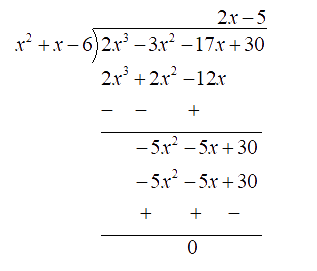
Let's divide  $ f\left( x \right) = 2{x^3} - 3{x^2} - 17x + 30 $  by  $ {x^2} + x - 6 $  to get the other factors of  $ f\left( x \right) $ .

Factors of  $ f\left( x \right) $ .

By long division, we have 

seo images


 $ 2{x^3} - 3{x^2} - 17x + 30 = \left( {{x^2} + x - 6} \right)\left( {2x - 5} \right) $ 

 $  \Rightarrow \,2{x^3} - 3{x^2} - 17x + 30 = \left( {x - 2} \right)\left( {x + 3} \right)\left( {2x - 5} \right) $ 

Hence,  $ \,2{x^3} - 3{x^2} - 17x + 30 = \left( {x - 2} \right)\left( {x + 3} \right)\left( {2x - 5} \right) $ 

Ans: Let  $ f\left( x \right) = {x^3} - 6{x^2} + 11x - 6 $ be the given Polynomial. The factors of the constant term  $  - 6 $  are  $  \pm 1, \pm 2, \pm 3\,\,and\,\, \pm 6 $ . 

We  $ f\left( 1 \right) = {\left( 1 \right)^3} - 6{\left( 1 \right)^2} + 11\left( 1 \right) - 6 = 0 $ 

And  $ f\left( 2 \right) = {\left( 2 \right)^3} - 6{\left( 2 \right)^2} + 11\left( 2 \right) - 6 = 8 - 24 + 22 - 6 = 0 $ 

Hence,  $ \left( {x - 1} \right) $   $ \left( {x - 2} \right) $ ,  will be factors   $ f\left( x \right) $ .

 $  \Rightarrow \left( {x - 1} \right)\left( {x - 2} \right) = {x^2} - 3x + 2 $  will be a factor of  $ f\left( x \right) $ .

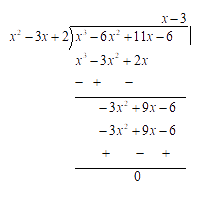
Let us divide  $ f\left( x \right) = {x^3} - 6{x^2} + 11x - 6 $  by  $ {x^2} - 3x + 2 $  to get the other factors of  $ f\left( x \right) $ .

Factors of  $ f\left( x \right) $ .

By long division, we have 

seo images


 $ {x^3} - 6{x^2} + 11x - 6 = \left( {{x^2} - 3x + 2} \right)\left( {x - 3} \right) $ 

 $  \Rightarrow {x^3} - 6{x^2} + 11x - 6 = \left( {x - 1} \right)\left( {x - 2} \right)\left( {x - 3} \right) $ 

Hence,  $ {x^3} - 6{x^2} + 11x - 6 = \left( {x - 1} \right)\left( {x - 2} \right)\left( {x - 3} \right) $ 

Ans: Let  $ f\left( x \right) = {x^3} + {x^2} - 4x - 4 $ be the given Polynomial. The factors of the constant term  $  - 4 $  are  $  \pm 1, \pm 2, \pm 4\, $ . 

We  $ f\left( { - 1} \right) = {\left( { - 1} \right)^3} + {\left( { - 1} \right)^2} - 4\left( { - 1} \right) - 4 = 0 $ 

And  $ f\left( 2 \right) = {\left( 2 \right)^3} + {\left( 2 \right)^2} - 4\left( 2 \right) - 4 = 8 + 4 - 8 - 4 = 0 $ 

Hence,  $ \left( {x + 1} \right) $  ,  $ \left( {x - 2} \right) $  are factors of  $ f\left( x \right) $ .

 $  \Rightarrow \left( {x + 1} \right)\left( {x - 2} \right) = {x^2} - x - 2 $  will be a factor of  $ f\left( x \right) $ .

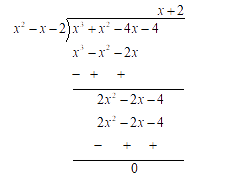
Let's now divide  $ f\left( x \right) = {x^3} + {x^2} - 4x - 4 $  by  $ {x^2} - x - 2 $  to get the other factors of  $ f\left( x \right) $ .

By long division, we have 

seo images


 $ {x^3} + {x^2} - 4x - 4 = \left( {{x^2} - x - 2} \right)\left( {x + 2} \right) $ 

 $  \Rightarrow {x^3} + {x^2} - 4x - 4 = \left( {x + 1} \right)\left( {x - 2} \right)\left( {x + 2} \right) $ 

Hence,  $ {x^3} + {x^2} - 4x - 4 = \left( {x + 1} \right)\left( {x - 2} \right)\left( {x + 2} \right) $ 

Ans: Let  $ f\left( x \right) = 3{x^3} - {x^2} - 3x + 1 $ be the given Polynomial. The factors of a constant term  $  + 1 $  are  $  \pm 1.\, $ The factor of coefficient of  $ {x^3} $  is  $ 3 $ .Hence, possible rational roots of  $ f\left( x \right) $  are  $  \pm \dfrac{1}{3} $ . 

We have,

 $ f\left( 1 \right) = 3{\left( 1 \right)^3} - {\left( 1 \right)^2} - 3\left( 1 \right) + 1 = 0 $ 

And  $ f\left( { - 1} \right) = 3{\left( { - 1} \right)^3} - {\left( { - 1} \right)^2} - 3\left( { - 1} \right) + 1 =  - 3 - 1 + 3 + 1 = 0 $ 

Hence,  $ \left( {x - 1} \right) $   $ \left( {x + 1} \right) $ ,  will be factors of  $ f\left( x \right) $ .

 $  \Rightarrow \left( {x - 1} \right)\left( {x + 2} \right) = {x^2} - 1 $  will be factor of  $ f\left( x \right) $ .

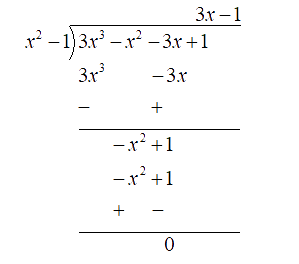
Let's now divide  $ f\left( x \right) = 3{x^3} - {x^2} - 3x + 1 $  by  $ {x^2} - 1 $  to get the other factors of  $ f\left( x \right) $ .

By long division, we have 

seo images


 $ 3{x^3} - {x^2} - 3x + 1 = \left( {{x^2} - 1} \right)\left( {3x - 1} \right) $ 

 $  \Rightarrow 3{x^3} - {x^2} - 3x + 1 = \left( {x - 1} \right)\left( {x + 1} \right)\left( {3x - 1} \right) $ 

Hence,  $ 3{x^3} - {x^2} - 3x + 1 = \left( {x - 1} \right)\left( {x + 1} \right)\left( {3x - 1} \right) $ 


Q25Written answer

Using suitable identify, evaluate the following:

(i)  $ {103^3} $ 

(ii)  $ 101 \times 102 $ 

(iii)  $ {999^2} $ 

Show solutionHide solution
Worked solution

Ans: $ {103^3} = {\left( {100 + 3} \right)^3} $ 

Now using identify  $ {\left( {a + b} \right)^3} = {a^3} + {b^3} + 3ab\left( {a + b} \right) $ , we have

 $ {\left( {100 + 3} \right)^3} = {\left( {100} \right)^3} + {\left( 3 \right)^3} + 3\left( {100} \right)\left( 3 \right)\left( {100 + 3} \right) $ 

 $  = 1000000 + 27 + 900\left( {100 + 3} \right) $ 

 $  = 1000000 + 27 + 90000 + 2700 $ 

 $  = 1092727 $ 

Ans: $ 101 \times 102 $ 

 $  = \left( {100 + 1} \right)\left( {100 + 2} \right) $  (using  $ \left( {x + a} \right)\left( {x + b} \right) = {x^2} + \left( {a + b} \right)x + ab $ )

We have,

 $  = {\left( {100} \right)^2} + \left( {1 + 2} \right)100 + \left( 1 \right)\left( 2 \right) $ 

 $  = 10000 + \left( 3 \right)100 + 2 = 10000 + 300 + 2 = 10302 $ 

Ans: $ {999^2} $ 

Ans:  $ {\left( {1000 - 1} \right)^2} $ 

 $  = {\left( {1000} \right)^2} - 2\left( {1000} \right) \times 1 + {1^2} $ 

 $  = 1000000 - 2000 + 1 = 998001 $ 


Q26Written answer

Factorise the following:

(i)  $ 4{x^2} + 20x + 25 $ 

(ii)  $ 9{y^2} - 66yz + 121{z^2} $ 

(iii)  $ {\left( {2x + \dfrac{1}{3}} \right)^2} - {\left( {x - \dfrac{1}{2}} \right)^2} $ 

Show solutionHide solution
Worked solution

Ans: We have,

 $ 4{x^2} + 20x + 25 = {\left( {2x} \right)^2} + 2\left( {2x} \right)5 + {\left( 5 \right)^2} $ 

 $  = {\left( {2x + 5} \right)^2} $   $ \left[ {{a^2} + 2ab + {b^2} = {{\left( {a + b} \right)}^2}} \right] $ 

 $  = \left( {2x + 5} \right)\left( {2x + 5} \right) $ 

Ans: We have,

 $ 9{y^2} - 66yz + 121{z^2} = {\left( {3y} \right)^2} - 2\left( {3y} \right)\left( {11z} \right) + {\left( { - 11z} \right)^2} $ 

 $  = {\left( {3y - 11z} \right)^2} $   $ \left[ {{a^2} + {b^2} - 2ab = {{\left( {a - b} \right)}^2}} \right] $ 

 $  = \left( {3y - 11} \right)\left( {3y - 11} \right) $ 

Ans: $ {\left( {2x + \dfrac{1}{3}} \right)^2} - {\left( {x - \dfrac{1}{2}} \right)^2} $ 

Now, using identity  $ {a^2} - {b^2} = \left( {a + b} \right)\left( {a - b} \right) $ 

 $  = \left[ {\left( {2x + \dfrac{1}{3}} \right) + \left( {x - \dfrac{1}{2}} \right)} \right]\left[ {\left( {2x + \dfrac{1}{3}} \right) - \left( {x - \dfrac{1}{2}} \right)} \right] $ 

 $  = \left( {2x + \dfrac{1}{3} + x - \dfrac{1}{2}} \right)\left( {2x + \dfrac{1}{3} - x + \dfrac{1}{2}} \right) = \left( {3x - \dfrac{1}{6}} \right)\left( {x + \dfrac{5}{6}} \right) $ 


Q27Written answer

Factorise the following:

(i)  $ 9{x^2} - 12x + 3 $ 

(ii)  $ 9{x^2} - 12x + 4 $ 

Show solutionHide solution
Worked solution

Ans: we have,

 $ 9{x^2} - 12x + 3 = 9{x^2} - 9x - 3x + 3 $ 

 $  = 9x\left( {x - 1} \right) - 3\left( {x - 1} \right) $ 

 $  = \left( {9x - 3} \right)\left( {x - 1} \right) $ 

 $  = 3\left( {3x - 1} \right)\left( {x - 1} \right) $ 

Ans: We have,

 $ 9{x^2} - 12x + 4 = {\left( {3x} \right)^2} - 2\left( {3x} \right)\left( 2 \right) + {\left( 2 \right)^2} $ 

 $  = {\left( {3x - 2} \right)^2}\left[ {{a^2} - 2ab + {b^2} = {{\left( {a - b} \right)}^2}} \right] $ 

 $  = \left( {3x - 2} \right)\left( {3x - 2} \right) $ 


Q28Written answer

Expand the following:

(i)  $ {\left( {4a - b + 2c} \right)^2} $ 

(ii)  $ {\left( {3a - 5b - c} \right)^2} $ 

(iii)  $ {\left( { - x + 2y - 3z} \right)^2} $ 

Show solutionHide solution
Worked solution

Ans: We have,

 $ {\left( {4a - b + 2c} \right)^2} = {\left( {4a} \right)^2} + {\left( { - b} \right)^2} + {\left( {2c} \right)^2} + 2\left( {4a} \right)\left( { - b} \right) + 2\left( { - b} \right)\left( {2c} \right) + 2\left( {2c} \right)\left( {4a} \right) $ 

Using  $ \left[ {{a^2} + b + {c^2} + 2ab + 2bc + 2ca = {{\left( {a + b + c} \right)}^2}} \right] $ 

 $  = 16{a^2} + {b^2} + 4{c^2} - 8ab - 4bc + 16ca $ 

Ans: We have,

 $ {\left( {3a - 5b - c} \right)^2} = {\left( {3a} \right)^2} + {\left( { - 5b} \right)^2} + {\left( { - c} \right)^2} + 2\left( {3a} \right)\left( { - 5b} \right) + 2\left( { - 5b} \right)\left( { - c} \right) + 2\left( { - c} \right)\left( {3a} \right) $ 

Using  $ \left[ {{a^2} + {b^2} + {c^2} + 2ab + 2bc + 2ca = {{\left( {a + b + c} \right)}^2}} \right] $ 

 $  = 9{a^2} + 25{b^2} + {c^2} - 30ab + 10bc - 6ca $ 

Ans: We have

 $ {\left( { - x + 2y - 3z} \right)^2} = {\left( { - x} \right)^2} + {\left( {2y} \right)^2} + {\left( { - 3z} \right)^2} + 2\left( { - x} \right)\left( {2y} \right) + 2\left( {2y} \right)\left( { - 3z} \right) + 2\left( { - 3z} \right)\left( { - x} \right) $ 

 $  = {x^2} + 4{y^2} + 9{z^2} - 4xy - 12yz + 6xz $ 


Q29Written answer

Factorise the following:

(i)  $ 9{x^2} + 4{y^2} + 16{z^2} + 12xy - 16yz - 24xz $ 

(ii)  $ 25{x^2} + 16{y^2} + 4{z^2} - 40xy + 16yz - 20xz $ 

(iii)  $ 16{x^2} + 4{y^2} + 9{z^2} - 16xy - 12yz + 24xz $ 

Show solutionHide solution
Worked solution

Ans: We have,

 $  \Rightarrow {\left( {3x} \right)^2} + {\left( {2y} \right)^2} + {\left( { - 4z} \right)^2} + 2\left( {3x} \right)\left( {2y} \right) + 2\left( {2y} \right)\left( { - 4z} \right) + 2\left( { - 4z} \right)\left( {3x} \right) $ 

 $  \Rightarrow {\left\{ {3x + 2y + \left( { - 4z} \right)} \right\}^2}\,\left[ {{a^2} + {b^2} + {c^2} + 2ab + 2bc + 2ca = {{\left( {a + b + c} \right)}^2}} \right] $ 

 $  \Rightarrow {\left( {3x + 2y - 4z} \right)^2} = \left( {3x + 2y - 4z} \right)\left( {3x + 2y - 4z} \right) $ 

Ans: We have,

 $  \Rightarrow {\left( { - 5x} \right)^2} + {\left( {4y} \right)^2} + {\left( {2z} \right)^2} + 2\left( { - 5x} \right)\left( {4y} \right) + 2\left( {4y} \right)\left( {2z} \right) + 2\left( {2z} \right)\left( { - 5x} \right) $ 

 $  \Rightarrow {\left\{ { - 5x + 4y + 2z} \right\}^2}\,\left[ {{a^2} + {b^2} + {c^2} + 2ab + 2bc + 2ca = {{\left( {a + b + c} \right)}^2}} \right] $ 

Ans: We have,

 $  \Rightarrow {\left( {4x} \right)^2} + {\left( { - 2y} \right)^2} + {\left( {3z} \right)^2} + 2\left( {4x} \right)\left( { - 2y} \right) + 2\left( { - 2y} \right)\left( {3z} \right) + 2\left( {3z} \right)\left( {4x} \right) $ 

 $  \Rightarrow {\left\{ {4x - 2y + 3z} \right\}^2}\,\left[ {{a^2} + {b^2} + {c^2} + 2ab + 2bc + 2ca = {{\left( {a + b + c} \right)}^2}} \right] $ 

 $  \Rightarrow {\left( {4x - 2y + 3z} \right)^2} = \left( {4x - 2y + 3z} \right)\left( {4x - 2y + 3z} \right) $ 


Q30Written answer

If  $ a + b + c = 9 $  and  $ ab + bc + ca = 26 $ , find  $ {a^2} + {b^2} + {c^2} $ .

Show solutionHide solution
Worked solution

Ans: We know that 

 $ {\left( {a + b + c} \right)^2} = {a^2} + {b^2} + {c^2} + 2ab + 2bc + 2ca $ 

 $  \Rightarrow {\left( {a + b + c} \right)^2} = \left( {{a^2} + {b^2} + {c^2}} \right) + 2\left( {ab + bc + ca} \right) $ 

Now, on putting the values, we get

 $  \Rightarrow {\left( 9 \right)^2} = \left( {{a^2} + {b^2} + {c^2}} \right) + 2\left( {26} \right) $ 

 $  \Rightarrow {a^2} + {b^2} + {c^2} = 81 - 52 = 29 $