My Cart
Your Cart 0

    Your cart is empty.

  • Total (Amount) ₹0.00
NCERT Exemplar · Class 9 · Maths

Chapter 2: Polynomials

Practice each question, then open the answer or worked solution.

Exercise 2.3

40 questions
Q11Written answer

Find the zeroes of the Polynomial in each of the following:

(i)  $ p\left( x \right) = x - 4 $ 

(ii)  $ g\left( x \right) = 3 - 6x $ 

(iii)  $ q\left( x \right) = 2x - 7 $ 

(iv)  $ h\left( y \right) = 2y $ 

Show solutionHide solution
Worked solution

Ans: Here we have to Solve the equation  $ p\left( x \right) = 0 $ , we get

 $ x - 4 = 0 $ 

 $ x = 4 $  

So,  $ 4 $  is a zero of the Polynomial  $ x - 4 $ .

Ans: Here we have to Solve the equation  $ g\left( x \right) = 0 $ , we get

 $ 3 - 6x = 0 $ 

 $ x = \dfrac{1}{2} $  

So,  $ \dfrac{1}{2} $  is a zero of the Polynomial  $ 3 - 6x $ .

Ans: Here we have to Solve the equation  $ q\left( x \right) = 0 $ , we get

 $ 2x - 7 = 0 $ 

 $ x = \dfrac{7}{2} $  

So,  $ \dfrac{7}{2} $  is a zero of the Polynomial  $ 2x - 7 $ .

Ans: Here we have to Solve the equation  $ h\left( y \right) = 0 $ , we get

 $ 2y = 0 $ 

 $ y = 0 $  

So,  $ 0 $  is a zero of the Polynomial  $ 2y $ .


Q12Written answer

Find the zeroes of the Polynomial  $ {\left( {x - 2} \right)^2} - {\left( {x + 2} \right)^2} $ .

Show solutionHide solution
Worked solution

Ans: Let  $ p\left( x \right) = {\left( {x - 2} \right)^2} - {\left( {x + 2} \right)^2} $ 

To get the zeroes of p(x), we have to Solve the equation \[p\left( x \right){\text{ }} = {\text{ }}0\].

So, \[p\left( x \right){\text{ }} = {\text{ }}0\]

 $ {\left( {x - 2} \right)^2} - {\left( {x + 2} \right)^2} = 0 $ 

 $ \left( {\left( {x - 2} \right) - \left( {x + 2} \right)} \right)\left( {\left( {x - 2} \right) + \left( {x + 2} \right)} \right) = 0 $ 

\[\left( { - 4} \right)\left( {2x} \right) = 0\]

 $ x = 0 $ 

Hence,  $ x = 0 $  is the only one zero of  $ p\left( x \right) $ .


Q13Written answer

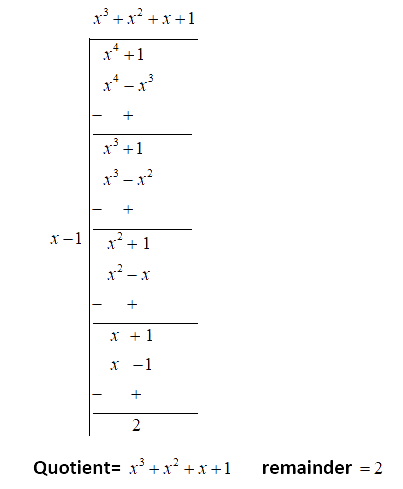
By acute division, find the quotient and the remainder when the first Polynomial is divided by the second  $ {x^4} + 1\,;\,x + 1 $ .

Show solutionHide solution
Worked solution

Ans: By acute division, we have


seo images


Q14Written answer

By remainder Theorem find the remainder, when p(x) is divided by g(x), where

(i)  $ p\left( x \right) = {x^3} - 2{x^2} - 4x - 1\,,\,g\left( x \right) = x + 1 $ 

(ii)  $ p\left( x \right) = {x^3} - 3{x^2} + 4x + 50\,,\,g\left( x \right) = x - 3 $ 

(iii)  $ p\left( x \right) = 4{x^3} - 12{x^2} + 14x - 3\,,\,g\left( x \right) = 2x - 1 $ 

(iv)  $ p\left( x \right) = {x^3} - 6{x^2} + 2x - 4\,,\,g\left( x \right) = 1 - \dfrac{3}{2}x $ 

Show solutionHide solution
Worked solution

Ans:  According to the remainder theorem, if we divide a polynomial p(x) by a factor \[\left( {{\text{ }}{\mathbf{x}}{\text{ }}-{\text{ }}{\mathbf{a}}{\text{ }}} \right)\]; then you will find a smaller polynomial with a remainder. This remainder which has been obtained is actually a value of p(x) at  $ x = a $ , specifically p(a). So, \[\left( {{\text{ }}{\mathbf{x}}{\text{ }}-{\text{ }}{\mathbf{a}}{\text{ }}} \right)\] is the divisor of p(x) if and only if \[p\left( a \right){\text{ }} = {\text{ }}0\] .

We have,  $ g\left( x \right) = x + 1 $ 

Now, put 

\[g\left( x \right) = 0\]

Therefore,

 $  \Rightarrow x + 1 = 0 $ 

  $  \Rightarrow x =  - 1 $ 

Remainder  $  = \,p\left( { - 1} \right) $ 

 $  = {\left( { - 1} \right)^3} - 2{\left( { - 1} \right)^2} - 4\left( { - 1} \right) =  - 1 - 2 + 4 - 1 = 0 $ 

Ans: According to the remainder theorem, if we divide a polynomial p(x) by a factor \[\left( {{\text{ }}{\mathbf{x}}{\text{ }}-{\text{ }}{\mathbf{a}}{\text{ }}} \right)\]; then you will find a smaller polynomial with a remainder. This remainder which has been obtained is actually a value of p(x) at  $ x = a $ , specifically p(a). So, \[\left( {{\text{ }}{\mathbf{x}}{\text{ }}-{\text{ }}{\mathbf{a}}{\text{ }}} \right)\] is the divisor of p(x) if and only if \[p\left( a \right){\text{ }} = {\text{ }}0\] .

We have,  $ g\left( x \right) = x - 3 $ 

Therefore,

 $  \Rightarrow x - 3 = 0 $ 

  $  \Rightarrow x = 3 $ 

Remainder  $  = \,p\left( 3 \right) $ 

 $  = {\left( 3 \right)^3} - 3{\left( 3 \right)^2} + 4\left( 3 \right) + 50 = 27 - 27 + 12 + 50 = 62 $ 

Ans: According to the remainder theorem, if we divide a polynomial p(x) by a factor \[\left( {{\text{ }}{\mathbf{x}}{\text{ }}-{\text{ }}{\mathbf{a}}{\text{ }}} \right)\]; then you will find a smaller polynomial with a remainder. This remainder which has been obtained is actually a value of p(x) at  $ x = a $ , specifically p(a). So, \[\left( {{\text{ }}{\mathbf{x}}{\text{ }}-{\text{ }}{\mathbf{a}}{\text{ }}} \right)\] is the divisor of p(x) if and only if \[p\left( a \right){\text{ }} = {\text{ }}0\] .

We have,  $ g\left( x \right) = 2x - 1 $ 

Therefore,

 $  \Rightarrow 2x - 1 = 0 $ 

  $  \Rightarrow x = \dfrac{1}{2} $ 

Remainder  $  = \,p\left( {\dfrac{1}{2}} \right) $ 

 $  = 4{\left( {\dfrac{1}{2}} \right)^3} - 12{\left( {\dfrac{1}{2}} \right)^2} + 14\left( {\dfrac{1}{2}} \right) - 3 = 4\left( {\dfrac{1}{8}} \right) - 12\left( {\dfrac{1}{4}} \right) + 7 - 3 $ 

 $  = \dfrac{1}{2} - 3 + 7 - 3 = \dfrac{1}{2} + 1 = \dfrac{3}{2} $ 

Ans: According to the remainder theorem, if we divide a polynomial p(x) by a factor \[\left( {{\text{ }}{\mathbf{x}}{\text{ }}-{\text{ }}{\mathbf{a}}{\text{ }}} \right)\]; then you will find a smaller polynomial with a remainder. This remainder which has been obtained is actually a value of p(x) at  $ x = a $ , specifically p(a). So, \[\left( {{\text{ }}{\mathbf{x}}{\text{ }}-{\text{ }}{\mathbf{a}}{\text{ }}} \right)\] is the divisor of p(x) if and only if \[p\left( a \right){\text{ }} = {\text{ }}0\] .

 We have,  $ g\left( x \right) = 1 - \dfrac{3}{2}x $ 

Therefore,

 $  \Rightarrow 1 - \dfrac{3}{2}x = 0 $ 

  $  \Rightarrow x = \dfrac{2}{3} $ 

Remainder  $  = \,p\left( {\dfrac{2}{3}} \right) $ 

 $  = {\left( {\dfrac{2}{3}} \right)^3} - 6{\left( {\dfrac{2}{3}} \right)^2} + 2\left( {\dfrac{2}{3}} \right) - 4\, = \dfrac{8}{{27}} - 6 \times \dfrac{4}{9} + \dfrac{4}{3} - 4 $ 

 $  = \dfrac{8}{{27}} - \dfrac{8}{3} + \dfrac{4}{3} - 4 = \dfrac{{8 - 72 + 36 - 108}}{{27}} = \dfrac{{ - 136}}{{27}} $ 

Q15Written answer

Check whether p(x) is a multiple of g(x) or not:

(i)  $ p\left( x \right) = {x^3} - 5{x^2} + 4x - 3\,,\,g\left( x \right) = x - 2 $ 

(ii)  $ p\left( x \right) = 2{x^3} - 11{x^2} - 4x + 5\,,\,g\left( x \right) = 2x + 1 $ 

Show solutionHide solution
Worked solution

Ans: According to the remainder theorem, if we divide a polynomial p(x) by a factor \[\left( {{\text{ }}{\mathbf{x}}{\text{ }}-{\text{ }}{\mathbf{a}}{\text{ }}} \right)\]; then you will find a smaller polynomial with a remainder. This remainder which has been obtained is actually a value of p(x) at  $ x = a $ , specifically p(a). So, \[\left( {{\text{ }}{\mathbf{x}}{\text{ }}-{\text{ }}{\mathbf{a}}{\text{ }}} \right)\] is the divisor of p(x) if and only if \[p\left( a \right){\text{ }} = {\text{ }}0\] .

p(x) is a multiple of g(x) if g(x) divides p(x)

Now,  $ g\left( x \right) = x - 2 $  gives  $ x = 2 $ if we put  $ g\left( x \right) = 0 $ .

Remainder  $  = \,p\left( 2 \right) = {\left( 2 \right)^3} - 5{\left( 2 \right)^2} + 4\left( 2 \right) - 3 $ 

 $  = 8 - 5\left( 4 \right) + 8 - 3 = 8 - 20 + 8 - 3 =  - 7 $ 

Hence, the remainder  $  \ne 0 $ 

Therefore, function p(x) is not a multiple of function g(x).

Ans: According to the remainder theorem, if we divide a polynomial p(x) by a factor \[\left( {{\text{ }}{\mathbf{x}}{\text{ }}-{\text{ }}{\mathbf{a}}{\text{ }}} \right)\]; then you will find a smaller polynomial with a remainder. This remainder which has been obtained is actually a value of p(x) at  $ x = a $ , specifically p(a). So, \[\left( {{\text{ }}{\mathbf{x}}{\text{ }}-{\text{ }}{\mathbf{a}}{\text{ }}} \right)\] is the divisor of p(x) if and only if \[p\left( a \right){\text{ }} = {\text{ }}0\] .

p(x) will be a multiple of g(x) if and only if g(x) divides p(x).

so,

 $ g\left( x \right) = 2x + 1 $  give  $ x =  - \dfrac{1}{2} $ 

remainder  $  = p\left( { - \dfrac{1}{2}} \right) = 2{\left( {\dfrac{{ - 1}}{2}} \right)^3} - 11{\left( { - \dfrac{1}{2}} \right)^2} - 4\left( { - \dfrac{1}{2}} \right) + 5 $ 

 $  = 2\left( { - \dfrac{1}{8}} \right) - 11\left( {\dfrac{1}{4}} \right) + 2 + 5 = \dfrac{{ - 1}}{4} - \dfrac{{11}}{4} + 7 $ 

 $  = \dfrac{{ - 1 - 11 + 28}}{4} = \dfrac{{16}}{4} = 4 $ 

Since the remainder  $  \ne 0 $ .

So, p(x) will not be a multiple of g(x).


Q16Written answer

Show that:

(i)  $ x + 3 $  is a factor of  $ 69 + 11x - {x^2} + {x^3} $ 

(ii)  $ 2x - 3 $  is a factor of  $ x + 2{x^3} - 9{x^2} + 12 $ 

Show solutionHide solution
Worked solution

Ans: Let  $ p\left( x \right) = 69 + 11x - {x^2} + {x^3}\,\,,\,\,g\left( x \right) = x + 3 $ 

 $ g\left( x \right) = x + 3 = 0 $ 

It will give,  $ x =  - 3 $ 

g(x) will be a factor of p(x) if  $ p\left( { - 3} \right) = 0 $  (Factor theorem).

Now,  $ p\left( { - 3} \right) = 69 + 11\left( { - 3} \right) - {\left( { - 3} \right)^2} + {\left( { - 3} \right)^3} $ 

 $  = 69 - 33 - 9 - 27 = 0 $ 

Hence  $ p\left( { - 3} \right) = 0 $ ,  g(x) will be a factor of p(x).

Ans: Let  $ p\left( x \right) = x + 2{x^3} - 9{x^2} + 12 $  and  $ g\left( x \right) = 2x - 3 $ 

 $ g\left( x \right) = 2x - 3 $  

Now,

 $ g\left( x \right) = 0 $ 

 $ 2x - 3 = 0 $ 

 $ x = \dfrac{3}{2} $ , 

g(x) will be factor of p(x) if  $ p\left( {\dfrac{3}{2}} \right) = 0 $  (Factor theorem)

Now,  $ p\left( {\dfrac{3}{2}} \right) = \dfrac{3}{2} + 2{\left( {\dfrac{3}{2}} \right)^3} - 9{\left( {\dfrac{3}{2}} \right)^2} + 12 = \dfrac{3}{2} + 2\left( {\dfrac{{27}}{8}} \right) - 9\left( {\dfrac{9}{4}} \right) + 12 $ 

 $  = \dfrac{3}{2} + \dfrac{{27}}{4} - \dfrac{{81}}{4} + 12 = \dfrac{{6 + 27 - 81 + 48}}{4} = \dfrac{0}{4} = 0 $ 

Since,  $ p\left( {\dfrac{3}{2}} \right) = 0 $ , therefore, g(x) is a factor of p(x).


Q17Written answer

Determine which of the following Polynomials has  $ x - 2 $ the factor as:

(i)  $ 3{x^2} + 6x - 24 $ 

(ii)  $ 4{x^2} + x - 2 $

Show solutionHide solution
Worked solution

Ans: As we know that if  $ \left( {x - a} \right) $ is a factor of p(x), then p(A) =0.

Let  $ p\left( x \right) = 3{x^2} + 6x - 24 $ 

If  $ x - 2 $  will be factor of  $ p\left( x \right) = 3{x^2} + 6x - 24 $ , then  $ p\left( 2 \right) $  should be equal to  $ 0 $ .

Now,  $ p\left( 2 \right) = 3{\left( 2 \right)^2} + 6\left( 2 \right) - 24 $ 

 $  = 3\left( 4 \right) + 6\left( 2 \right) - 24 = 12 + 12 - 24 = 0 $ 

Therefore, by factor theorem  $ x - 2 $ , is factor of  $ 3{x^2} + 6x - 24 $ .

Ans: As we know that if  $ \left( {x - a} \right) $ is a factor of p(x), then p(A) =0.

Let  $ p\left( x \right) = 4{x^2} + x - 2 $ 

If  $ x - 2 $  will be factor of  $ p\left( x \right) = 4{x^2} + x - 2 $ , then  $ p\left( 2 \right) $  should be equal to  $ 0 $ .

Now, 

 $ p\left( 2 \right) = 4{\left( 2 \right)^2} + 2 - 2 $ 

 $  = 16 + 2 - 2 = 16 $ 

Since,  $ 16 \ne 0 $ 

Therefore,  $ x - 2 $  is not a factor of  $ 4{x^2} + x - 2 $ .


Q18Written answer

Show that  $ p - 1 $  is a factor of  $ {p^{10}} - 1 $  and also of  $ {p^{11}} - 1 $ .

Show solutionHide solution
Worked solution

Ans:  $ p - 1 $  is a factor  $ {p^{10}} - 1 $ , then  $ {\left( 1 \right)^{10}} - 1 $ should be equal to zero.

Now,  $ {\left( 1 \right)^{10}} - 1 = 1 - 1 = 0 $ 

Therefore,  $ p - 1 $  is a factor  $ {p^{10}} - 1 $ .

Again, if  $ p - 1 $  is a factor of  $ {p^{11}} - 1 $  , then  $ {\left( 1 \right)^{11}} - 1 $  should be equal to zero.

Now,  $ {\left( 1 \right)^{11}} - 1 = 1 - 1 = 0 $ 

Therefore,  $ p - 1 $ is a factor  $ {p^{11}} - 1 $ .

Hence,  $ p - 1 $  is a factor of  $ {p^{10}} - 1 $  and also of  $ {p^{11}} - 1 $ .


Q19Written answer

For what value of m is  $ {x^3} - 2m{x^2} + 16 $  divisible by  $ x + 2 $ ?

Show solutionHide solution
Worked solution

Ans: If  $ {x^3} - 2m{x^2} + 16 $  is divisible by  $ x + 2 $  , then  $ x + 2 $  is a factor of  $ {x^3} - 2m{x^2} + 16 $ .

Now, let  $ p\left( x \right) = {x^3} - 2m{x^2} + 16 $ 

As,  $ x + 2 = x - \left( { - 2} \right) $  is a factor of  $ {x^3} - 2m{x^2} + 16 $ .

So,  $ p\left( { - 2} \right) = 0 $ 

Now,  $ p\left( { - 2} \right) = {\left( { - 2} \right)^3} - 2m{\left( { - 2} \right)^2} + 16 $ 

 $  =  - 8 - 8m + 16 = 8 - 8m $ 

Now,  $ p\left( { - 2} \right) = 0 $ 

 $  \Rightarrow \,8 - 8m = 0 $ 

 $  \Rightarrow 8m = 8 $ 

 $  \Rightarrow m = 1 $ 

Hence, for  $ m = 1 $  ,  $ x + 2 $  is a factor of  $ {x^3} - 2m{x^2} + 16 $ so that  $ {x^3} - 2m{x^2} + 16 $  is completely divisible by  $ x + 2 $ .


Q20Written answer

If  $ x + 2a $  is a factor of  $ {x^5} - 4{a^2}{x^3} + 2x + 2a + 3 $ , find a.

Show solutionHide solution
Worked solution

Ans: Let  $ p\left( x \right) = {x^5} - 4{a^2}{x^3} + 2x + 2a + 3 $ 

If  $ x - \left( { - 2a} \right) $  is a factor of  $ p(x) $ , then  $ p\left( { - 2a} \right) = 0 $ .

 $ p\left( { - 2a} \right) = {\left( { - 2a} \right)^5} - 4{a^2}{\left( { - 2a} \right)^3} + 2\left( { - 2a} \right) + 2a + 3 $ 

 $  =  - 32{a^5} + 32{a^5} - 4a + 2a + 3 $ 

 $  =  - 2a + 3 $ 

Now,  $ p\left( { - 2a} \right) = 0 $ 

 $  \Rightarrow  - 2a + 3 = 0 $ 

 $  \Rightarrow a = \dfrac{3}{2} $