My Cart
Your Cart 0

    Your cart is empty.

  • Total (Amount) ₹0.00
NCERT Exemplar · Class 12 · Maths

Chapter 13: Probability

Practice each question, then open the answer or worked solution.

Questions

54 questions
Q41Written answer

Three bags contain a number of red and white balls as follows:

Bag 1 : 3 red balls, Bag 2 : 2 red balls and 1 white ball

Bag 3 : 3 white balls.

The probability that bag i will be chosen and a ball is selected from it is i/6, i = 1, 2, 3. What is the probability that

(i) a red ball will be selected? (ii) a white ball is selected?

Show solutionHide solution
Worked solution

Given:

Bag 1 : 3 red balls,

Bag 2 : 2 red balls and 1 white ball

Bag 3 : 3 white balls

Now, let E1, E2 and E3 be the events of choosing Bag 1, Bag 2 and Bag 3 respectively and a ball is drawn from it.

And, we have

P(E1) = 1/6, P(E2) = 2/6 and P(E3) = 3/6
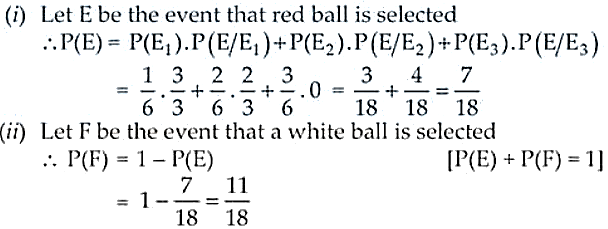
NCERT Exemplar Solutions Class 12 Mathematics Chapter 13 - 30

Therefore, the required probabilities are 7/18 and 11/18.
Q42Written answer

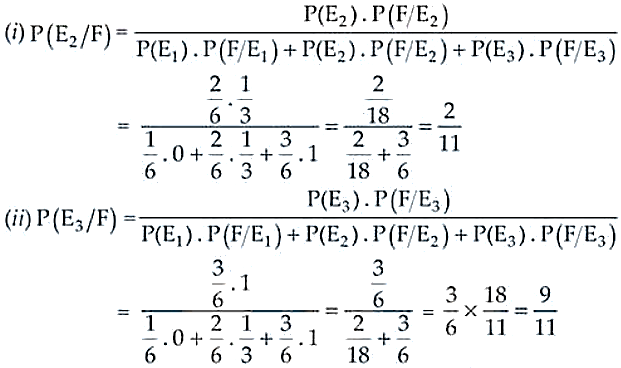
Refer to Question 41 above. If a white ball is selected, what is the probability

that it came from (i) Bag 2 (ii) Bag 3

Show solutionHide solution
Worked solution

Referring the Question 41, here we will use Baye’s Theorem

NCERT Exemplar Solutions Class 12 Mathematics Chapter 13 - 31

Therefore, the required probabilities are 2/11 and 9/11.

Q43Written answer

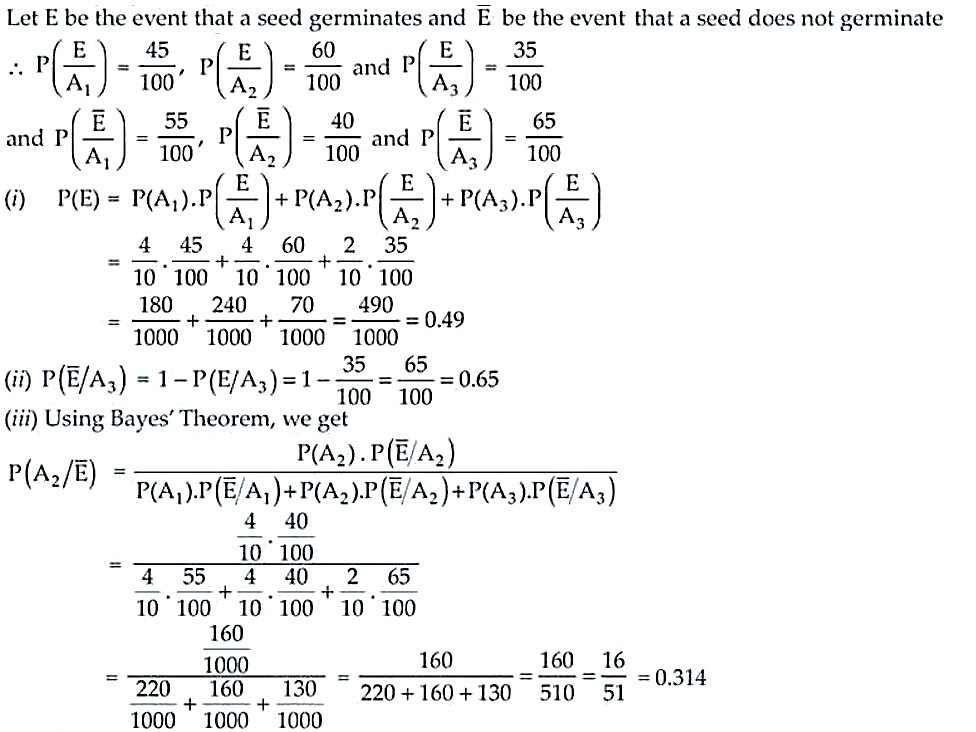
A shopkeeper sells three types of flower seeds A1, A2 and A3. They are sold as a mixture where the proportions are 4:4:2 respectively. The germination rates of the three types of seeds are 45%, 60% and 35%. Calculate the probability

(i) of a randomly chosen seed to germinate

(ii) that it will not germinate given that the seed is of type A3,

(iii) that it is of the type A2 given that a randomly chosen seed does not germinate.

Show solutionHide solution
Worked solution

Given that: A1: A2: A3 = 4: 4: 2

So, the probabilities will be

P(A1) = 4/10, P(A2) = 4/10 and P(A3) = 2/10,

Where A1, A2 and A3 are the three types of seeds.

NCERT Exemplar Solutions Class 12 Mathematics Chapter 13 - 32

Therefore, the required probability is 16/51 or 0.314.

Q44Written answer

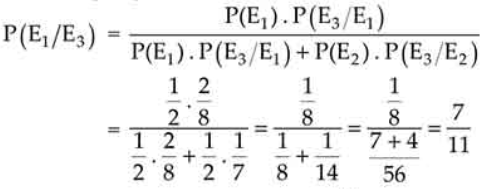
A letter is known to have come either from TATA NAGAR or from CALCUTTA. On the envelope, just two consecutive letter TA are visible. What is the probability that the letter came from TATA NAGAR.

Show solutionHide solution
Worked solution

Let E1 be the event that the letter comes from TATA NAGAR,

E2 be the event that the letter comes from CALCUTTA

And, E3 be the event that on the letter, two consecutive letters TA are visible

Now,

P(E1) = ½, P(E2) = ½, P(E3/E1) = 2/8 and P(E3/E2) = 1/7

For TATA NAGAR, the two consecutive letters visible are TA, AT, TA, AN, NA, AG, GA and AR

So, P(E3/E1) = 2/8

And, for CALCULTTA the two consecutive letters visible are CA, AL, LC, CU, UT, TT and TA

So, P(E3/E2) = 1/7

Now, using Baye’s Theorem we have

NCERT Exemplar Solutions Class 12 Mathematics Chapter 13 - 33

Therefore, the required probability is 7/11.

Q45Written answer

There are two bags, one of which contains 3 black and 4 white balls while the other contains 4 black and 3 white balls. A die is thrown. If it shows up 1 or 3, a ball is taken from the Ist bag; but it shows up any other number, a ball is chosen from the second bag. Find the probability of choosing a black ball.

Show solutionHide solution
Worked solution

Let E1 be the event of selecting Bag 1 and E2 be the event of selecting Bag 2.

Also, let E3 be the event that black ball is selected

Now,

P(E1) = 2/6 = 1/3 and P(E2) = 1 – 1/3 = 2/3

P(E3/E1) = 3/7 and P(E3/E2) = 4/7

So,

P(E3) = P(E1). P(E3/E1) + P(E2). P(E3/E2)

= 1/3. 3/7 + 2/3. 4/7 = (3 + 8)/ 21 = 11/21

Therefore, the required probability is 11/21.

Q46Written answer

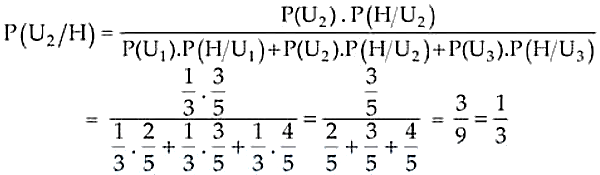
There are three urns containing 2 white and 3 black balls, 3 white and 2 black balls, and 4 white and 1 black balls, respectively. There is an equal probability of each urn being chosen. A ball is drawn at random from the chosen urn and it is found to be white. Find the probability that the ball drawn was from the second urn.

Show solutionHide solution
Worked solution

Given, we have 3 urns:

Urn 1 = 2 white and 3 black balls

Urn 2 = 3 white and 2 black balls

Urn 3 = 4 white and 1 black balls

Now, the probabilities of choosing either of the urns are

P(U1) = P(U2) = P(U3) = 1/3

Let H be the event of drawing white ball from the chosen urn.

So,

P(H/U1) = 2/5, P(H/U2) = 3/5 and P(H/U3) = 4/5

By using Baye’s Theorem, we have

NCERT Exemplar Solutions Class 12 Mathematics Chapter 13 - 34

Therefore, the required probability is 1/3.

Q47Written answer

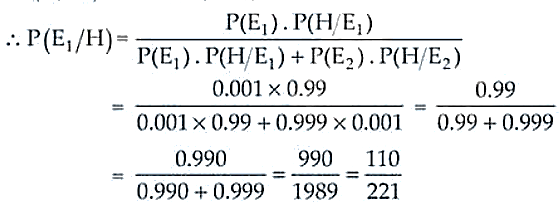
By examining the chest X ray, the probability that TB is detected when a person is actually suffering is 0.99. The probability of an healthy person diagnosed to have TB is 0.001. In a certain city, 1 in 1000 people suffers from TB. A person is selected at random and is diagnosed to have TB. What is the probability that he actually has TB?

Show solutionHide solution
Worked solution

Let E1 = Event that a person has TB

E2 = Event that a person does not have TB

And H = Event that the person is diagnosed to have TB.

So,

P(E1) = 1/1000 = 0.001, P(E2) = 1 – 1/1000 = 999/1000 = 0.999

P(H/E1) = 0.99, P(H/E2) = 0.001

Now, using Baye’s theorem we have

NCERT Exemplar Solutions Class 12 Mathematics Chapter 13 - 35

Therefore, the required probability is 110/221.

Q48Written answer

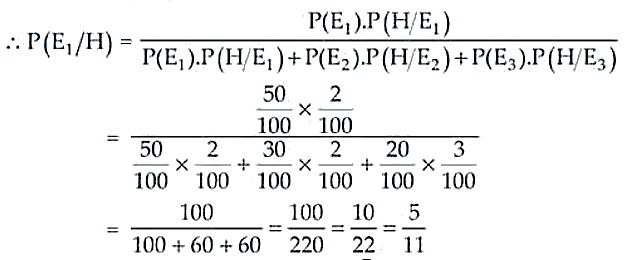
An item is manufactured by three machines A, B and C. Out of the total number of items manufactured during a specified period, 50% are manufactured on A, 30% on B and 20% on C. 2% of the items produced on A and 2% of items produced on B are defective, and 3% of these produced on C are defective. All the items are stored at one godown. One item is drawn at random and is found to be defective. What is the probability that it was manufactured on machine A?

Show solutionHide solution
Worked solution

Let’s consider:

E1 = The event that the item is manufactured on machine A

E2 = The event that the item is manufactured on machine B

E3 = The event that the item is manufactured on machine C

Let H be the event that the selected item is defective.

Thus, by using Baye’s theorem we have

P(E1) = 50/100, P(E2) = 30/100, P(E3) = 20/100

P(H/E1) = 2/100, P(H/E2) = 2/100 and P(H/E3) = 3/100

NCERT Exemplar Solutions Class 12 Mathematics Chapter 13 - 36

Therefore, the required probability is 5/11.

Q49Written answer

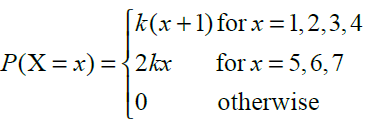
Let X be a discrete random variable whose probability distribution is defined as follows:

NCERT Exemplar Solutions Class 12 Mathematics Chapter 13 - 37

where k is a constant. Calculate

(i) the value of k (ii) E (X) (iii) Standard deviation of X.

Show solutionHide solution
Worked solution

(i) Given, P(X = x) = k(x + 1) for x = 1, 2, 3, 4

So, P(X = 1) = k(1 + 1) = 2k

P(X = 2) = k(2 + 1) = 3k

P(X = 3) = k(3 + 1) = 4k

P(X = 4) = k(4 + 1) = 5k

Also, P(X = x) = 2kx for x = 5, 6, 7

P(X = 5) = 2k(5) = 10k

P(X = 6) = 2k(6) = 12k

P(X = 7) = 2k(7) = 14k

And, for otherwise it is 0.

Thus, the probability distribution is given by

X 1 2 3 4 5 6 7 Otherwise
P(X) 2k 3k 4k 5k 10k 12k 14k 0

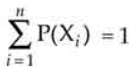
We know that,

NCERT Exemplar Solutions Class 12 Mathematics Chapter 13 - 38

So, 2k + 3k + 4k + 5k + 10k + 12k + 14k = 1

⇒ 50k = 1

⇒ k = 1/50

Therefore, the value of k is 1/50.

(ii) Now, the probability distribution is

X 1 2 3 4 5 6 7
P(X) 2/50 3/50 4/50 5/50 10/50 12/50 14/50

E(X) = 1 x 2/50 + 2 x 3/50 + 3 x 4/50 + 4 x 5/50 + 5 x 10/50 + 6 x 12/50 + 7 x 14/50

= 2/50 + 6/50 + 12/50 + 20/50 + 50/50 + 72/50 + 98/50

= 260/50

= 26/5 = 5.2

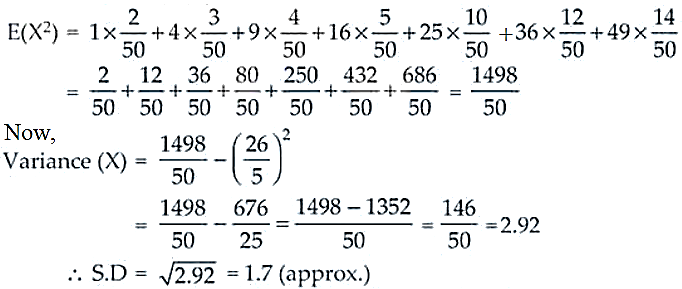
(ii) We know that the standard deviation (SD) = √Variance

Variance = E(X2) – [E(X)]2

NCERT Exemplar Solutions Class 12 Mathematics Chapter 13 - 39

Q50Written answer

The probability distribution of a discrete random variable X is given as under:

X 1 2 4 2A 3A 5A
P(X) 1/2 1/5 3/25 1/10 1/25 1/25

Calculate:

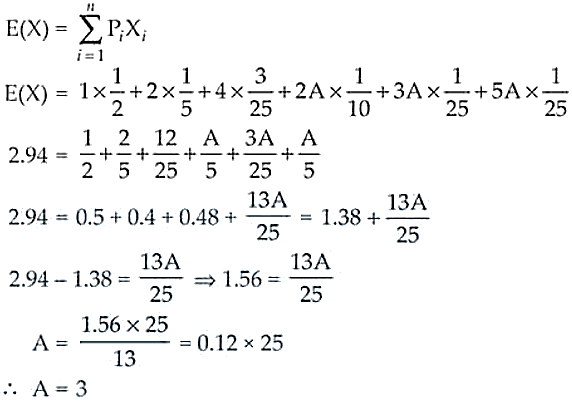
(i) The value of A if E(X) = 2.94

(ii) Variance of X.

Show solutionHide solution
Worked solution

(i) We know that:

NCERT Exemplar Solutions Class 12 Mathematics Chapter 13 - 40

(ii) Now, the distribution becomes

X 1 2 4 6 9 15
P(X) 1/2 1/5 3/25 1/10 1/25 1/25

E(X2) = 1 x ½ + 4 x 1/5 + 16 x 3/25 + 36 x 1/10 + 81 x 1/25 + 225 x 1/25

= ½ + 4/5 + 48/25 + 36/10 + 81/25 + 225/25

= 0.5 + 0.8 + 1.92 + 3.6 + 3.24 + 9 = 19.06

Variance (X) = E(X2) – [E(X)]2

= 19.06 – (2.94)2 = 19.06 – 8.64 = 10.42