My Cart
Your Cart 0

    Your cart is empty.

  • Total (Amount) ₹0.00
NCERT Exemplar · Class 12 · Maths

Chapter 13: Probability

Practice each question, then open the answer or worked solution.

Questions

54 questions
Q31Written answer

A factory produces bulbs. The probability that any one bulb is defective is 1/50 and they are packed in boxes of 10. From a single box, find the probability that

(i) none of the bulbs is defective

(ii) exactly two bulbs are defective

(iii) more than 8 bulbs work properly

Show solutionHide solution
Worked solution

Let’s assume X to be the random variable denoting a bulb to be defective.

Here, n = 10, p = 1/50, q = 1 – 1/50 = 49/50

We know that, P(X = r) = nCr pr qn – r

(i) None of the bulbs is defective, i.e., r = 0

P(x = 0) = 10C0 (1/50)0(49/50)10 – 0 = (49/50)10

(ii) Exactly two bulbs are defective

So, P(x = 2) = 10C2 (1/50)2(49/50)10 – 2

= 45.498/5010 = 45 x (1/50)10 x 498

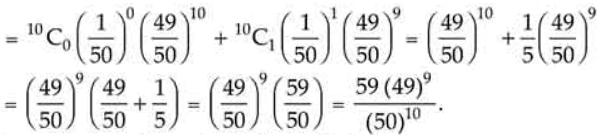
(iii) More than 8 bulbs work properly

We can say that less than 2 bulbs are defective

P(x < 2) = P(x = 0) + P(x = 1)
NCERT Exemplar Solutions Class 12 Mathematics Chapter 13 - 23

Q32Written answer

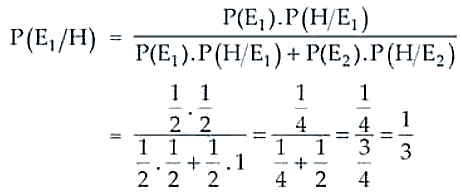
Suppose you have two coins which appear identical in your pocket. You know that one is fair and one is 2-headed. If you take one out, toss it and get a head, what is the probability that it was a fair coin?

Show solutionHide solution
Worked solution

Let’s consider

E1 = Event that the coin is fair

E2 = Event that the coin is 2 headed

And H = Event that the tossed coin gets head.

Now,

P(E1) = ½, P(E2) = ½, P(H/E1) = ½, P(H/E2) = 1

Using Baye’s Theorem, we get

NCERT Exemplar Solutions Class 12 Mathematics Chapter 13 - 24

Therefore, the required probability is 1/3.

Q33Written answer

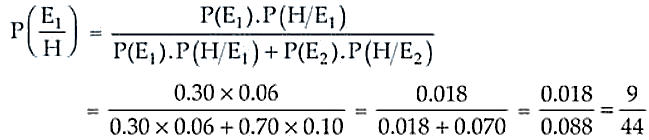
Suppose that 6% of the people with blood group O are left-handed and 10% of those with other blood groups are left-handed 30% of the people have blood group O. If a left-handed person is selected at random, what is the probability that he/she will have blood group O?

Show solutionHide solution
Worked solution

Let’s assume

E1 = The event that a person selected is of blood group O

E2 = The event that the people selected is of other group

And H = The event that selected person is left handed

Now,

P(E1) = 0.30 and P(E2) = 0.70

Further, P(H/E1) = 0.06 and P(H/E2) = 0.10

Using Baye’s Theorem, we have

NCERT Exemplar Solutions Class 12 Mathematics Chapter 13 - 25

Therefore, the required probability is 9/44.

Q34Written answer

Two natural numbers r, s are drawn one at a time, without replacement from the set S={1, 2, 3, …., n} . Find P[r £ p|s £ p] , where pÎS.

Show solutionHide solution
Worked solution

Given, S = {1, 2, 3, …, n}

So, P(r ≤ p/s ≤ p) = P(P ⋂ S)/ P(S)

= p – 1/n x n/(n – 1)

= (p – 1)/(n – 1)

Therefore, the required probability is (p – 1)/(n – 1).

Q35Written answer

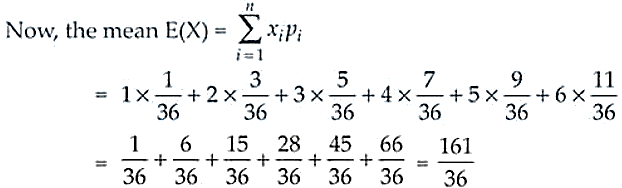
Find the probability distribution of the maximum of the two scores obtained when a die is thrown twice. Determine also the mean of the distribution.

Show solutionHide solution
Worked solution

Let X be the random variable scores when a die is thrown twice.

X = 1, 2, 3, 4, 5, 6

And S = {(1, 1), (1, 2), (2, 1), (2, 2) , (1, 3) , (2, 3) , (3, 1) , (3, 2) , (3, 3) , (3, 4) , (3, 5) , …, (6, 6)}

So,

P(X = 1) = 1/6 . 1/6 = 1/36

P(X = 2) = 1/6 . 1/6 + 1/6 . 1/6 + 1/6 . 1/6 = 3/36

P(X = 3) = 1/6 . 1/6 + 1/6 . 1/6 + 1/6 . 1/6 + 1/6 . 1/6 + 1/6 . 1/6 = 5/36

Similarly,

P(X = 4) = 7/36; P(X = 5) = 9/36 and P(X = 6) = 11/36

Hence, the required distribution is

X 1 2 3 4 5 6
P(X) 1/36 3/36 5/36 7/36 9/36 11/36

NCERT Exemplar Solutions Class 12 Mathematics Chapter 13 - 26

Therefore, the required mean = 161/36.

Q36Written answer

The random variable X can take only the values 0, 1, 2. Given that P(X = 0) = P (X = 1) = p and that E(X2) = E[X], find the value of p.

Show solutionHide solution
Worked solution

Given, X = 0, 1, 2 and P(X = 0) = P (X = 1) = p

Let P(X) at X = 2 is x

⇒ p + p + x = 1 ⇒ x = 1 – 2p

Now, we have the following distribution:

X 0 1 2
P(X) p p 1 – 2p

So,

E(X) = 0.p + 1.p + 2(1 – 2p) = p + 2 – 4p = 2 – 3p

And, E(X2) = 0.p + 1.p + 4(1 – 2p) = p + 4 – 8p = 4 – 7p

Also, given E(X) = E(X2)

2 – 3p = 4 – 7p

4p = 2

p = ½

Therefore, the required value of p is ½.

Q37Written answer

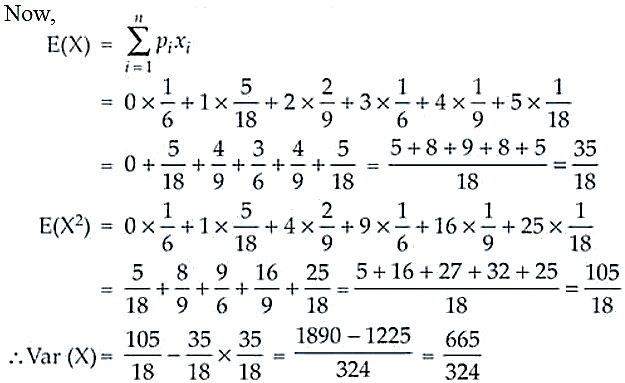
Find the variance of the distribution:

x 0 1 2 3 4 5
P(x) 1/6 5/18 2/9 1/6 1/9 1/18
Show solutionHide solution
Worked solution

We know that,

Variance(X) = E(X2) – [E(X)]2

NCERT Exemplar Solutions Class 12 Mathematics Chapter 13 - 27

Therefore, the required variance is 665/324.

Q38Written answer

A and B throw a pair of dice alternately. A wins the game if he gets a total of 6 and B wins if she gets a total of 7. It A starts the game, find the probability of winning the game by A in third throw of the pair of dice.

Show solutionHide solution
Worked solution

Let’s take A1 to be the event of getting a total of 6

A1 = {(2, 4), (4, 2), (1, 5), (5, 1), (3, 3)}

And, B1 be the event of getting a total of 7

B1 = {(2, 5), (5, 2), (1, 6), (6, 1), (3, 4), (4, 3)}

Let P(A1) is the probability, if A wins in a throw = 5/36

And P(B1) is the probability, if B wins in a throw = 1/6

Therefore, the required probability of wining A in his third throw

NCERT Exemplar Solutions Class 12 Mathematics Chapter 13 - 28

Q39Written answer

Two dice are tossed. Find whether the following two events A and B are independent:

A = {(x, y) : x + y = 11} B = {(x, y) : x ¹ 5}

where (x, y) denotes a typical sample point.

Show solutionHide solution
Worked solution

Given, two events A and B are independent such that A = {(x, y) : x + y = 11} B = {(x, y) : x ¹ 5}

Now,

A = {(5, 6), (6, 5)}

B = {(1, 1), (1, 2), (1, 3), (1, 5), (1, 6), (2, 1), (2, 2), (2, 4), (2, 5), (2, 6), (3, 1), (3, 3), (3, 4), (3, 5), (3, 6), (4, 2), (4, 3), (4, 4), (4, 5), (4, 6), (5, 1), (5, 2), (5, 3), (5, 4), (5, 5), (5, 6), (6, 1), (6, 2), (6, 3), (6, 4), (6, 5), (6, 6)}

n(A) = 2, n(B) = 30 and n(A ⋂ B) = 1

So, P(A) = 2/36 = 1/18 and P(B) = 30/36 = 5/6

Now,

P(A).P(B) = 1/18. 5/6 = 5/108 and P(A ⋂ B) 1/36

As P(A). P(B) ≠ P(A ⋂ B)

Therefore, events A and B are not independent.

Q40Written answer

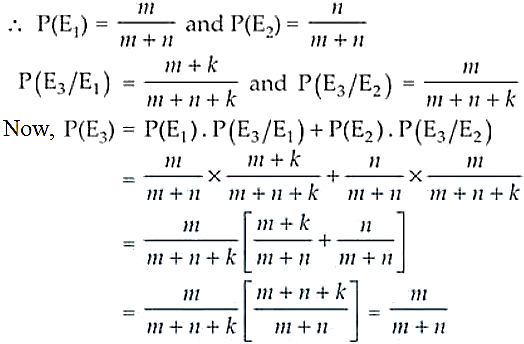
An urn contains m white and n black balls. A ball is drawn at random and is put back into the urn along with k additional balls of the same colour as that of the ball drawn. A ball is again drawn at random. Show that the probability of drawing a white ball now does not depend on k.

Show solutionHide solution
Worked solution

Let’s consider A to be the event of having m white and n black balls

E1 = First ball drawn of white colour

E2 = First ball drawn of black colour

E3 = Second ball drawn of white colour

NCERT Exemplar Solutions Class 12 Mathematics Chapter 13 - 29

Therefore, the probability if drawing a white ball does not depend upon k.

Long Answer (L.A.)