Ten coins are tossed. What is the probability of getting at least 8 heads?
Show solutionHide solution
Here we have, n = 10, p = ½ and q = 1 – ½ = ½
P(X ≥ 8) = P(x = 8) + P(x = 9) + P(x = 10)
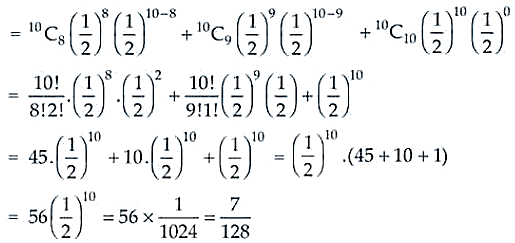
Therefore, the required probability is 7/128.
Your cart is empty.
Practice each question, then open the answer or worked solution.
Ten coins are tossed. What is the probability of getting at least 8 heads?
Here we have, n = 10, p = ½ and q = 1 – ½ = ½
P(X ≥ 8) = P(x = 8) + P(x = 9) + P(x = 10)

Therefore, the required probability is 7/128.
The probability of a man hitting a target is 0.25. He shoots 7 times. What is the probability of his hitting at least twice?
Here, we have n = 7, p = 0.25 = 25/100 = ¼ and q = 1 – ¼ = ¾
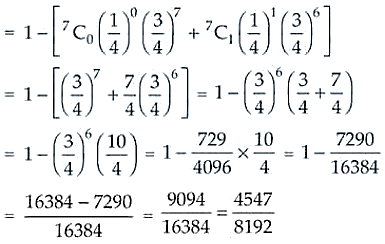
P(X ≥ 2) = 1 – [P(X = 0) + P(X = 1)]

Therefore, the required probability is 4547/8192.
A lot of 100 watches is known to have 10 defective watches. If 8 watches are selected (one by one with replacement) at random, what is the probability that there will be at least one defective watch?
Given: Total number of watches = 100 and number of defective watches = 10
So, the probability of selecting a detective watch = 10/100 = 1/10
Now,
n = 8, p = 1/10 and q = 1 – 1/10 = 9/10, r ≥ 1
P(X ≥ 1) = 1 – P(x = 0) = 1 – 8C0 (1/10)0(9/10)8 – 0 = 1 – (9/10)8
Therefore, the required probability is 1 – (9/10)8.
Consider the probability distribution of a random variable X:
| X | 0 | 1 | 2 | 3 | 4 |
| P(X) | 0.1 | 0.25 | 0.3 | 0.2 | 0.15 |
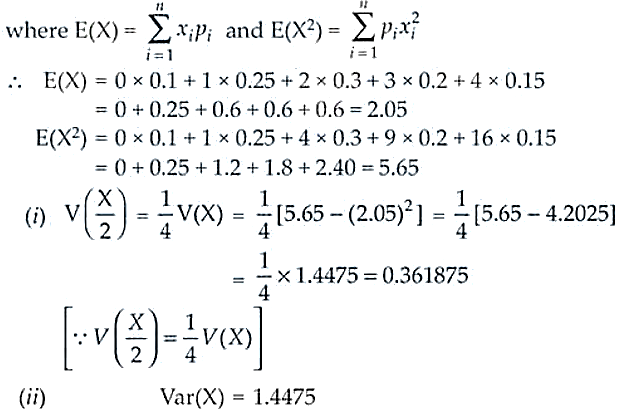
Calculate: (i) V(X/2) (ii) Variance of X.
Given:
| X | 0 | 1 | 2 | 3 | 4 |
| P(X) | 0.1 | 0.25 | 0.3 | 0.2 | 0.15 |
We know that: Var(X) = E(X2) – [E(X)]2

The probability distribution of a random variable X is given below:
| X | 0 | 1 | 2 | 3 |
| P(X) | k | k/2 | k/4 | k/8 |
(i) Determine the value of k.
(ii) Determine P(X £ 2) and P(X > 2)
(iii) Find P(X £ 2) + P (X > 2).
(i) W.k.t P(0) + P(1) + P(2) + P(3) = 1
⇒ k + k/2 + k/4 + k/8 = 1
(8k + 4k + 2k + k)/8 = 1
15k = 8
Hence, k = 8/15
(ii) P(X ≤ 2) = P(X = 0) + P(X = 1) + P(X = 2)
= k + k/2 + k/4 = 7k/4 = 7/4 x 8/15 = 14/15
And P(X > 2) = P(X = 3) = k/8 = 1/8 x 8/15 = 1/15
(iii) P(X ≤ 2) + P(X ≥ 2) = 14/15 + 1/15 = (14 + 1)/15 = 15/15 = 1
For the following probability distribution determine standard deviation of the random variable X.
| X | 2 | 3 | 4 |
| P(X) | 0.2 | 0.5 | 0.3 |
We know that: Standard deviation (S.D.) = √Variance
So, Var(X) = E(X2) – [E(X)]2
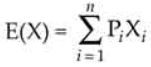
E(X) = 2 x 0.2 + 3 x 0.5 + 4 x 0.3 = 0.4 + 1.5 + 1.2 = 3.1
E(X2) = 4 x 0.2 + 9 x 0.5 + 16 x 0.3 = 0.8 + 4.5 + 4.8 = 10.1
⇒ V(X) = 10.1 – (3.1)2 = 10.1 – 9.61 = 0.49
Therefore, S.D. = √0.49 = 0.7
A biased die is such that P(4) = 1/10 and other scores being equally likely. The die
is tossed twice. If X is the ‘number of fours seen’, find the variance of the
random variable X.
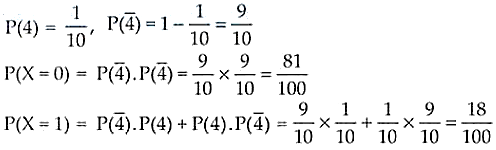
Here, random variable X = 0, 1, 2

P(X = 2) = P(4).P(4) = 1/10 x 1/10 = 1/100
| X | 0 | 1 | 2 |
| P(X) | 81/100 | 18/100 | 1/100 |
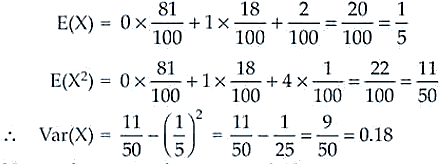
Now, we know V(X) = E(X2) – [E(X)]2

Therefore, the required variance = 0.18.
A die is thrown three times. Let X be ‘the number of twos seen’. Find the
expectation of X.
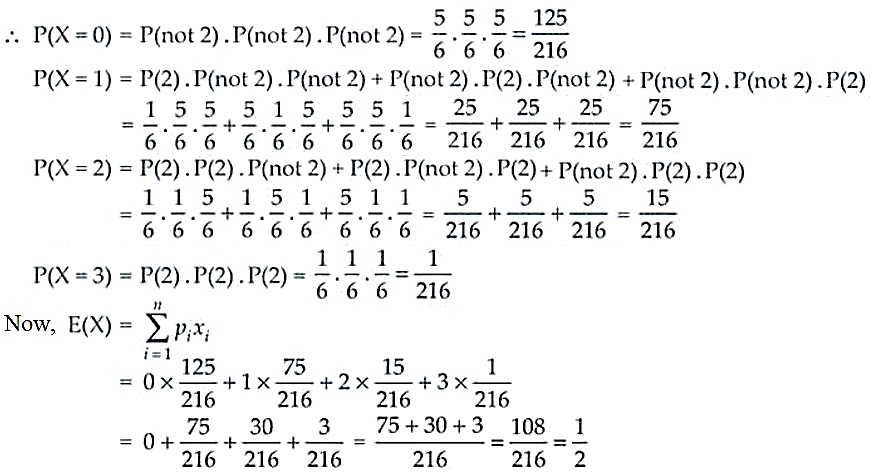
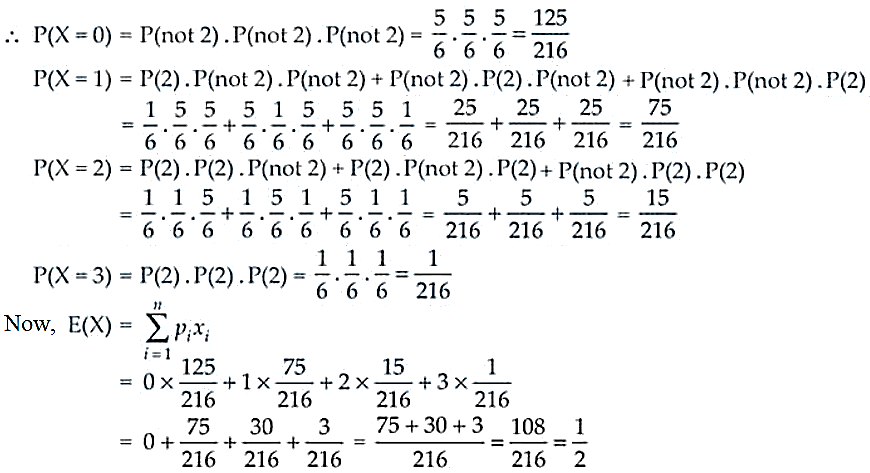
Here, we have X = 0, 1, 2, 3 [Since, die is thrown 3 times]
And p = 1/6, q = 5/6


Therefore, the required expression is ½.
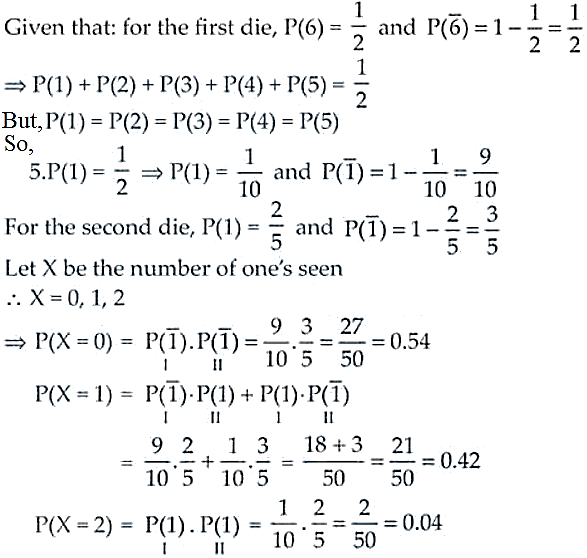
Two biased dice are thrown together. For the first die P(6) = 1/2, the other scores being equally likely while for the second die, P(1) = 2/5 and the other scores are equally likely. Find the probability distribution of ‘the number of ones seen’.

Therefore, the required probability distribution is
| X | 0 | 1 | 2 |
| P(X) | 0.54 | 0.42 | 0.04 |
Two probability distributions of the discrete random variable X and Y are given below.
| X | 0 | 1 | 2 | 3 |
| P(X) | 1/5 | 2/5 | 1/5 | 1/5 |
| Y | 0 | 1 | 2 | 3 |
| P(Y) | 1/5 | 3/10 | 2/5 | 1/10 |
Prove that E(Y2) = 2 E(X).
The probability distribution of random variable X is
| X | 0 | 1 | 2 | 3 |
| P(X) | 1/5 | 2/5 | 1/5 | 1/5 |
We know that,

E(X) 0. 1/5 + 1. 2/5 + 2. 1/5 + 3. 1/5 = 0 + 2/5 + 2/5 + 3/5 = 7/5
For the second probability distribution of random variable Y,
| Y | 0 | 1 | 2 | 3 |
| P(Y) | 1/5 | 3/10 | 2/5 | 1/10 |
E(Y2) = 0. 1/5 + 1. 3/10 + 4. 2/5 + 9. 1/10
= 0 + 3/10 + 8/5 + 9/10 = 28/10 = 14/5
Now, E(Y2) = 14/5 and 2 E(X) = 2.7/5 = 14/5
Therefore, E(Y2) = 2E(X)