My Cart
Your Cart 0

    Your cart is empty.

  • Total (Amount) ₹0.00
NCERT Exemplar · Class 12 · Maths

Chapter 13: Probability

Practice each question, then open the answer or worked solution.

Questions

54 questions
Q1Written answer

For a loaded die, the probabilities of outcomes are given as under:

P(1) = P(2) = 0.2, P(3) = P(5) = P(6) = 0.1 and P(4) = 0.3.

The die is thrown two times. Let A and B be the events, ‘same number each time’, and ‘a total score is 10 or more’, respectively. Determine whether or not A and B are independent.

Show solutionHide solution
Worked solution

Given that a loaded die is thrown such that

P(1) = P(2) = 0.2, P(3) = P(5) = P(6) = 0.1 and P(4) = 0.3 and die is thrown two times. Also given that:

A = same number each time and

B = Total score is 10 or more.

So, P(A) = [P(1, 1) + P(2, 2) + P(3, 3) + P(4, 4) + P(5, 5) + P(6, 6)]

= P(1).P(1) + P(2).P(2) + P(3).P(3) + P(4).P(4) + P(5).P(5) + P(6).P(6)

= 0.2 x 0.2 + 0.2 x 0.2 + 0.1 x 0.1 + 0.3 x 0.3 + 0.1 x 0.1 + 0.1 x 0.1

= 0.04 + 0.04 + 0.01 + 0.09 + 0.01 + 0.01 = 0.20

Now, B = [(4, 6), (6, 4), (5, 5), (5, 6), (6, 5), (6, 6)]

P(B) = [P(4).P(6) + P(6).P(4) + P(5).P(5) + P(5).P(6) + P(6).P(5) + P(6).P(6)]

= 0.3 x 0.1 + 0.1 x 0.3 + 0.1 x 0.1 + 0.1 x 0.1 + 0.1 x 0.1 + 0.1 x 0.1

= 0.03 + 0.03 + 0.01 + 0.01 + 0.01 + 0.01 = 0.10

A and B both events will be independent if

P(A ⋂ B) = P(A).P(B) …. (i)

And, here (A ⋂ B) = {(5, 5), (6, 6)}

So, P(A ⋂ B) = P(5, 5) + P(6, 6) = P(5).P(5) + P(6).P(6)

= 0.1 x 0.1 + 0.1 x 0.1 = 0.02

From equation (i) we get,

0.02 = 0.20 x 0.10

0.02 = 0.02

Therefore, A and B are independent events.
Q2Written answer

Refer to Exercise 1 above. If the die were fair, determine whether or not the events A and B are independent.

Show solutionHide solution
Worked solution

According to the solution of exercise 1, we have

A = {(1, 1), (2, 2), (3, 3), (4, 4), (5, 5), (6, 6)}and n(6) and n(S) = 6 x 6 = 36

So, P(A) = n(A)/n(S) = 6/36 = 1/6

And, B = {(4, 6), (6, 4), (5, 5), (5, 6), (6, 5), (6, 6)}; n(B) = 6 and n(S) = 36

So, P(B) = n(B)/n(S) = 6/36 = 1/6

Now, A ⋂ B = {(5, 5), (6, 6)}

So, P(A ⋂ B) = 2/36 = 1/18

Hence, if A and B are not independent, then

P(A ⋂ B) ≠ P(A).P(B)

1/18 ≠ 1/6 x 1/6 ⇒ 1/18 ≠ 1/36

Therefore, A and B are not independent events.

Q3Written answer

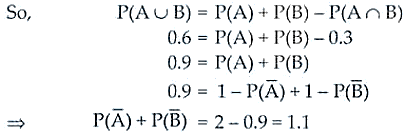
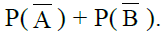
The probability that at least one of the two events A and B occurs is 0.6. If A and B occur simultaneously with probability 0.3, evaluateNCERT Exemplar Solutions Class 12 Mathematics Chapter 13 - 1

Show solutionHide solution
Worked solution

W.k.t, A ⋃ B denotes that atleast one of the events occurs and A ⋂ B denotes that two events occur simultaneously.

NCERT Exemplar Solutions Class 12 Mathematics Chapter 13 - 2

Therefore, the required answer is 1.1.

Q4Written answer

A bag contains 5 red marbles and 3 black marbles. Three marbles are drawn one by one without replacement. What is the probability that at least one of the three marbles drawn be black, if the first marble is red?

Show solutionHide solution
Worked solution

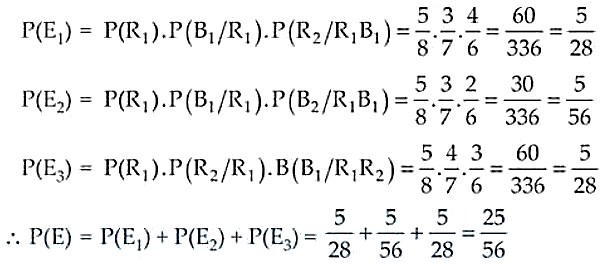
Let red marbles be presented with R and black marble with B. Also, let E be the event that at least one of the three marbles drawn be black when the first marble is red.

Now, the following three conditions are possible, if atleast one of the three marbles drawn be black and the first marble is red.

(i) E1: 2nd ball is black and 3rd ball is red

(ii) E2: 2nd ball is black and 3rd ball is also black

(iii) E3: 2nd ball is red and 3rd ball is black

The probabilities of the above events are:

NCERT Exemplar Solutions Class 12 Mathematics Chapter 13 - 3

Therefore, the required probability is 25/56.

Q5Written answer

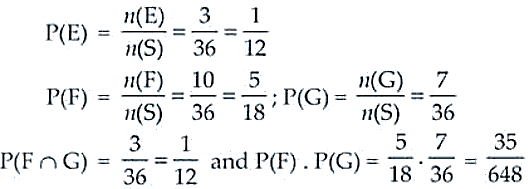
Two dice are thrown together and the total score is noted. The events E, F and G are ‘a total of 4’, ‘a total of 9 or more’, and ‘a total divisible by 5’, respectively. Calculate P(E), P(F) and P(G) and decide which pairs of events, if any, are independent.

Show solutionHide solution
Worked solution

If two dice are thrown together, we have

n(S) = 36

Now, let’s consider:

E = A total of 4 = {(2, 2), (1, 3), (3, 1)} ⇒ n(E) = 3

F = A total of 9 or more

= {(3, 6), (6, 3), (5, 4), (4, 5), (5, 5), (4, 6), (6, 4), (5, 6), (6, 5), (6, 6)}

So, n(F) = 10

G = A total divisible by 5

= {(1, 4), (4, 1), (2, 3), (3, 2), (4, 6), (6, 4), (5, 5)}

So, n(G) = 7

It’s seen that (E ⋂ F) = Ø and (E ⋂ G) = Ø

And, (F ⋂ G) = {(4, 6), (6, 4), (5, 5)}

⇒ n(F ⋂ G) = 3 and (E ⋂ F⋂ G) = Ø

Hence, the probabilities if the events are:

NCERT Exemplar Solutions Class 12 Mathematics Chapter 13 - 4

As, P(F ⋂ G) ≠ P(F). P(G)

Therefore, there is no pair of independent events.

Q6Written answer

Explain why the experiment of tossing a coin three times is said to have binomial distribution.

Show solutionHide solution
Worked solution

As the random variable X takes 0, 1, 2, 3, …, n is said to be binomial distribution having parameters n and p, if the probability is given by

P(X = r) = nCr pr qn-r, where q = 1 – p and r = 0, 1, 2, 3, …

Similarly, in case of tossing a coin 3 times, we have

n = 3 and X has the values 0, 1, 2, 3 with p = ½, q = ½.

Therefore, it is said that the experiment of tossing a coin three times have binomial distribution.

Q7Written answer

A and B are two events such that P(A) = 1/2, P(B) = 1/3 and P(A Ç B) = 1/4.

Find:

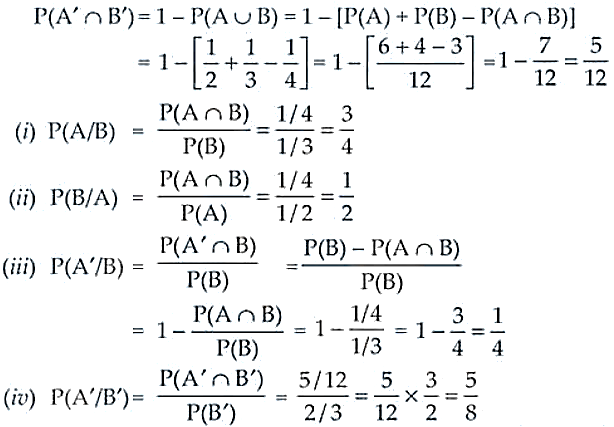
(i) P(A|B) (ii) P(B|A) (iii) P(A’|B) (iv) P(A’|B’)

Show solutionHide solution
Worked solution

Given, P(A) = 1/2, P(B) = 1/3 and P(A Ç B) = 1/4.

P(A’) = 1 – 1/2 = 1/2, P(B’) = 1 – 1/3 = 2/3

Now,

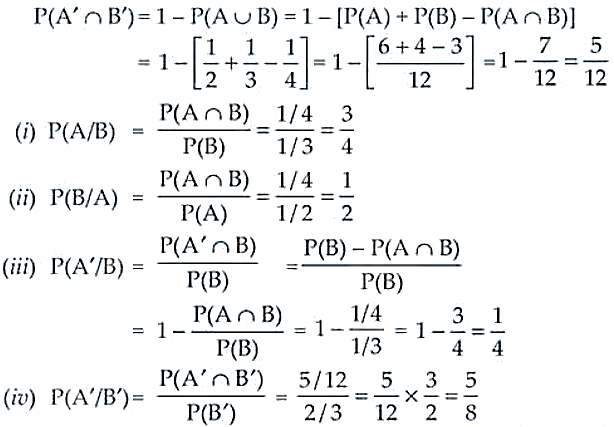
NCERT Exemplar Solutions Class 12 Mathematics Chapter 13 - 5

NCERT Exemplar Solutions Class 12 Mathematics Chapter 13 - 6

Q8Written answer

Three events A, B and C have probabilities 2/5, 1/3 and ½ respectively. Given that P(AÇ C) = 1/5 and P(B Ç C) = ¼, find the values of P(C | B) and P(A’Ç C’).

Show solutionHide solution
Worked solution

Given, P(A) = 2/5, P(B) = 1/3 and P(C) = ½

P(A Ç C) = 1/5 and P(B Ç C) = ¼

So, P(C/B) = P(B Ç C)/ P(B) = (¼)/ (1/3) = ¾

P(A’ Ç C’) = 1 – P(A ⋃ C)

= 1 – [P(A) + P(C) – P(A Ç C)]

= 1 – [2/5 + ½ – 1/5] = 1 – 7/10 = 3/10

Therefore, the required probabilities are ¾ and 3/10.

Q9Written answer

Let E1 and E2 be two independent events such that p(E1) = p1 and P(E2) = p2. Describe in words of the events whose probabilities are:

(i) p1 p2 (ii) (1–p1) p2 (iii) 1 – (1 – p1)(1 – p2) (iv) p1 + p2 – 2p1p2

Show solutionHide solution
Worked solution

Here, P(E1) = p1 and P(E2) = p2

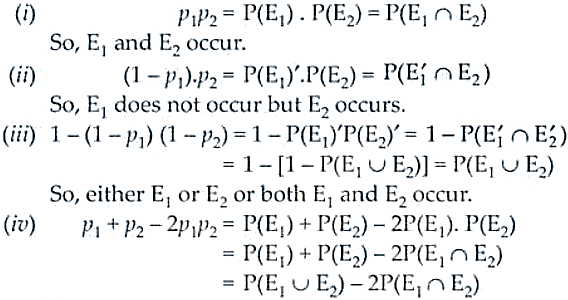
NCERT Exemplar Solutions Class 12 Mathematics Chapter 13 - 7

Now, its clearly seen that either E1 or E2 occurs but not both.

Q10Written answer

A discrete random variable X has the probability distribution given as below:

X 0.5 1 1.5 2
P(X) k k2 2k2 k

(i) Find the value of k

(ii) Determine the mean of the distribution.

Show solutionHide solution
Worked solution

For a probability distribution, we know that if Pi ≥ 0

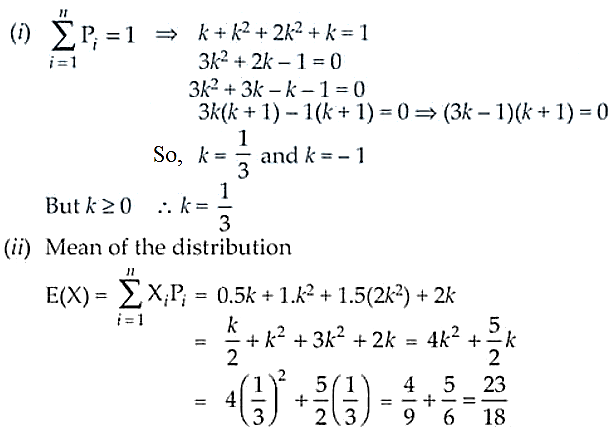
NCERT Exemplar Solutions Class 12 Mathematics Chapter 13 - 8