My Cart
Your Cart 0

    Your cart is empty.

  • Total (Amount) ₹0.00
NCERT Exemplar · Class 11 · Physics

Chapter 9: Mechanical Properties of Solids

Practice each question, then open the answer or worked solution.

Questions

29 questions
Q9.21Written answer

To what depth must a rubber ball be taken in the deep sea so that its volume is decreased by 0.1%.

Show solutionHide solution
Worked solution

Bulk modulus of rubber = 9.8 × 10⁸ N/m2

Density of sea water = 103 kg/m3

Percentage decrease in volume = 0.1%

Change in pressure, p = hρg

B = ∆P/(∆V/V)

∆P = hρg

h = 100 m

Q9.22Written answer

A truck is pulling a car out of a ditch by means of a steel cable that is 9.1 m long and has a radius of 5 mm. When the car just begins to move, the tension in the cable is 800 N. How much has the cable stretched?

Show solutionHide solution
Worked solution

Length of steel cable, l = 9.1 m

Radius, r = 5 mm

Tension on the cable = 800 N

Young’s modulus = Y = 2 × 10¹¹ N/m2

Y = (F/A)/( ∆L/L)

∆L = 0.5 × 10⁻³ m

Q9.23Written answer

Two identical solid balls, one of ivory and the other of wet clay, are dropped from the same height on the floor. Which one will rise to a greater height after striking the flood and why?

Show solutionHide solution
Worked solution

Ivory ball will rise to a greater height after striking the flood because the ivory ball is more elastic than clay ball and the amount of energy and momentum transferred is more on the ivory ball.

Long Answers
Q9.24Written answer

Consider a long steel bar under tensile stress due to forces F acting at the edges along the length of the bar. Consider a plane making an angle θ with the length. What are the tensile and shearing stresses on this plane?

Exemplar Solutions Class 11 Physics Chapter 9 - 6

a) for what angle is the tensile stress a maximum?

b) for what angle is the shearing stress a maximum?

Show solutionHide solution
Worked solution

Given,

F is applied along the horizontal

When F is perpendicular = F sin θ

When F is parallel = F cos θ

A is the cross-sectional area of the bar.

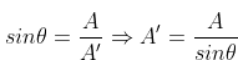
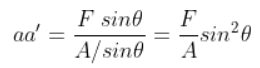
The plane aa’ is equilibrium.

Area of the plane aa’ is

Exemplar Solution Physics Class 11 Chapter 9 Img 9

Tensile stress on the plane aa’ is

Exemplar Solution Physics Class 11 Chapter 9 Img 8

Shear stress on the plane aa’ is

F sin 2θ/2A

a) When the tensile stress is maximum θ = 90o

b) When the shearing stress is maximum θ = 45o

Q9.25Written answer

a) A steel wire of mass μ per unit length with a circular cross-section has a radius of 0.1 cm. The wire is of length 10 m when measured lying horizontal, and hangs from a hook on the wall. A mass of 25 kg is hung from the free end of the wire. Assuming the wire to be uniform and lateral strains << longitudinal strains, find the extension in the length of the wire. The density of steel is 7860 kg/m3.

b) If the yield strength of steel is 2.5 × 10⁸ N/m2, what is the maximum weight that can be hung at the lower end of the wire?

Show solutionHide solution
Worked solution

Let dx be the small element

Let dm be the mass

Let L be the length of the wire

Let x be the distance from the end where it is hung

Let μ be the mass per unit length

Therefore,

dm = μ.dx

r = 0.1 cm

A = π(10)-3

M = 25 kg

L = 10 m

a) The downward force is used for calculating the mass, m = 0.25 kg

b) The maximum weight that can be hung at the lower end of the wire is calculated using the tension in the wire which is the maximum at x = L

Therefore, the mass is = 78.25 kg

Q9.26Written answer

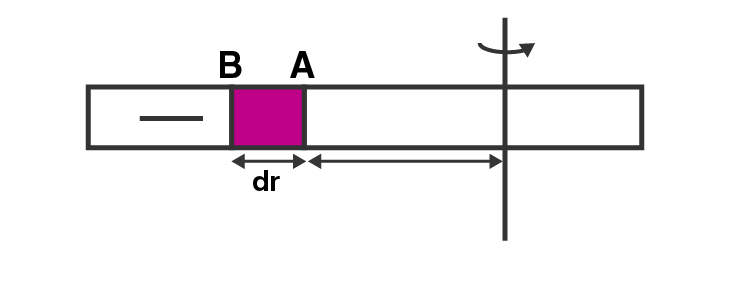
A steel rod of length 2l, cross-sectional area A and mass M is set rotating in a horizontal plane about an axis passing through the centre. If Y is the Young’s modulus for steel, find the extension in the length of the rod.

Show solutionHide solution
Worked solution

Exemplar Solutions Class 11 Physics Chapter 9 - 7

T(r) and T(r+dr) are the tensions that act as an external force to the rod at points A and B.

T(r+dr)-T(r) is the centrifugal force on the element due to the tension difference

dr = dm.rω2 is the centripetal force due to rotation on the element

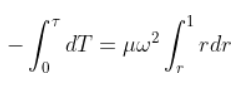
When the below equation is integrated,

Exemplar Solution Physics Class 11 Chapter 9 Img 7

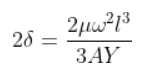
We get the extension in the rod from both sides as:

Exemplar Solution Physics Class 11 Chapter 9 Img 6

Q9.27Written answer

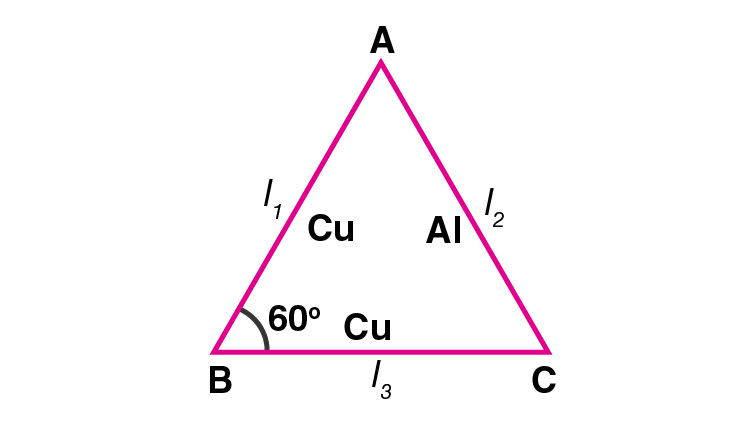
An equilateral triangle ABC is formed by two Cu rods AB and BC, and one Al rod. It is heated in such a way that the temperature of each rod increases by ∆T. Find the change in the angle ABC.

Show solutionHide solution
Worked solution

Exemplar Solutions Class 11 Physics Chapter 9 - 8

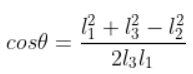
Trigonometry is used for determining the change in the angle ABC

Exemplar Solution Physics Class 11 Chapter 9 Img 5

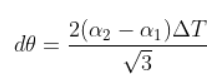
When the above equation is differentiated, the change in the angle ABC is given as

Exemplar Solution Physics Class 11 Chapter 9 Img 4

Q9.28Written answer

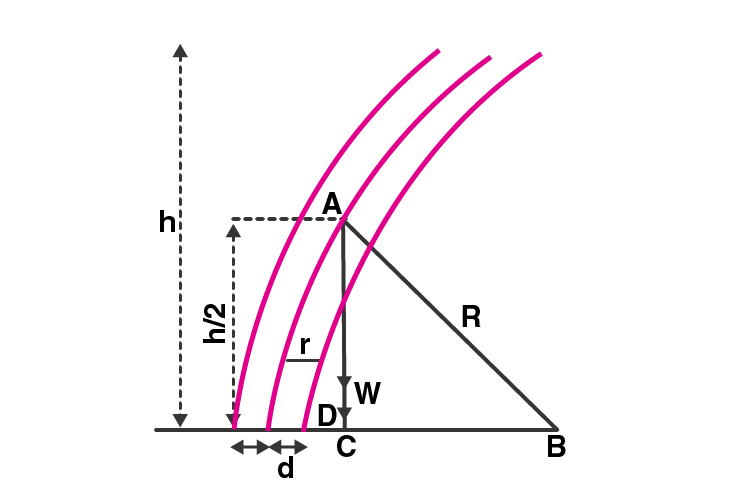
In nature, the failure of structural members usually results from large torque because of twisting or bending rather than due to tensile or compressive strains. This process of structural breakdown is called buckling, and in cases of tall cylindrical structures like trees, the torque is caused by its own weight bending the structure. Thus the vertical through the centre of gravity does not fall within the base. The elastic torque caused because of this bending about the central axis if the tree is given by
Exemplar Solution Physics Class 11 Chapter 9 Img 65. Y is the Young’s modulus, r is the radius of the trunk, and R is the radius of curvature of the bent surface along the height of the trees containing the centre of gravity. Estimate the critical height of the trees for a given radius of the trunk.

Show solutionHide solution
Worked solution

Exemplar Solutions Class 11 Physics Chapter 9 - 9

Using Pythagoras theorem,

R2 = (R – d)2 + (h/2)2

Solving the equation, we get d as

d = h2/8R

W0 is the weight of the trunk per unit volume

The weight of the trunk is = (Volume)(W0)

Substituting the values for volume and weight, we can calculate the critical height, h as

h = [2Y/W0]1/3 r2/3

Q9.29Written answer

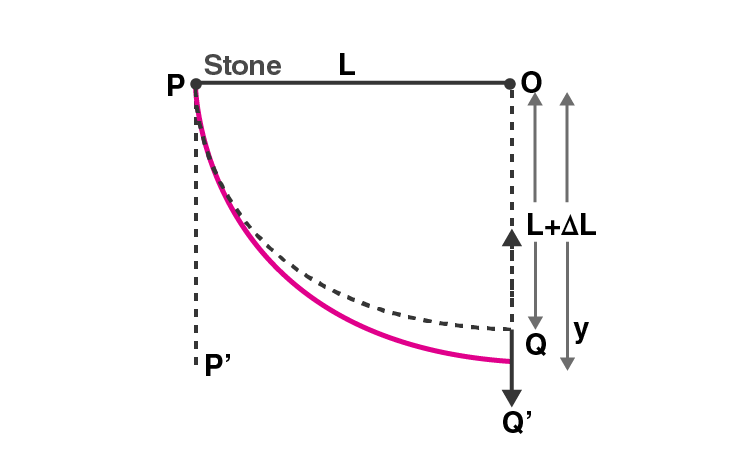
A stone of mass m is tied to an elastic string of negligible mass and spring constant k. The unstretched length of the string is L and has negligible mass. The other end of the string is fixed to a nail at point P. Initially, the stone is at the same level as point P. The stone is dropped vertically from point P.

a) find the distance y from the top when the mass comes to rest for an instant, for the first time

b) what is the maximum velocity attained by the stone in this drop?

c) what shall be the nature of the motion after the stone has reached its lowest point?

Show solutionHide solution
Worked solution

Exemplar Solutions Class 11 Physics Chapter 9 - 10

PE of stone = mechanical energy of string

mgy = ½ K(y-L)2

Where K is the spring constant

L is the length of the string

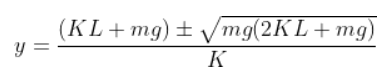
Solving the above equation, we get

Ky2 – 2(KL + mg)y + KL2 = 0

Using the above equation, we can determine the distance y from the top when the mass comes to rest for an instant

D = b2 – 4ac

Where a = K, b = -2(KL +mg) and c = KL2

Substituting the values we get

Exemplar Solution Physics Class 11 Chapter 9 Img 3

Therefore, y is solved as:

Exemplar Solution Physics Class 11 Chapter 9 Img 2

b) When the velocity is maximum, acceleration is zero, and therefore the force is also zero.

Let v be the maximum velocity of the stone.

The maximum velocity attained by the stone is determined with the help of the law of conservation of energy

PE lost by the stone from p to Q’ = KE of the stone + PE gained by the string

mg (L + x) = 1/2 mv2 + 1/2 Kx2

Solving the above equation gives maximum velocity v as

Exemplar Solution Physics Class 11 Chapter 9 Img 1

c) The nature of the motion after the stone has reached its lowest point is z0

z0 = [L + mg/K]