My Cart
Your Cart 0

    Your cart is empty.

  • Total (Amount) ₹0.00
NCERT Exemplar · Class 11 · Physics

Chapter 9: Mechanical Properties of Solids

Practice each question, then open the answer or worked solution.

Questions

29 questions
Q9.11Written answer

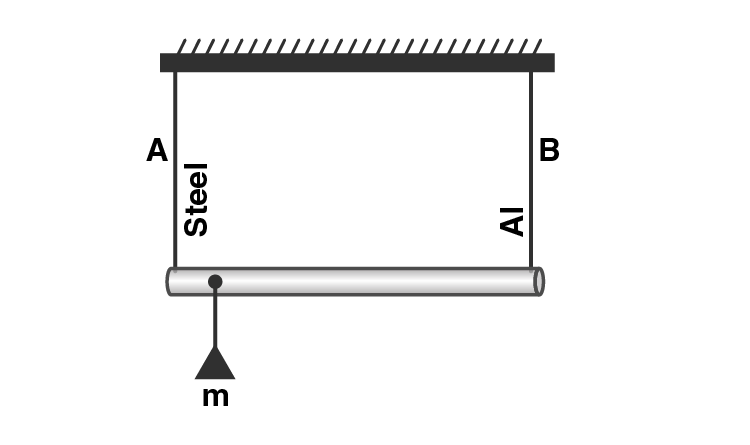
A rod of length l and negligible mass is suspended at its two ends by two wires of steel (wire A) and aluminium (wire B) of equal lengths. The cross-sectional areas of wires A and B are 1.0 mm2 and 2.0 mm2, respectively.
Exemplar Solutions Class 11 Physics Chapter 9 - 4

a) mass m should be suspended close to wire A to have equal stresses in both the wires

b) mass m should be suspended close to B to have equal stresses in both the wires

c) mass m should be suspended at the middle of the wires to have equal stresses in both the wires

d) mass m should be suspended close to wire A to have equal strain in both wires

Show solutionHide solution
Worked solution

The correct answers are

b) mass m should be suspended close to B to have equal stresses in both the wires

d) mass m should be suspended close to wire A to have equal strain in both wires
Q9.12Written answer

For an ideal liquid

a) the bulk modulus is infinite

b) the bulk modulus is zero

c) the shear modulus is infinite

d) the shear modulus is zero

Show solutionHide solution
Worked solution

The correct answers are

a) the bulk modulus is infinite

d) the shear modulus is zero

Q9.13Multiple choice

A copper and a steel wire of the same diameter are connected end to end. A deforming force F is applied to this composite wire which causes a total elongation of 1 cm. The two wires will have

Show solutionHide solution
Worked solution

The correct answers are

a) the same stress

d) different strain

Very Short Answers
Q9.14Written answer

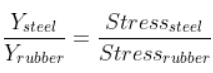
Young’s modulus for steel is more than that for rubber. For the same longitudinal strain, which one will have greater tensile stress?

Show solutionHide solution
Worked solution

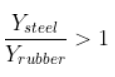
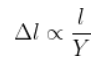
Young’s modulus is given as:

Exemplar Solution Physics Class 11 Chapter 9 Img 19

When the longitudinal strain is the same for both, steel will have a greater tensile stress.

Exemplar Solution Physics Class 11 Chapter 9 Img 18

Exemplar Solution Physics Class 11 Chapter 9 Img 17

Exemplar Solution Physics Class 11 Chapter 9 Img 16

Q9.15Written answer

Is stress a vector quantity?

Show solutionHide solution
Worked solution

Stress is neither a scalar quantity nor a vector quantity. It is a tensor quantity. This is because stress is equal to the magnitude of the internal reaction force divided by the area of the cross-section.

Q9.16Written answer

Identical springs of steel and copper are equally stretched. On which, more work will have to be done?

Show solutionHide solution
Worked solution

When the identical springs of steel and copper are equally stretched, force is given as:

Exemplar Solution Physics Class 11 Chapter 9 Img 15

Because the springs are the same, their length and area will also be the same

Exemplar Solution Physics Class 11 Chapter 9 Img 14

From both equations, we can say that

Exemplar Solution Physics Class 11 Chapter 9 Img 13

Q9.17Written answer

What is the Young’s modulus for a perfect rigid body?

Show solutionHide solution
Worked solution

According to Hooke’s law,

Young’s modulus = Stress/ Longitudinal strain

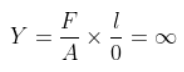
When the given body is a perfect rigid body, then the Young’s modulus is given as:

Exemplar Solution Physics Class 11 Chapter 9 Img 12

Q9.18Written answer

What is the Bulk modulus for a perfect rigid body?

Show solutionHide solution
Worked solution

Bulk modulus is given as:

Bulk modulus = Stress/ Volume strain = pV/∆V

For a perfectly rigid body, bulk modulus is

B = pV/0 = ∞

Short Answers
Q9.19Written answer

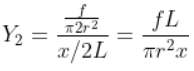
A wire of length L and radius r is clamped rigidly at one end. When the other end of the wire is pulled by a force f, its length increases by l. Another wire of the same material of length 2L and radius 2r is pulled by force 2f. Find the increase in length of this wire.

Show solutionHide solution
Worked solution

Exemplar Solutions Class 11 Physics Chapter 9 - 5

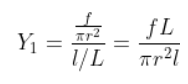
From the given figure, Young’s modulus is given as

Y = (f/A)(L/l)

First case:

Length of wire = L

Radius of wire = r

Force applied = f

Increase in length = l

Exemplar Solution Physics Class 11 Chapter 9 Img 11

Second case:

Length of wire = 2L

Radius of wire = 2r

Force applied = 2f

Increase in length = x

Exemplar Solution Physics Class 11 Chapter 9 Img 10

Therefore, it can be said that x = l.

Q9.20Written answer

A steel rod of length 1 m and area of cross-section 1 cm2 is heated from 0oC to 200oC without being allowed to extend or bend. What is the tension produced in the rod?

Show solutionHide solution
Worked solution

Young’s modulus of steel, Y = 2.0 × 10¹¹ N/m2

Coefficient of thermal expansion, α = 10-5 oC-1

Length, L = 1 m

Area of cross section A = 1 cm2 = 1×10⁻⁴ m2

Rise in temperature = 200oC

Tension produced in rod by the compression is

Y = (T/A)/(∆L/L)

T = 4 × 10⁴ N