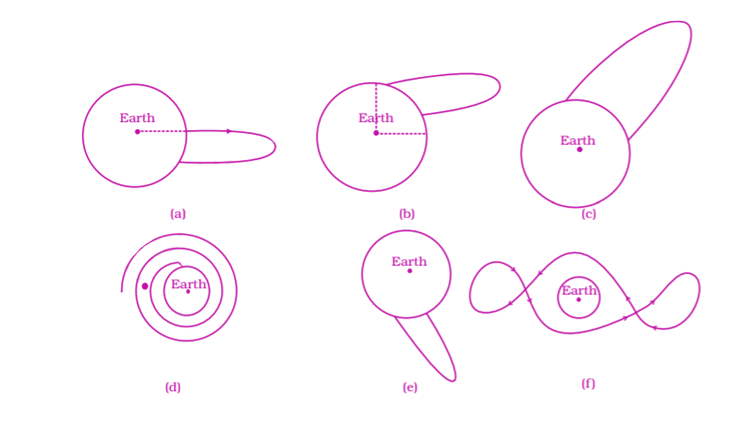
Shown are several curves. Explain with reason, which ones amongst them can be possible trajectories traced by a projectile

Show solutionHide solution
The given options, option (c) show the focus of trajectory.
Your cart is empty.
Practice each question, then open the answer or worked solution.
Shown are several curves. Explain with reason, which ones amongst them can be possible trajectories traced by a projectile

The given options, option (c) show the focus of trajectory.
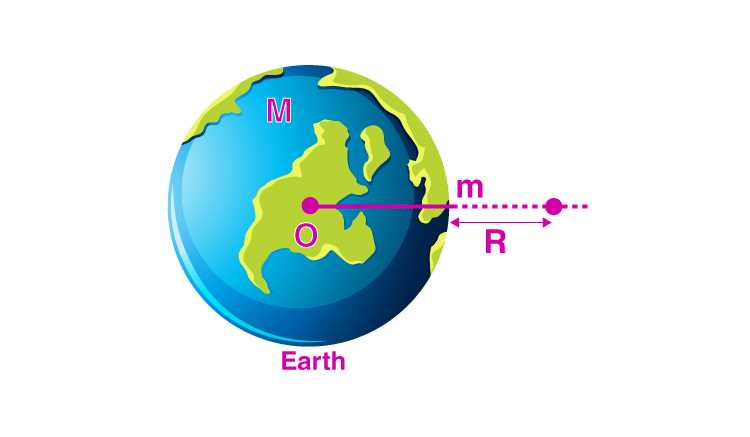
An object of mass m is raised from the surface of the earth to a height equal to the radius of the earth, that is, taken from a distance R to 2R from the centre of the earth. What is the gain in its potential energy?
The PE of the body on the earth = -GMm/R
When the body is close to the equator, the PE = -GMm/2R
Gain in PE = 1/2 mgR

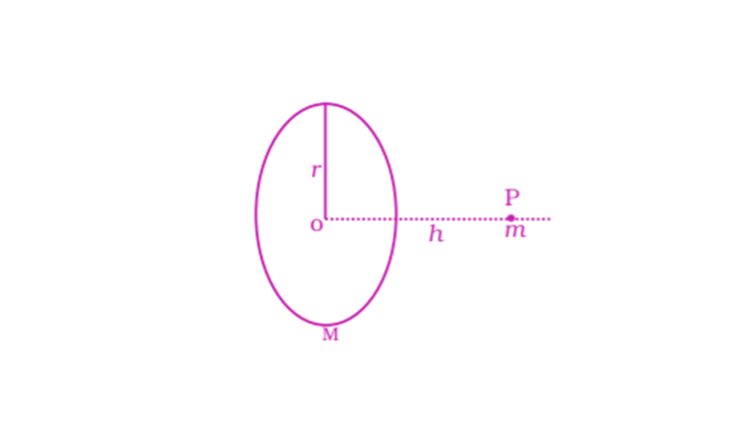
A mass m is placed at P a distance h along the normal through the centre O of a thin circular ring of mass M and radius r. If the mass is removed further away such that OP becomes 2h, by what factor the force of gravitation will decrease, if h = r?

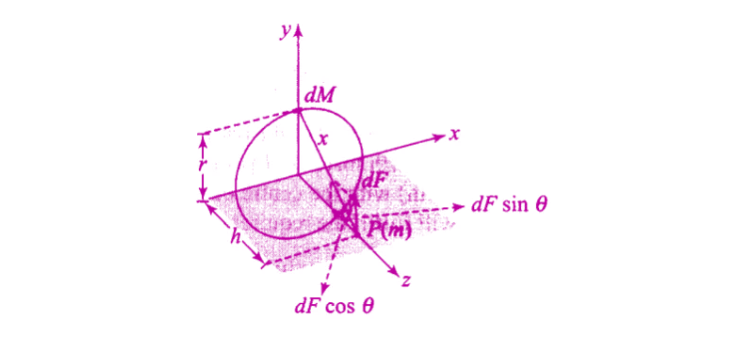
Let r be the radius of the ring and m be the mass of the ring. Small element dM is considered as the mass, the gravitation force dF = G(dM)m/x2
Where x2 = r2 + h2
When the force is integrated, the distance between the m and the ring is 2h.

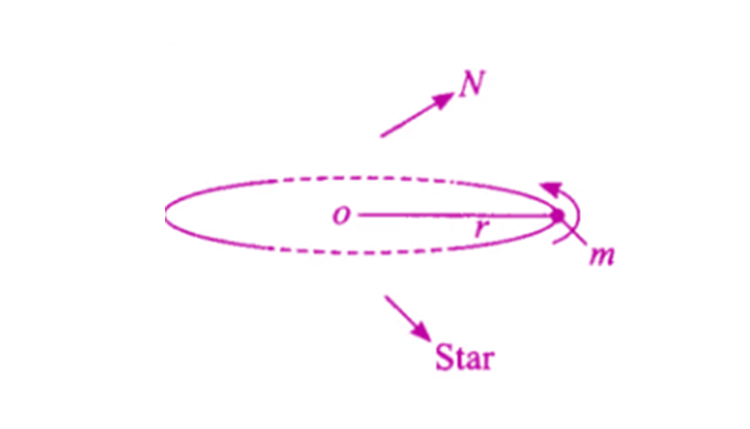
A star, like the sun, has several bodies moving around it at different distances. Consider that all of them are moving in circular orbits. Let r be the distance of the body from the centre of the star and let its linear velocity be v, angular velocity ω, kinetic energy K, gravitational potential energy U, total energy E, and angular momentum l. As the radius r of the orbit increases, determine which of the above quantities increase and which ones decrease.

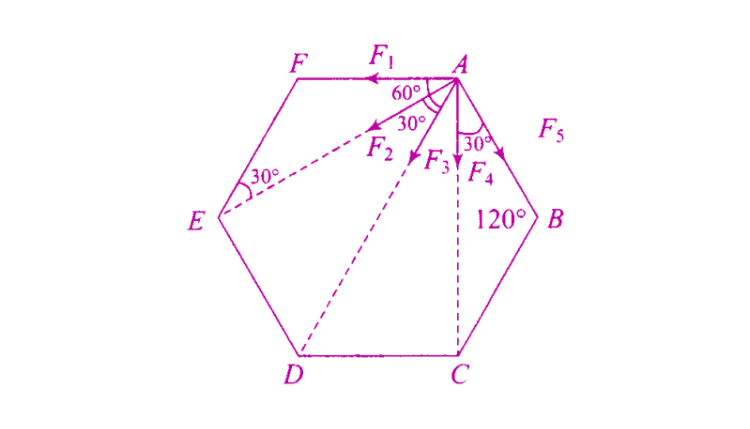
Six-point masses of mass m each are at the vertices of a regular hexagon of side l. Calculate the force on any of the masses.
AE = AG + EG = AG + AG = 2AG = 2l cos 30o
AE = AC = √3l
AD = 2l
Therefore,
Force on A due to B is Gm2/l2 along B to A
Force on A due to C is Gm2/3l2 along D to A
Force on A due to D is Gm2/4l2 along D to A
Force on A due to E is Gm2/3l2 along E to A
Therefore, total force = F = Gm2/l2 (1 + 1/√3 + 1/4) along DA

A satellite is to be placed in equatorial geostationary orbit around the earth for communication
a) calculate height of such a satellite
b) find out the minimum number of satellites that are needed to cover the entire earth so that at least one satellite is visible from any point on the equator
a) Mass of the earth, M = 6 1024 kg
Radius of the earth, R = 6.4 103 m
Time period = 24 36 102 s
G = 6.67 10-11 N.m2/kg2
Orbital radius = R + h
Using orbital velocity, we can calculate h = 35,940 km
b) The no.of satellites that are needed to cover the entire earth so that at least one satellite is visible from any point of the equator is 3.
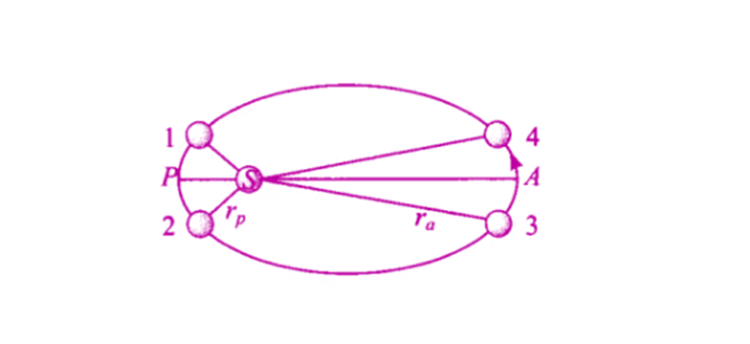
Earth’s orbit is an ellipse with an eccentricity of 0.0167. Thus, the earth’s distance from the sun and speed as it moves around the sun varies from day to day. This means that the length of the solar day is not constant throughout the year. Assume that the earth’s spin axis is normal to its orbital plane and find out the length of the shortest and the longest day. A day should be taken from noon to noon. Does this explain the variation in the length of the day during the year?

Velocity of the earth at perigee = vp
Velocity of the earth at apogee = va
Angular velocity of the earth at perihelion = ꞷp
Angular velocity of the earth at aphelion = ꞷa
ꞷp/ꞷa = 1.0691
ꞷ is the mean angular speed = 1.0691
ꞷp/ꞷ = ꞷ/ꞷa = 1.034
Therefore, it can be said that this does not explain the actual variation in the length of the day during the year.
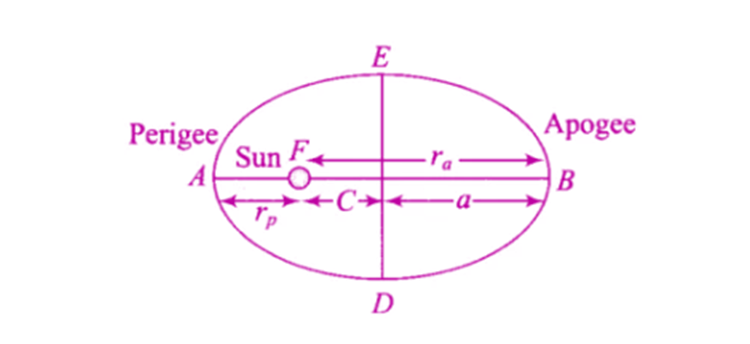
A satellite is in an elliptic orbit around the earth with an aphelion of 6R and perihelion of 2R where R = 6400 km is the radius of the earth. Find eccentrically of the orbit. Find the velocity of the satellite at apogee and perigee. What should be done if this satellite has to be transferred to a circular orbit of radius 6R?

Radius of perigee = rp = 2R
Radius of apogee = ra = 6R
rp = 2R
ra = 6R
rp = a(1-e) = 2R
ra = a(1+e) = 6R
From the above equation, e = 1/2
Since there is no external force on the system, from the law of conservation of angular momentum
L1 = L2
ma = mp = m = mass of the satellite
va/vp = rp/ra = 1/3
Therefore, vp = 3va
From the conservation of energy, we get
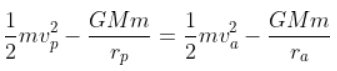
va = 2.28 km/s
vc = 3.23 km/s
The velocity at the apogee is vc – va = 0.95 km/s
Important Topics Covered in Chapter 8 Gravitation