My Cart
Your Cart 0

    Your cart is empty.

  • Total (Amount) ₹0.00
NCERT Exemplar · Class 11 · Physics

Chapter 8: Gravitation

Practice each question, then open the answer or worked solution.

Questions

38 questions
Q8.1Multiple choice

The earth is an approximate sphere. If the interior contained matter which is not of the same density everywhere, then on the surface of the earth, the acceleration due to gravity

Show answerHide answer
Correct option: D
Show solutionHide solution
Worked solution

The correct answer is d) cannot be zero at any point
Q8.2Written answer

As observed from earth, the sun appears to move in an approximately circular orbit. For the motion of another planet like mercury as observed from earth, this would

a) be similarly true

b) not be true because the force between earth and mercury is not inverse square law

c) not be true because the major gravitational force on mercury is due to the sun

d) not be true because mercury is influenced by forces other than gravitational forces

Show solutionHide solution
Worked solution

The correct answer is c) not be true because the major gravitational force on mercury is due to the sun

Q8.3Written answer

Different points in the earth are at slightly different distances from the sun and hence experience different forces due to gravitation. For a rigid body, we know that if various forces act at various points in it, the resultant motion is as if a net force acts on the cm, causing translation and a net torque at the cm causing translation and a net torque at the cm causing rotation around an axis through the cm. For the earth-sun system

a) the torque is zero

b) the torque causes the earth to spin

c) the rigid body result is not applicable since the earth is not even approximately a rigid body

d) the torque causes the earth to move around the sun

Show solutionHide solution
Worked solution

The correct answer is a) the torque is zero

Q8.4Written answer

Satellites orbiting the earth have a finite life, and sometimes debris of satellites fall to the earth. This is because

a) the solar cells and batteries in satellites run out

b) the laws of gravitation predict a trajectory spiralling inwards

c) of viscous forces causing the speed of the satellite and hence height to gradually decrease

d) of collisions with other satellites

Show solutionHide solution
Worked solution

The correct answer is c) of viscous forces causing the speed of the satellite and hence height to gradually decrease

Q8.5Written answer

Both the earth and moon are subject to the gravitational force of the sun. as observed from the sun, the orbit of the moon

a) will be elliptical

b) will not be strictly elliptical because the total gravitational force on it is not central

c) is not elliptical but will necessarily be a closed curve

d) deviates considerably from being elliptical due to the influence of planets other than earth

Show solutionHide solution
Worked solution

The correct answer is b) will not be strictly elliptical because the total gravitational force on it is not central

Q8.6Written answer

In our solar system, the interplanetary region has chunks of matter called asteroids. They

a) will not move around the sun since they have very small masses compared to the sun

b) will move in an irregular way because of their small masses and will drift away from outer space

c) will move around the sun in closed orbits but not obey Kepler’s laws

d) will move in orbits like planets and obey Kepler’s laws

Show solutionHide solution
Worked solution

The correct answer is d) will move in orbits like planets and obey Kepler’s laws

Q8.7Multiple choice

Choose the wrong option.

Show answerHide answer
Correct option: D
Show solutionHide solution
Worked solution

The correct answer is d) gravitational mass of a particle-like proton can depend on the presence of neighbouring heavy objects, but the inertial mass cannot

Q8.8Written answer

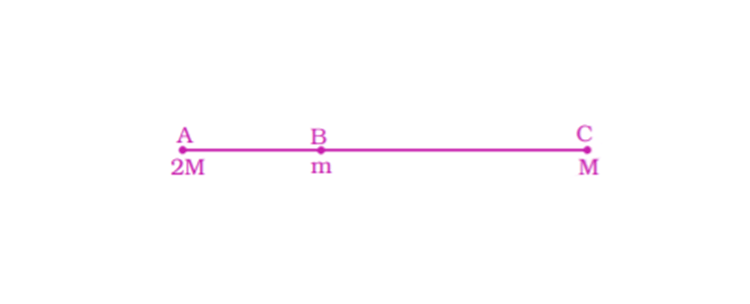
Particles of masses 2M, m and M are respectively at points A, B, and C with AB = 1/2 (BC). M is much smaller than M, and at time t = 0, they are all at rest. At subsequent times before any collision takes place

Exemplar Solutions Physics Class 11 Chapter 8 - 1

a) m will remain at rest

b) m will move towards M

c) m will move towards 2M

d) m will have oscillatory motion

Show solutionHide solution
Worked solution

The correct answer is c) m will move towards 2M

Multiple Choice Questions II
Q8.9Multiple choice

Which of the following options is correct?

Show solutionHide solution
Worked solution

The correct answers are

a) acceleration due to gravity decreases with increasing altitude

c) acceleration due to gravity increases with increasing latitude

Q8.10Written answer

If the law of gravitation, instead of being inverse-square law, becomes an inverse-cube-law

a) planets will not have elliptic orbits

b) circular orbits of planets are not possible

c) projectile motion of a stone thrown by hand on the surface of the earth will be approximately parabolic

d) there will be no gravitational force inside a spherical shell of uniform density

Show solutionHide solution
Worked solution

The correct answers are

a) planets will not have elliptic orbits

b) circular orbits of planets are not possible

c) projectile motion of a stone thrown by hand on the surface of the earth will be approximately parabolic